
SEO translation – How to translate your website (into German)


SEO translation – How to translate your website (into German)
Let me guess: You want to translate your SEO-optimized website? But when it comes to the "how," questions abound. In this article, I'll answer frequently asked questions and give you tips on what to consider when translating, localizing, or transcreating your SEO content so that it gets found on Google. Just take 5 minutes to read. Then you can get started translating your website—into German, English, or another language.Let me guess: You want to translate your SEO-optimized website? But when it comes to the "how," questions abound. In this article, I'll answer frequently asked questions and give you tips on what to consider when translating, localizing, or transcreating your SEO content so that it gets found on Google. Just take 5 minutes to read. Then you can get started translating your website—into German, English, or another language.

What you can expect in this post
Translating SEO content – but how?
Is a traditional translation better, or a search engine optimized translation? What's the difference between SEO translation, SEO localization, and SEO transcreation? And which one is the right type of translation for your website? In short: How do you translate your website so that it convinces customers—and also ranks at the top of Google?
As an SEO consultant and copywriter, I work daily with multilingual website projects. My focus is on translating English websites into German. However, my tips apply to all website translations – regardless of the target language.
The first step
Before you embark on the SEO translation of a website or look for an SEO translator, it's best to first take a look at the current state of your company website :
- Has the existing content on your website already been created according to SEO criteria?
- Does your company work with a strategy for SEO content marketing?
- Do you have up-to-date metadata (SEO title & meta description) for your website?
- Does it make sense to translate all existing content – or only some of it? Which content is also relevant for other cultures and in other languages? A product page where you advertise a cookbook in dialect is unlikely to interest customers who speak other languages.
Depending on your answers to these questions, there are 4 1/2 possible scenarios for how you can translate (or have translated) your website (into German).

4 1/2 ways to translate your website
The more strategic and high-quality your content is in the source language, the less work and cost you'll incur for (SEO) translation. I've experienced this time and again over my years as an SEO translator.
What the right type of translation for your website ? And how can customers best find your website when searching on Google in another language? Read on and then decide which of the following scenarios best applies to your website translation project.
1. Classical translation
Your website is (deliberately) not SEO-optimized.
Your website is intended purely as an online business card. There's a good reason why you don't want visitors to find you on Google.
For example, one of my clients knew that he was being recommended by name for his highly specialized consulting services. No one was searching for that on Google. So, after receiving the recommendation, his clients were specifically accessing his website via the URL.
In this case, a classic translation of the website a sensible choice.
Have the website translated into easily readable German by a native German speaker.
2. SEO Transcreation
Your original content are not yet SEO-optimized.
Your original website content are not yet written according to an SEO strategy , but you want your translated content to be found on Google?
Then it's time to think about SEO transcreation:
Transcreation means that existing content are fundamentally revised during translation before being transferred into the target language.
In the case of SEO transcreation, your existing content will be used.
- Revised according to SEO criteria, i.e., keywords added, headings added, paragraphs shortened.
- Cultural peculiarities such as currency, units of measurement, regional holidays or customs are adapted for the target language.
The starting point for SEO transcreation is keyword research and an SEO strategy in the target language. With this professional content strategy, your website can rank at the top of search engines like Google, Yahoo!, and Bing – both domestically and internationally.
3. SEO translation
Your original content is already SEO-optimized.
If your existing website is built according to an SEO content strategy, I recommend an SEO translation.
In SEO translation, the keywords are first translated and checked by an SEO translator. Search terms and search intent often differ from culture to culture. Therefore, a keyword cannot necessarily be translated word for word from the source language into German.
Questions arise such as:
Should I optimize the English search term "seo translator" for my German website to "seo übersetzer" or better yet to "seo Übersetzung"?
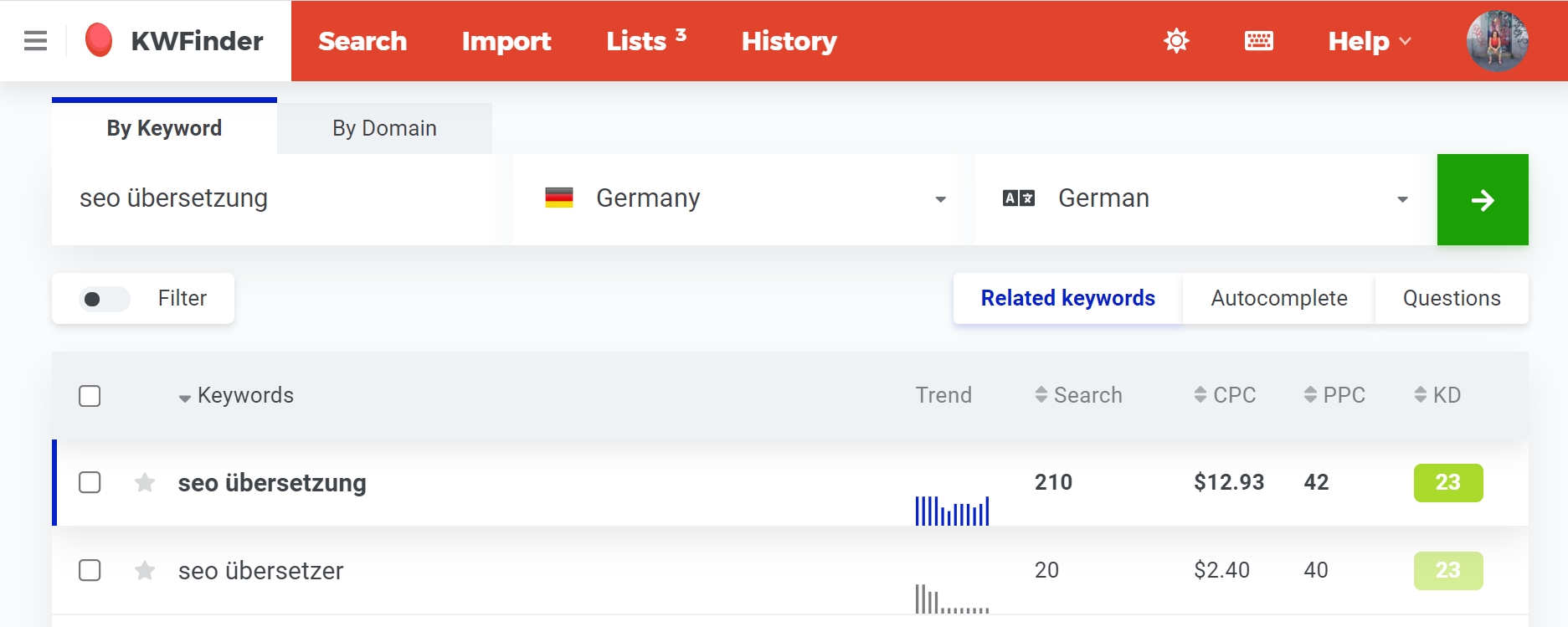
For such questions, keyword research is useful before starting to translate the actual content.
Based on this keyword translation, I, as an SEO translator, first adapt the existing SEO content strategy into the target language.
Then I translate the website into German and, if necessary, adapt the content to changed keywords.
With the completed SEO translation, your German website can then rank at the top of Google in your target market. At the same time, the translation contributes to the SEO strategy of the original website.
It sounds a bit complicated. And it is. That's why I recommend working with an experienced SEO translator for such website translations.
4. Website Localization
Your original content is already SEO-optimized and should be adapted for the German-speaking market.
If your website is already SEO-optimized, but heavily focused on your original market, things get a bit more complex. In addition to SEO translation, it's necessary to localize the translated SEO content.
SEO localization focuses on cultural aspects that cannot be exactly replicated through translation. For example...
- Units of measurement
- Address formats
- DIN standards
- Public Holidays
- Punctuation marks etc.
During localization, an SEO translator adapts the translated content to the search habits of the respective target culture.
Make sure your SEO translator has additional experience with user experience and UX writing . This will ensure your main menu remains user-friendly.
Besides search engine optimisation, localization plays a crucial role, especially for user-friendliness. Only when users can find and understand all the information on your website in their own language will they trust you enough to buy your product.
4 1/2. Create new SEO content in the target language
Yes, you're right: Writing new content isn't translation. (Hence ½.)
Nevertheless, I wanted to show you this possibility.
You might find that your new target audience has different (additional) questions and needs than your existing customers. In this case, you can identify the relevant topics in a multilingual SEO strategy – and create (or have created) targeted SEO content in other languages .
1, 2, 3, 4 or maybe 4 1/2? It's best to consult a content professional before SEO translation .
You should have the following parts of your website translated
When translating your website for SEO, you should absolutely ensure completeness. For optimal user experience, all content be translated into the target language.
Some content are frequently overlooked when translating websites. This means that you shouldn't just have SEO content translated, but also other types of content.
In addition to SEO content, you should translate (or have translated) the following elements:
- Alt content
- Image captions
- H1 heading & subheadings
- Keywords
- Markups for structured data
- Meta Descriptions
- Open Graph Tags
- SEO titles
- Title tags in links
- URLs of all pages and image content
- Error messages
- Legal notice, privacy policy, terms and conditions
If you pay attention to all these texts, nothing will stand in the way of your SEO translation and a seamless user experience on your multilingual website
PS: If you'd like to compare this blog post: You can find its English SEO translation here.
What clients ask me about SEO translations…
Here are some questions that my clients frequently ask me about SEO translation of their website into German.
SEO translations are not simply a word-for-word transfer from the source language, such as translating a website from English to German. Rather, it's essential to consider various factors when translating SEO content. These include keyword density , paragraph and sentence length , content structure , language level , and several others. Furthermore, it's crucial to adapt SEO content to the specific characteristics of the target country. Only with proper SEO localization will the website content be effective enough to secure a high ranking in search results for your business. Keywords themselves are a prime example of search engine optimized content that cannot simply be translated word for word into a foreign language. Often, SEO translators need to research search terms in the target language before translating and adjust the SEO strategy accordingly. Companies aiming to rank in Germany should seriously consider having their website translated into German.
Translators who translate your SEO content need qualifications beyond translation itself: they should be well-versed in search engine optimisation.
When it comes to translating SEO content for websites and adapting it to the requirements of specific target markets, you should always qualified SEO translators with extensive SEO expertise .
In addition to translating individual content, these SEO translators pay particular attention to localizing the relevant search terms ("keywords") within the SEO content. User search habits vary considerably from country to country and culture to culture.
Only when your SEO translator takes this into account can you ensure that your website is found by your target customers.
Counter-question: Do you want your website to be found on Google and other search engines?
Of course. It would be a shame to invest money in good translations that then almost miss their mark. Strategically sound translations from an SEO translator will be found online – and your sales will increase.