Understanding search intent: How to convince Google & AI search in 2026

Understanding search intent: How to convince Google & AI search in 2026
Do you even know how your target audience searches? Understanding search intent is THE fundamental requirement for making it into the search results of Google, ChatGPT, and other search engines in the age of AI search: Are customers looking for help with a purchase decision? A product comparison? Your local store? Or your website? AI searches now only recommend 3-5 providers. Is your website one of them? I'll explain how you can optimize for 5.5 different search intents – with concrete suggestions for on-page and off-page content formats.Do you even know how your target audience searches? Understanding search intent is THE fundamental requirement for making it into the search results of Google, ChatGPT, and other search engines in the age of AI search: Are customers looking for help with a purchase decision? A product comparison? Your local store? Or your website? AI searches now only recommend 3-5 providers. Is your website one of them? I'll explain how you can optimize for 5.5 different search intents – with concrete suggestions for on-page and off-page content formats.
What you can expect in this post
What is search intent – explained briefly
In the early days, SEO was straightforward: If you wanted to rank highly on Google, you needed keywords – and behind every search query lies an intention: Someone wants to know something, buy something, find a specific website – or several of these things at once. This intention is called search intent, search intent, or simply intent. It's a fundamental part of every good SEO and AI strategy.
Why is this relevant to your marketing budget?
If you misjudge search intent, you'll invest in content that never gets clicked, costs money, and generates no revenue.
Content that matches the correct search intent, on the other hand, brings visitors to your site: It is used as a source by Google, ChatGPT Search, Perplexity & Co., recommended and clicked.
On the website, it reduces the bounce rate. And it guides your target audience directly to the next action – whether it's a purchase, an inquiry, or a newsletter subscription.
What search intents will exist in 2026?
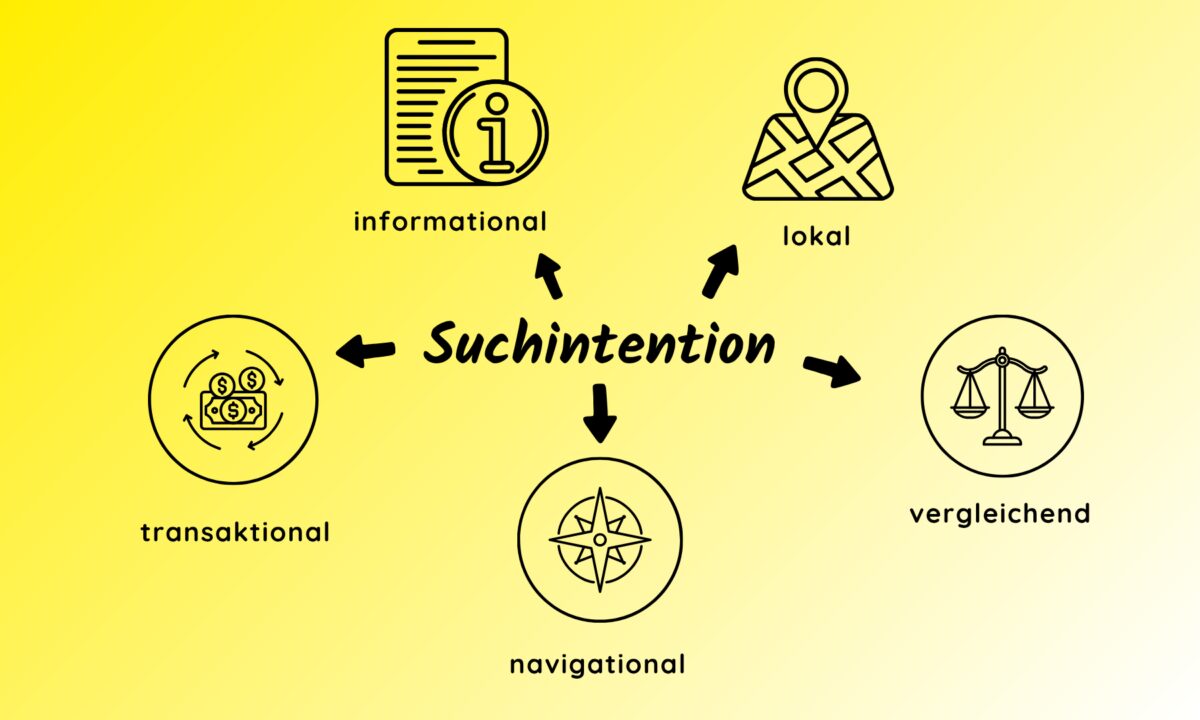
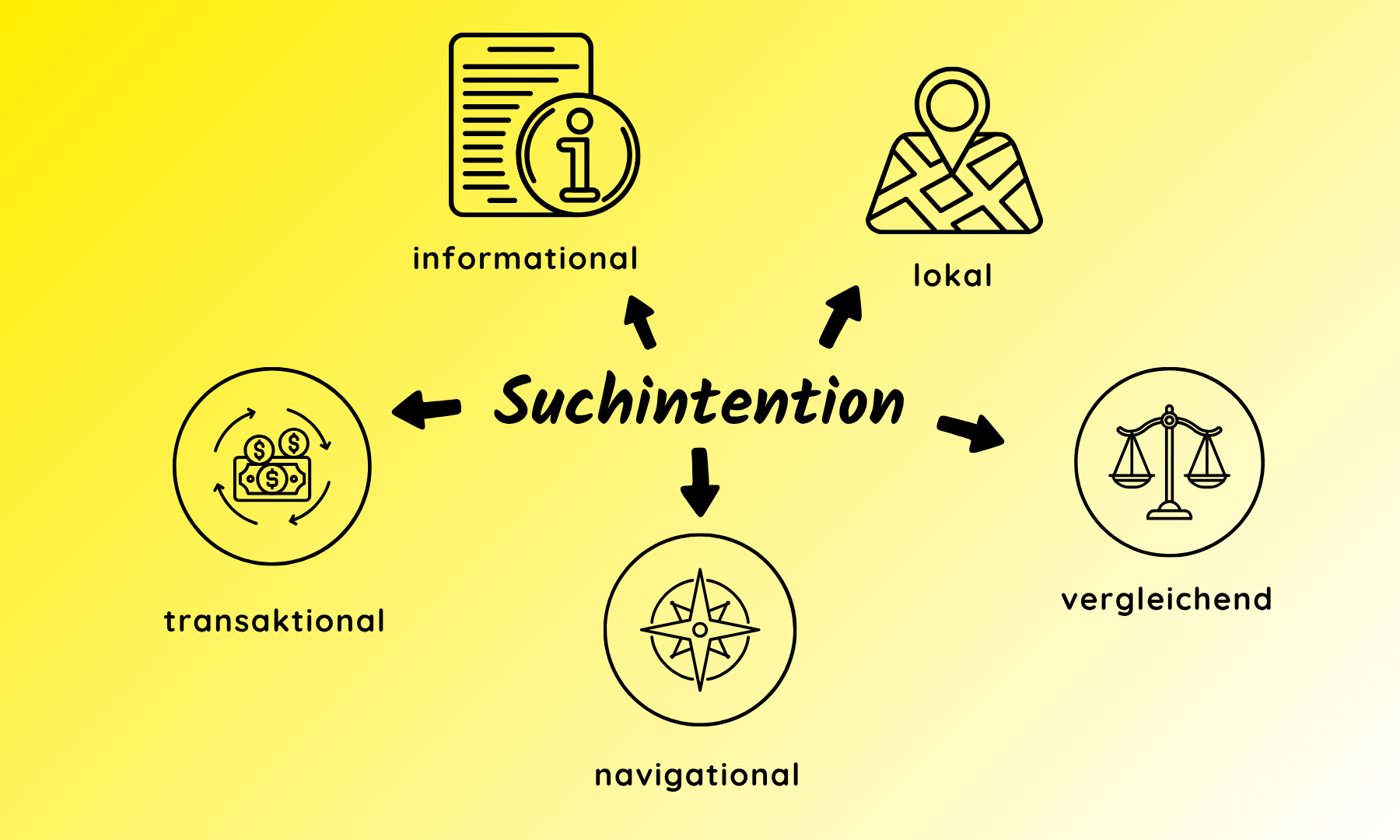
For years, there have been five basic types of search intent: informational, transactional, comparative, navigational, and local – plus various hybrid forms. However, their relative importance has shifted significantly due to AI search.
Understanding the search intent behind a keyword or prompt determines the format, length, and goal of your content.
Enough with the theory! How exactly do you create content that addresses specific search intent? Don't worry, I've prepared something for you.
But before we begin, one thing is paramount for all search intents: Write from experience (expert content, baby)! Understand and deliver exactly what the search intent needs. And write in a way that is as helpful as possible. In 2026, only quality will prevail against the mass of content out there.
1. Informational search query: Finding knowledge
One of the most common search intents you should be aware of is the informational search intent. Here, your target audience is looking for an answer, an explanation, or a concrete solution. This could be a simple definition or a complex, multi-step guide.
However, by 2026 you will hardly be able to gain any traffic with classic knowledge content.
The problem: Google answers simple knowledge-based questions directly in AI Overviews. Perplexity and ChatGPT provide structured answers including sources – often without anyone visiting your website. For classic "know-simple" queries, recent studies zero-click rates of 75-80%.
A glossary or superficial guide hardly generates any visibility anymore, neither in traditional search engines nor in AI search.
Incidentally, not every information search is formulated as a question. Terms like "optimize AI content search" or "website structure SEO" also have a clear informational search intent.
Examples:
- "Where is the Eiffel Tower?"
- "How do I optimize content according to search intent?"
- "Tips for AI-powered website searches"
- "Bundesliga results today"
Content formats and elements for informational search queries
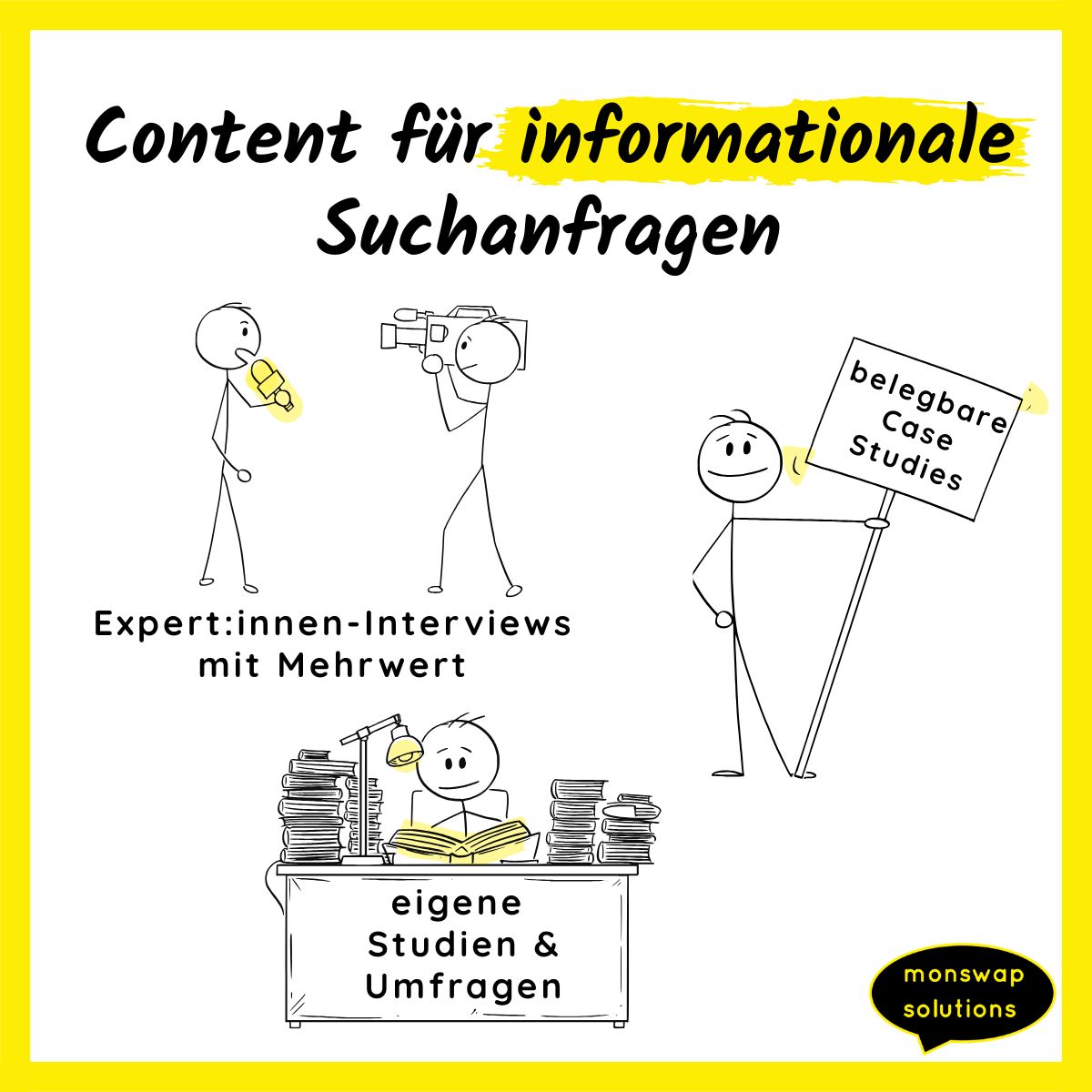
If you want to rank informationally, you need content that AI systems cannot answer on their own:
- Case studies with verifiable results (onpage)
- Blog content that provides concontent and takes a stand (onpage)
- Informative author bio (onpage)
- Disruptor element with performance indicators (onpage)
- Interviews with experts from your company or network (on- & off-page)
- own studies and surveys with concrete data (on- & off-page)
For example, I regularly interview tradespeople for BAUHAUS's "Expert Content" format. In helpful advice articles, carpenters, painters, and gardeners share their practical tips firsthand. These details don't exist in any database – which is why AI systems frequently cite them as sources.
2. Comparison searches: Decision-making aid before purchase
When using comparison searches, your target audience is close to making a purchase. Now it's decided whether you make the shortlist – or not. They are already familiar with the product or service and are now examining alternatives, reviews, and specific differences.
Typical signal words are comparison, test, rating, best, or, experiences, alternatives.
By 2026, comparison searches will be fiercely competitive: AI tools like ChatGPT or Perplexity create structured product comparisons within seconds. Often, the AI narrows the selection down to three to five providers. If your brand doesn't appear there, you lose visibility – and your chance of generating revenue.
Examples:
- "iPhone 16 or Samsung Galaxy S25"
- “Best SEO copywriter Augsburg”
- "Comparison of patio roof providers in Bavaria"
- “Experiences with monswap solutions”
Content formats and elements for comparison searches
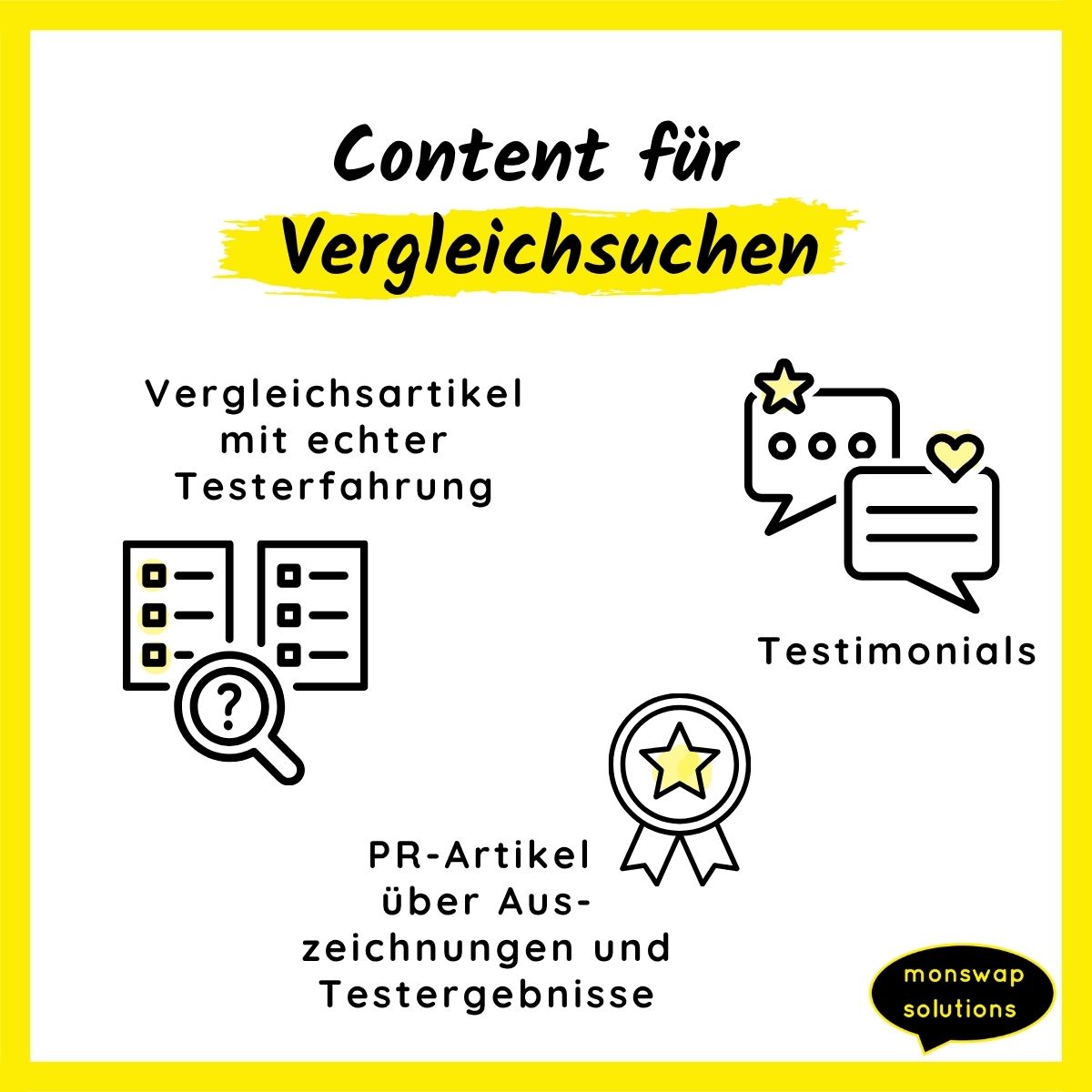
Comparing products doesn't mean you've made a decision yet – but you're actively looking for one. Reviews, tests, user experiences, and price comparisons can help with this. Comparative content needs more than just a table of features. You need content that evaluates, categorizes, and explains
- Guest contributions or specialist articles on relevant industry and comparison websites (off-page)
- Comparison article with clear criteria and real testing experience (onpage)
- PR articles about awards or test results with a linked original source (onpage)
- Clear, helpful product pages (onpage)
- Verified reviews with statements about benefits (on- & off-page)
For example, I write PR articles for the Munich-based management consultancy KBC Consulting, covering awards such as the prestigious "Best of Consulting" prize from Wirtschaftswoche – including links to the official source. This strengthens their positioning in comparison and evaluation requests and demonstrates to potential clients why consulting from KBC is the right choice.
3. Transactional searches: Buying products and services
Transactional search intent focuses on the specific step: buying, booking, inquiring, or ordering. The decision regarding the product has already been made. Now it's simply a matter of which provider is most convincing.
Typical keywords are buy, order, book, discount, offer, cost.
Transactional search queries are among the most stable and lucrative traffic sources – even in the age of AI search. Those who are visible here capture revenue.
Examples:
- "providers of terrace roofing in Bavaria"
- "Order a subscription to Zeit"
- “Buy blog posts”
- “MacBook Pro Apple Store”
Content formats and elements for greater visibility in transactional search queries
Those who search transactionally want to take direct action – to buy, book, or inquire. The path to action should be as short and straightforward as possible, without a lot of preamble. (You know those cooking websites where you have to read the chef's grandmother's biography before you finally get to see her lasagna recipe after 2,000 words? Annoying!) What actually works:
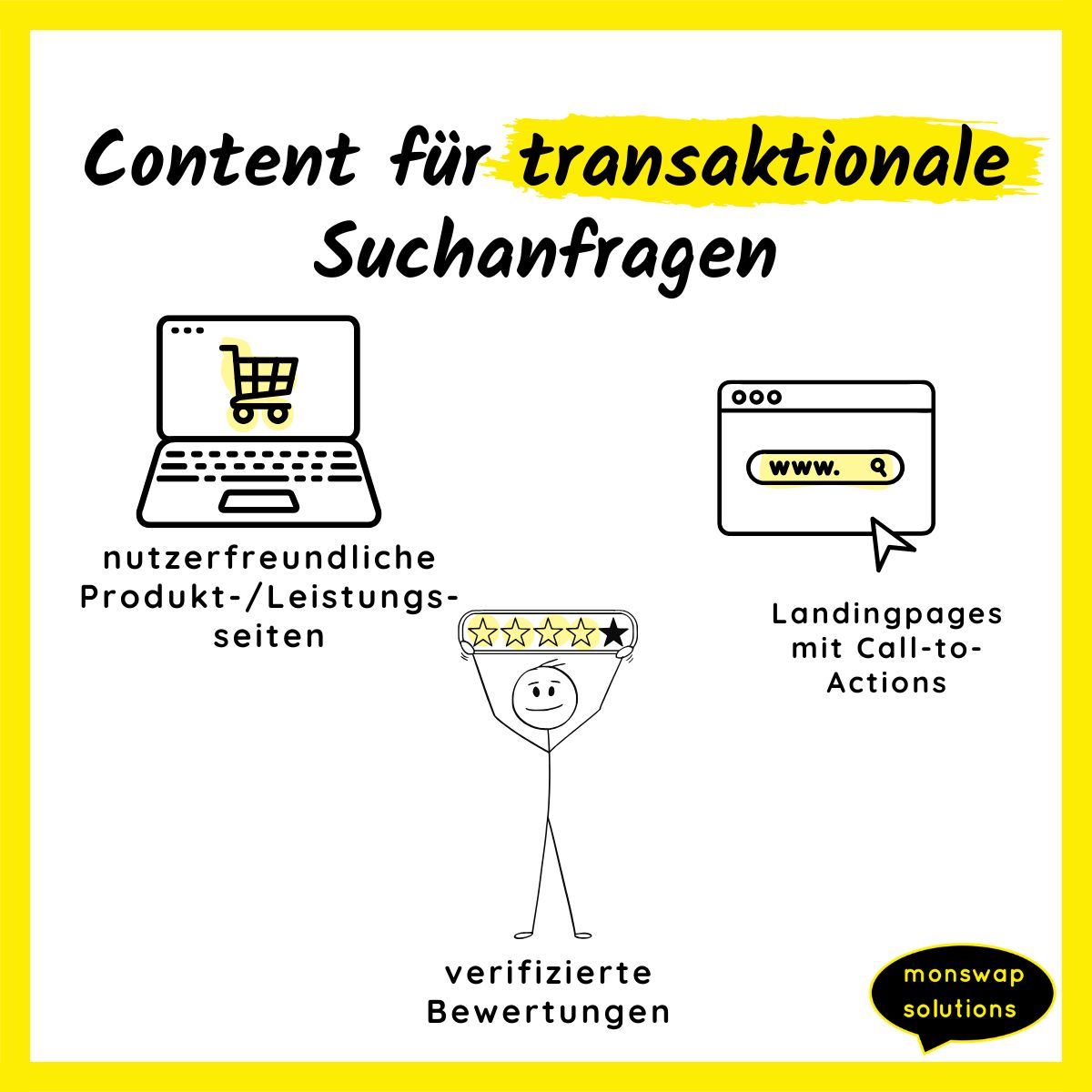
- Clearly structured product or service pages (onpage)
- Landing pages with visible calls to action (always in the header!) (onpage)
- Trust elements such as references or awards (onpage)
- Verified reviews with statements about benefits (on- & off-page)
For example, for my client terracasa studio, I optimize landing pages for keywords like "buy patio roof with installation". Each page has a custom configurator that allows interested parties to directly request prices for their desired product.
4. Navigational search intent: Accessing a website
With navigational search intent, your target audience is already familiar with your brand. They are specifically searching for a website, a login, or a company. Google or AI search serves only as a shortcut here, instead of typing in the URL.
Typical signal words are brand name, login, website, contact or product name in combination with a brand.
This is highly relevant for your marketing: Anyone searching for your brand has already built up trust. If you're not clearly visible here, you lose control over your own perception.
Examples:
- "monswap solutions SEO"
- “Instagram Login”
- “Süddeutsche Zeitung online”
- “Apple Website”
Content formats and elements for greater visibility in navigational search queries
Navigational search queries don't need lengthy explanations, but rather clarity and recognizability both on-page and off-page. Your brand, your name, or your product should be immediately visible – without third-party sites obscuring your presence. This includes:
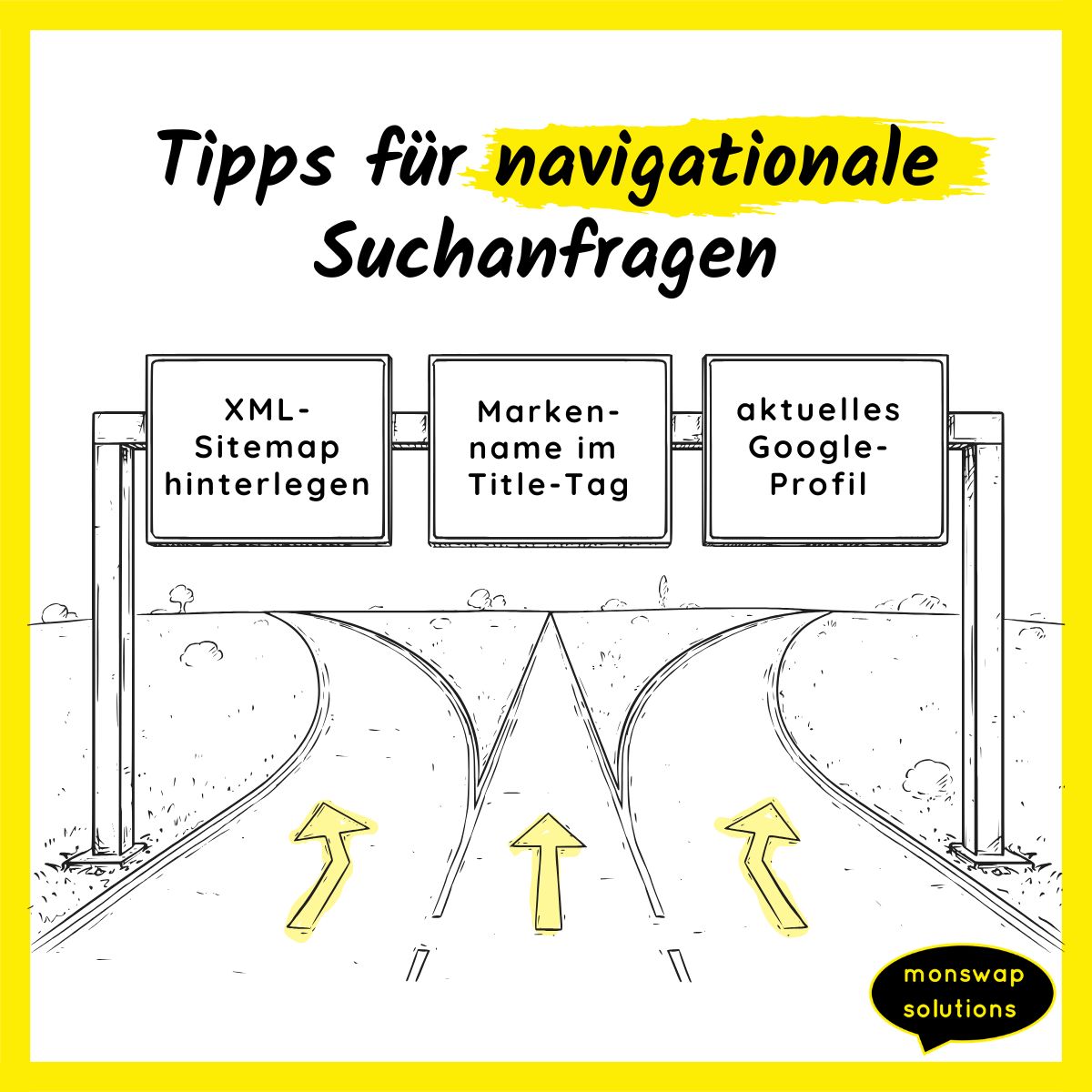
- Clean, well-maintained title tags with brand name (onpage)
- Structured data for person or organization (onpage)
- Include an XML sitemap in the robots.txt file (onpage)
- Consistent brand mention across all platforms (on-page & off-page)
- Well-maintained Google business profile (off-page)
For example, I optimize the website of author Alexa Hennig von Lange so that it appears clearly as the official source when her name is searched – without any intermediary third-party sites. To achieve this, I, among other things, cleanly manage metadata and work with structured data when maintaining the content.
5. Local search queries: being found locally
With local search intent, your target audience isn't just looking for a solution, but a specific provider in their vicinity. This is when it's decided who appears first in the Local Pack, on Google Maps, or in AI recommendations.
The regional reference can be explicit – for example, if a city or region is included in the keyword – or implicit, because Google or the AI recognizes the location via the IP address (“near me”).
Typical signal words are near me, local, in the vicinity of, city or region names.
Local search queries will be delivered across three channels in 2026: classic Google search, Google Maps, and AI search. Those who are visible on all three levels will secure predictable inquiries from the region.
Examples:
- "Patio roofing with installation in Bavaria"
- “SEO content Augsburg”
- "Carpenters near me"
- "Vegan Restaurant Munich"
Content formats and elements for visibility in local search queries
If you want to be found locally, you need more than just an address in your legal notice. Google and AI systems should clearly understand in which region you offer services – and what those services are. You can achieve this, among other things, by..
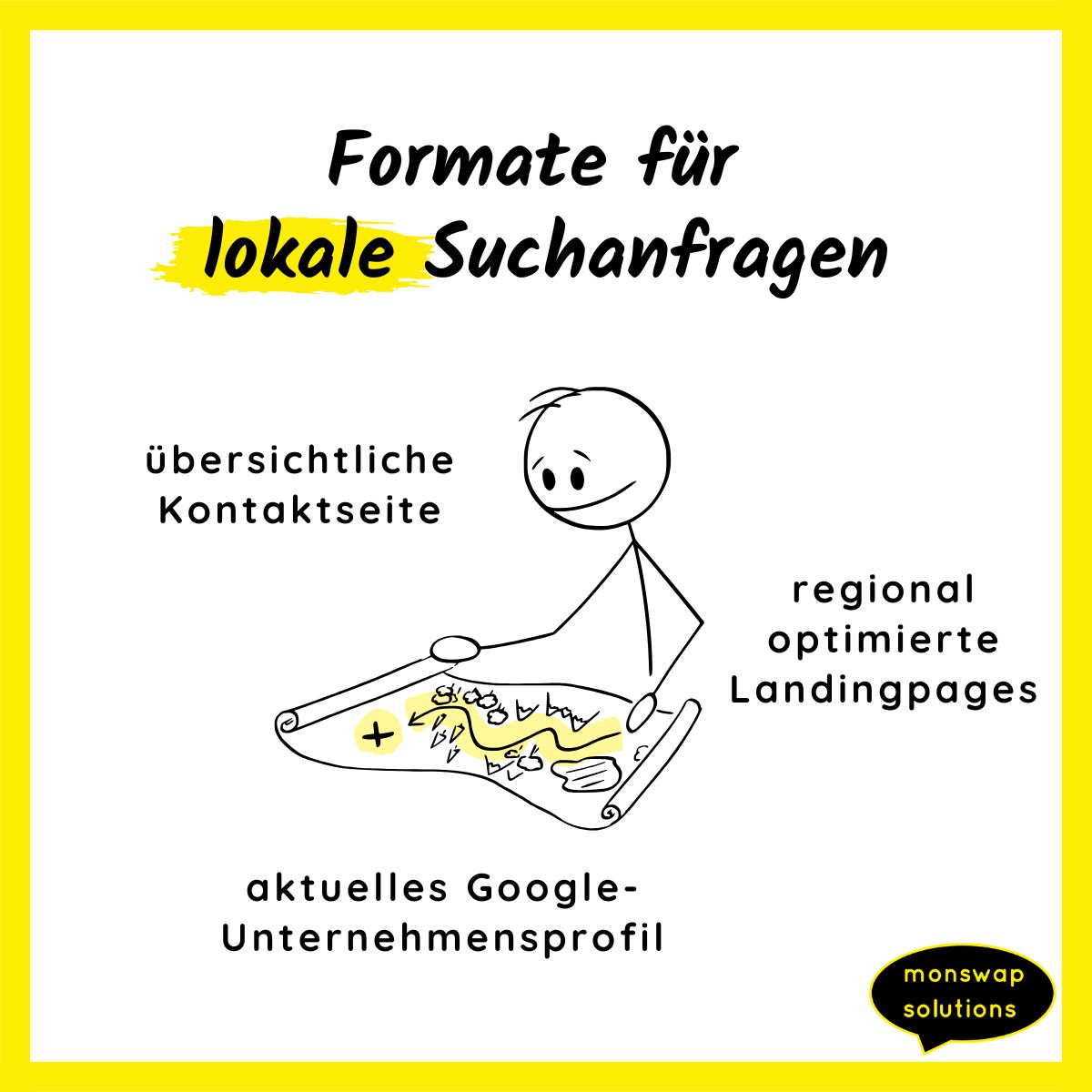
- Clearly structured contact page (onpage)
- Regional landing pages with a clear description of services (onpage)
- Structured data for LocalBusiness (onpage)
- Clean hreflang implementation for multilingualism (onpage)
- Consistent contact details on website and industry portals (on- & off-page)
- Well-maintained Google business profile with current reviews (off-page)
For example: For terracasa studio, I optimize a central landing page for the focus keyword "terrace roof Bavaria". Regional subpages such as "terrace roof with installation in Munich" or "terrace roof Nuremberg" link to this page and thus strategically contribute to regional visibility.
5 ½. Mixed Intent: The all-rounder
Not every search query is straightforward. Often, there's more than one search intent behind a keyword. Users might be looking for a specific website and want to buy something directly there. Or they might be researching a product and then want to purchase it locally.
This mixed form is called Mixed Intent.
For your content strategy, this means: First, identify the dominant search intent. What do the majority of searchers want first – information or action?
And then optimize as discussed above.
Examples:
- "apple.de ipad air"
- “Buy SEO content from monswap solutions”
- "run a Google Analytics login campaign"
- “sistrix keyword tool costs”
Identifying search intent: 3 proven methods
Because I want to understand search intent first in every SEO & AI strategy, I've developed three methods. I typically work with a combination of Sistrix and targeted AI searches.
1. Analyze SERPs
The simplest (and free) method: Enter the keyword into Google search and analyze the first three results. Does Google show guides, product pages, or videos? These results will tell you what search intent Google associates with the keyword.
Important: I always use incognito mode so that my search history doesn't skew the results. Especially with local keywords, you should also check your location. Nearby keywords for a Berlin bakery won't work from Munich.
2. Determine search intent with SISTRIX
My personal favorite for daily SEO work: SISTRIX shows you the search intent directly in the keyword tool. A small icon next to the keyword reveals at a glance whether Google classifies the query as informational, navigational, or transactional.
This saves time – especially if you are analyzing a large number of keywords at once, for example as part of an SEO strategy.
3. Consult AI search
Try entering your keyword into ChatGPT Search, Perplexity, or Google AI Overviews and take a close look at the results: What content does the AI cite? Which sources does it recommend? What criteria does it use? This will show you how AI tools understand search intent – and where you can focus your content.
Search intent checklist before you publish
Whether it's new or existing content – my approach is always the same when I want to understand the search intent.
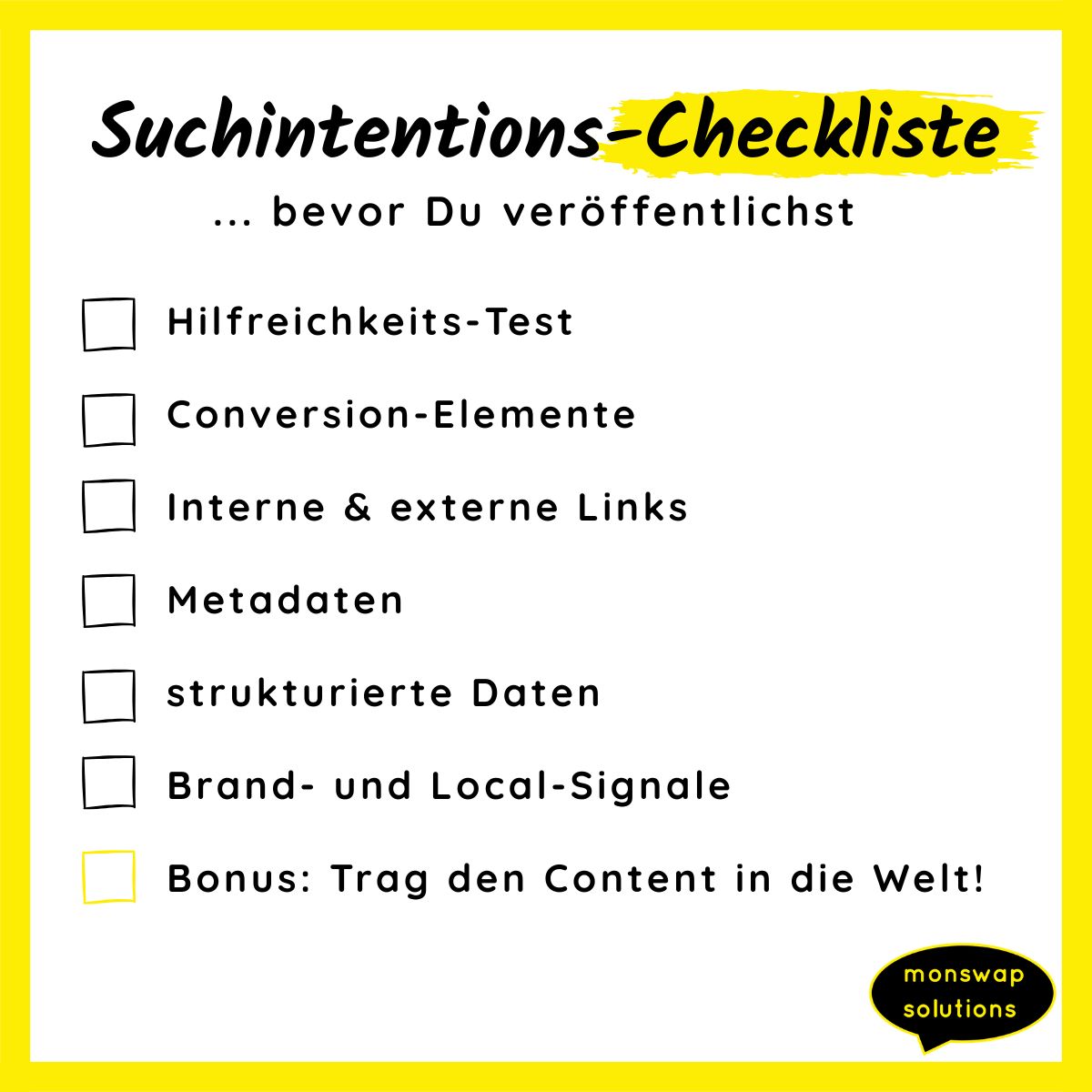
1. Helpfulness Test
Answer honestly:
- Is it immediately clear what needs to be done next?
- Is the search intent clearly answered within the first 30–60 seconds?
- Can your target audience implement at least 3 concrete steps after reading?
2. Conversion elements
- Are there any call-to-action elements?
- Do the CTAs match the search intent?
3. Internal & external links
Links show Google and AI systems concontent:
- Do you link to relevant in-depth content?
- Do you guide readers logically?
- Are there 1-2 high-quality external sources for concontent?
4. Metadata
- Does the SEO title contain the focus keyword and your brand?
- Does the meta description clearly reflect the search intent?
- Would you click yourself?
5. Structured Data
Have you included appropriate structured data?
6. Brand and Local Signals
- Is it clear who the sender is?
- Are the contact and location details consistent?
- Are there any trust signals such as references or reviews?
7. Bonus: Share the content with the world!
For which platform or medium could this content be helpful? Get in touch with trade magazines and partners, and include the content in your newsletter and social media editorial calendar.
Your next step?
Many marketers know how important it is to understand search intent. They simply lack the time to research it consistently. This is precisely where I can help: SEO & AI strategy, strategic SEO content and content updates – either as a one-off service or as ongoing SEO support that frees up your resources and stabilizes rankings in the long term.
What customers ask me about search intent…
In short: No – and yet, in a way, yes.
The search intent itself remains the same. A person wants to know something, compare, buy, or find a specific website. Neither Google nor AI search changes that.
What differs significantly, however, is the way results are displayed – and therefore the optimisation for it:
– Traditional search engines like Google evaluate individual pages based on keyword relevance, structure, signals, and authority.
– AI systems like ChatGPT Search or Perplexity work more concontentually: They combine multiple sources, weight brand authority, consider entities, and incorporate off-page signals more intensively.
Therefore, for AI search, simply ranking well isn't enough. Your content should be citable, unique, and scientifically sound. Off-page signals such as mentions, awards, studies, or expert interviews are gaining importance because AI systems rely on trustworthy sources.
Yes. And sometimes very significantly.
Search intent isn't static. It changes when language, technology, or user behavior evolves.
A good example is the term "cringe." Previously, people primarily searched for it to understand its meaning in English. With its use in youth slang, the search intent shifted: users now search for memes, videos, or Reddit feeds that are "cringe" for entertainment.
This also happens in marketing. A keyword can shift from informational to navigational or comparative when users are more ready to buy, a brand gains strength, or new providers enter the market.
That's why you should regularly update your SEO and AI strategy.
Better not. I recommend defining a dominant search intent for each keyword – and consistently aligning the format, structure, and conversion goal accordingly.
If you try to inform, compare, and sell on a single page, clarity suffers: Google won't recognize a clear focus, and neither will your target customers.