
9 points to consider when outsourcing content writing


9 points to consider when outsourcing content writing
Creating good content yourself is time-consuming. Many marketers therefore outsource content production to professional SEO copywriters. Perhaps you, too, don't have the time to write landing pages, blog posts, and the like? The solution: SEO content. and have content written for you. To ensure your website performs well with the purchased content, here are nine tips from my daily work as an SEO copywriter.Creating good content yourself is time-consuming. Many marketers therefore outsource content production to professional SEO copywriters. Perhaps you, too, don't have the time to write landing pages, blog posts, and the like? The solution: SEO content and content written for you. To ensure your website performs well with the purchased content, here are nine tips from my daily work as an SEO copywriter.

What you can expect in this post
1. Have content written by experts
Creating good SEO content is more complex than it first appears. If you're already spending money to have SEO content written, the quality should be top-notch. Working with professional SEO copywriters meansyou can be confident that the first draft will be perfect right from the start —or rather, ready after just a few rounds of revisions. This applies to tone, structure, and SEO optimisation.
Incidentally, the same applies to the second, third, or fourth content. The quality remains consistently high over time when you have content written by a professional. Content created in this way reliably and measurably improves your website's ranking. This saves you budget, time, and stress when buying SEO content
Learn more about the working methods of reputable copywriters in my blog article “Have professional content written: 4 reasons why you especially need a professional copywriter”
2. Use an SEO content strategy as a basis for content creation
Having professional SEO content written is important – but only half the battle: Only when this content is created based on an SEO content strategy can it measurably contribute to your company's marketing strategy. By approaching content production strategically, your company website will improve its Google ranking in the long term.
Ideally, you should therefore create (or have created) an SEO content strategy before you have your first SEO content written.
During quality control, ensure that the content contains precisely the right keywords . Good SEO content are systematically built around relevant SEO terms , also known as keywords. These keywords, derived from the SEO strategy, should be used along with synonyms and related expressions
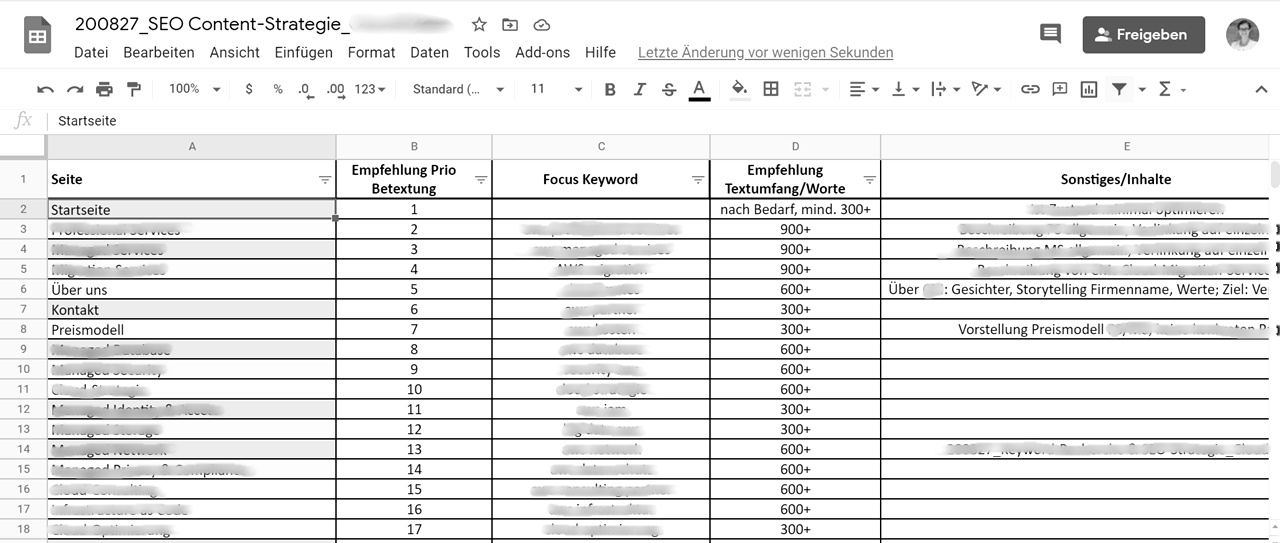
In this way, SEO professionals can optimize the content so that no competitor can actually surpass your website on a specific topic.
What other strategic considerations should you keep in mind when outsourcing content creation? Read about it in my blog post on SEO content strategy.
3. Pay attention to the ideal content length
It's difficult to give a general rule for how long an SEO content should be. Probably somewhere between 300 and 3,000 words.
Ideally, you can determine the optimal content length of SEO content based on a) search intent, b) search volume, and c) the existing, most relevant search results: if long content rank in positions 1-3 on Google, your content should not be too short – and vice versa.

In recent years, Google has developed a preference for comprehensive pages : the more complete and helpful (!) a content is in addressing a topic, the better it ranks. Therefore, as part of an SEO content strategy, you can have longer website content created for your most important target keywords. This allows a website to demonstrate its expertise in specific topics.
Not all SEO content need many words per page
Furthermore, when briefing for content creation, you should primarily focus on the reader and their current preferences. Of course, there are extensive topics that require a detailed, lengthy content. However, sometimes a short, informative, and well-researched content ranks higher than a long, unstructured, or boring one.
An interesting example of this is Gabler's business dictionary, in which an expert describes the term "Aufgabegeschäft" in a concise 59 words – and thus ranks number 1 on Google.

Under no circumstances should information be endlessly repeated on a page. Instead, it's crucial that all aspects of a topic are covered when commissioning content. The ideal content length certainly depends on the subject matter. Most importantly, the audience must find this content truly valuable. Keep this in mind when commissioning content.
In the blog article "SEO content length - How long is the optimal SEO content?" I'll tell you what else you should pay attention to regarding the optimal word count.
4. Focus on user-friendliness
When commissioning SEO content, always start with user needs . Users don't want to wade through meaningless content until they find the one piece of information they're actually looking for. Instead, they're interested in precise answers to their questions. User experience (UX) is therefore something you should pay attention to when commissioning content.
The good news: UX is measurable. One measurable factor to determine if your content is the right length is dwell time : it provides information about the usability and added value that your SEO content offer.
If a user can't find the information, products, or solutions they're looking for on your website, they'll soon leave and continue their search elsewhere. This way, you'll quickly realize when you need to improve the user-friendliness of your content or even have it rewritten by a UX writer.
Learn more about User Experience in my blog post “ UX Copywriters & the Magic of Microcopy ”
5. Calculate the costs for SEO content realistically
Many of my clients have had painful experiences in the past when buying cheap SEO content.
A new client told us on the phone last month: “After my colleagues and I had to completely revise all the purchased content three or four times, we could have written the content ourselves. If I factor in our time, these content have now become more expensive than if we had had them written directly by a professional like you. We won't make that mistake again!”
And she's right. Of course, you can buy German SEO content for as little as 100 euros. But is such a content actually well-thought-out and offering real added value to your customers? Almost certainly not. After all, even budget copywriting services have to pay their rent. And consequently, they can't invest much time or brainpower in a 100-euro content.
If you want copywriters to think proactively when writing your content, don't just focus on the cost, but also on quality. Otherwise, at the end of the day, not only will your content budget suffer, but also your sanity.
6. Buy unique content, never plagiarized content
Copying is easier than coming up with something yourself. That was true in school – and unfortunately, it's commonplace on the internet today.
If you're already spending your marketing budget on having SEO content written, you naturally want unique content . Only with content that offers real added value to users can you rank at the top of Google .
Every content should be original and genuinely provide helpful information to the reader. This works particularly well when content offers unique answers to questions that cannot be found with any competitor.
Plagiarism is really dangerous in SEO content
Speaking of ranking: Plagiarism is downright dangerous when it comes to SEO content. So-called duplicate content can lead to your website being penalized by search engines. In the worst-case scenario, it can result in your website being completely removed from the search results. In a slightly less severe case, your homepage's ranking will drop to page 100.
And as a joke among SEO nerds proves: "Where do you hide a dead body? On page 3 of Google." Imagine how few customers actually stumble upon page 100. Exactly: not a single one.
Furthermore, plagiarism can damage your reputation and erode trust in your website (the so-called Domain Authority, DA), which your company may have been working on for years. Ouch!
In my blog post “ Unique Content & Duplicate Content ”, I'll show you how to find out if purchased content is unique or copied.
Have unique content written for you – here's how to play it safe
Don't buy your SEO content just anywhere. Find a copywriter you can put a face to. The more accurately you can assess the reliability of the source, the more likely your content will be high-quality and trustworthy.

My tip:
- Get an idea of who you're dealing with on LinkedIn : Does this person seem trustworthy?
- Take a look at this copywriting professional's Google reviews : What do former clients say?
- And take a look at website : Does she actually write good, exciting, informative content?
If all three look solid, you can have your content written by this SEO copywriter with a clear conscience.
7. Have content written: landing pages, blog articles – or both?
My answer is: It depends on the SEO content strategy.
It details exactly what kind of content your website needs to rank even better.
In addition to static pages, you can of course also have sales funnels, content for a content hub, white papers, blog articles and many other types of content written.
Blog posts are an excellent way to answer everyday questions from users, and they can draw valuable conclusions and learn from them. SEO content on niche topics (so-called long-tail keywords) are particularly effective for generating traffic. A company blog allows you to build strong customer relationships.

By the way: Google measures the length of time readers spend on your blog posts and rewards your website accordingly in the ranking if your content is well received.
Are you thinking about getting help with writing your blog posts? In "Writing (or having someone write) blog articles: 3 tips from a pro," I explain what you should keep in mind.
8. As an international company, focus on multilingual content
Having content written in multiple languages? Does that make sense? I would say: yes. Multilingual SEO content are a key to international success.
This way, you can significantly increase the reach of your website in various target markets. Therefore, if your company wants to reach customers outside its home country, it's definitely worth developing a multilingual SEO content strategy.
Are you planning to implement a multilingual website project? Consider the following points:
- For multilingual keyword research and SEO content strategy , seek out experienced SEO consultantswho are experts in your target languages and markets. Their help will help you avoid cultural faux pas from the outset.
- Work with native-speaking SEO translators and transcreators for SEO content production . They translate SEO content , paying attention to the messages between the lines. They take cultural nuances into account instead of simply translating SEO content word for word.
If you have multilingual content written, your homepage will achieve a good ranking – not only on google.de or google.ch, but also on google.com, google.co.uk and so on.
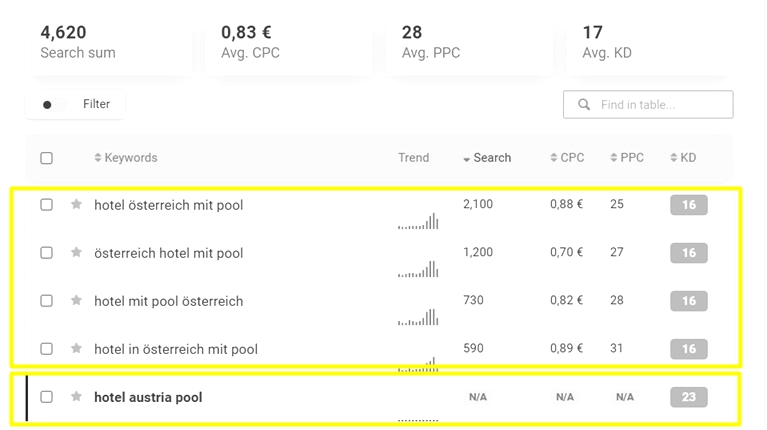
In the article " Multilingual SEO - Being found internationally on the web ," I describe how you can directly tap into new markets in other countries or language areas.
9. Consider search intent when having content written
For a content strategy to be successful, it's crucial that you understand and address your users' needs. When having content created, always ask yourself: "Why is a user searching for this keyword? What kind of content and information do they expect from me?"
This is precisely what is meant by search intent: Does the user want to find information, buy something, find a website, or be entertained?
If you consider both your users' search intent and the offerings on your website when briefing your copywriter, the resulting content will almost certainly hit the mark. However, if you neglect search intent optimisation , your content will likely miss the mark with your customers.
Search intent? How do I find out what my customer is looking for?
Professional SEO copywriters will always determine the search intent of users before developing an SEO content strategy. They use [methods of analysis/information - concontent needed] for this purpose.
- SEO tools that show which search intent lies behind each keyword.
- Information and surveys you have from actual users. It's often a good idea to conduct user surveys before a relaunch.
- Statistics tools that measure, among other things, the time users spend on your site and their interaction with your content.
- a large dose of common sense and years of experience writing content.
The purpose of content is to meet the needs of visitors and help them take the next step. If your website offers diverse information and products, visitors will stay longer. After all, they'll find everything they need there.
Congratulations, you did everything right!
You can find details about this in my blog post “Search Intent – SEO’s little, smarter brother”.
This is how you get the content that will help you progress
Many marketers outsource content production to professional SEO copywriters. To ensure your website performs as desired with the purchased content, you should consider the following:
- Get SEO content from experts with experience and references
- Don't start creating content without an SEO content strategy
- Pay attention to the ideal SEO content length
- Focus on user-friendliness (UX) in every content (!)
- Calculate the costs for SEO content realistically
- Buy unique content, never plagiarized content
- Opt for fixed formats: landing pages, blog articles, etc.
- As an international company, use multilingual SEO content
- When having content written, make sure they match the search intent
Are there any other points you think should be considered when outsourcing content writing? Feel free to leave your comments below.
What clients ask me about writing SEO content…
How much do SEO content cost?
The cost of good SEO content? It starts at around €400 per content. Of course, the price depends on the complexity of the topic, the content strategy, and the quality of your briefing.
So if you're considering having professional content written, remember: you're not just investing in words, but in where your website ranks on Google in the medium and long term. And how many customers find it there.
Let's create copy together that generates revenue. My costs as a copywriter are only a fraction of that.