Truly good SEO texts for Google & AI search: How to check quality and relevance


Truly good SEO texts for Google & AI search: How to check quality and relevance
"All SEO texts read terribly, right?" Admittedly, SEO texts have a bad reputation. But the days when keyword stuffing, atrocious grammar, and incorrect phrasing made it into Google's top 10 are over. (The same goes for AI search.) Today, what counts is content that truly helps readers—and simultaneously scores points with Google and AI search. The best indicator of quality? You […]
"All SEO texts read terribly, right?" Admittedly, SEO texts have a bad reputation. But the days when keyword stuffing, atrocious grammar, and incorrect phrasing made it into Google's top 10 are over. (The same goes for AI search.) Today, what counts is content that truly helps readers—and simultaneously scores highly in Google and AI search. The best indicator of quality? You don't even realize you're reading an SEO text. In this article, you'll learn how to easily check the quality of SEO texts with 8 tips and 4 tools—and immediately expose bad texts.
What to expect in this article
What makes a good SEO text?
Good SEO texts appeal to people first and foremost – not Google. If a text reads awkwardly because the keywords seem crammed in, it's not good. Period.
A good SEO text gets straight to the point with the right message, uses natural language – and is simply fun to read.
For this to succeed, it must be considered holistically. This means:
- He provides genuine insights and experiences instead of superficial information. First-hand experience counts – be it through personal examples, real figures, or concrete expert knowledge.
- It's clearly structured and easy to scan. People don't read online word for word – they scan. That's why good SEO text needs meaningful subheadings, concise paragraphs, and bold highlighting to help grasp the most important information at a glance. (Keyword: Content Design)
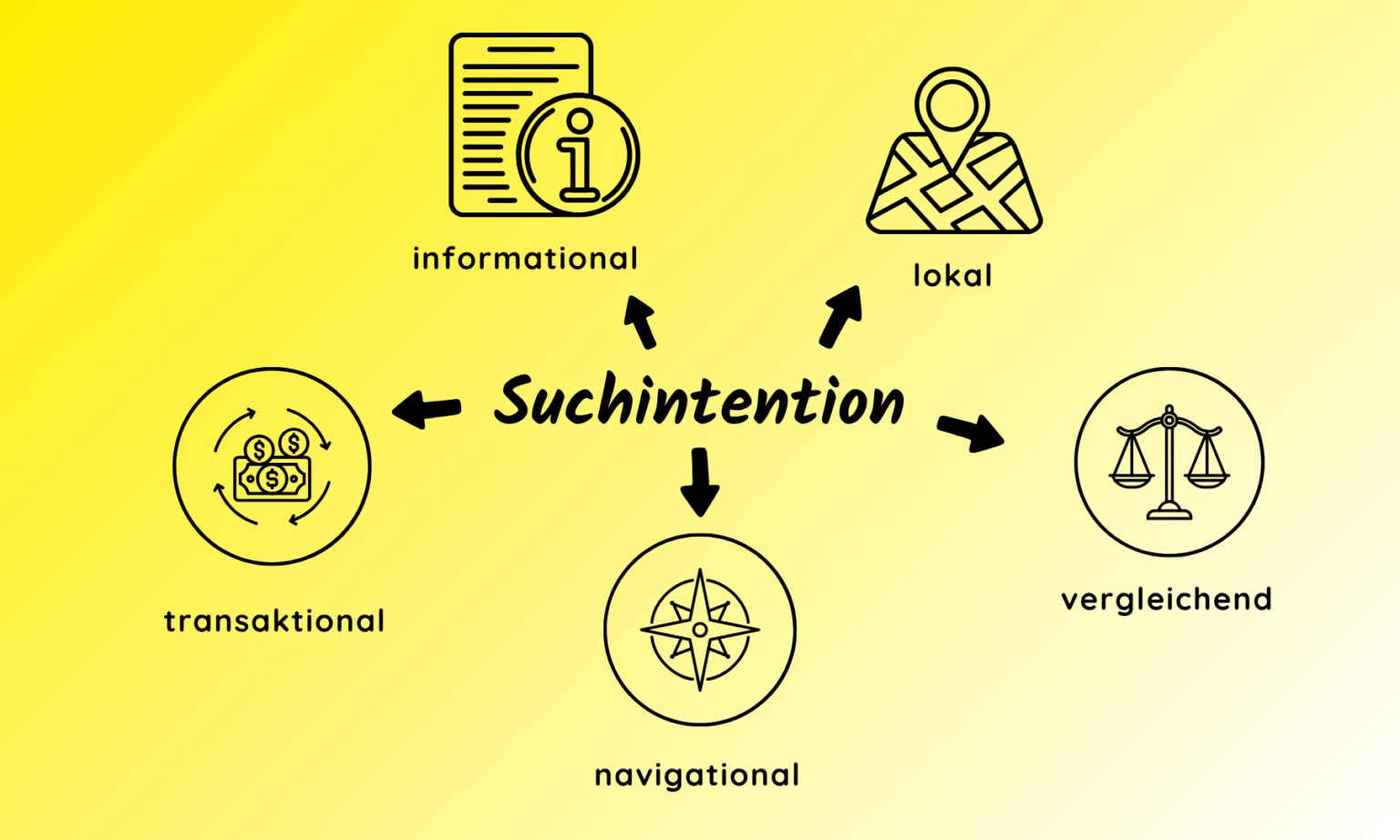
- He answers precisely the questions readers have. The key is search intent. Is someone looking for a product, information, or instructions? A good SEO text should deliver exactly what readers expect.
Good SEO texts are a future-proof investmentthat will endure even outside of traditional search engines.
If all three criteria are met – first-hand experience, a well-thought-out structure, and clear search intent – then people enjoy reading the text. And that's exactly what Google rewards. AI search systems like Google Search Engine, GPT Search, and Bing Chat are also increasingly evaluating content based on how clear, helpful, and user-centric it is.
Why bad SEO texts won't (or won't) work in 2026
A few years ago, you could still get away with generic SEO texts: just throw in some keywords, pay a little attention to the text length – done. Thankfully, that doesn't work anymore.
Google and other search engines are getting better and better at distinguishing filler text from content with real value. Consequently, they penalize poor AI content with low rankings.
AI search goes even further: it delivers perfect answers. And often without users even having to visit a website. Website operators who want to generate traffic in this environment need more in-depth content.
And: There's a lot of really good content out there now . Competition is increasing. Your SERPs (Search Engine Result Pages ) are sharing space with competitors , ads, FAQs, and image results .
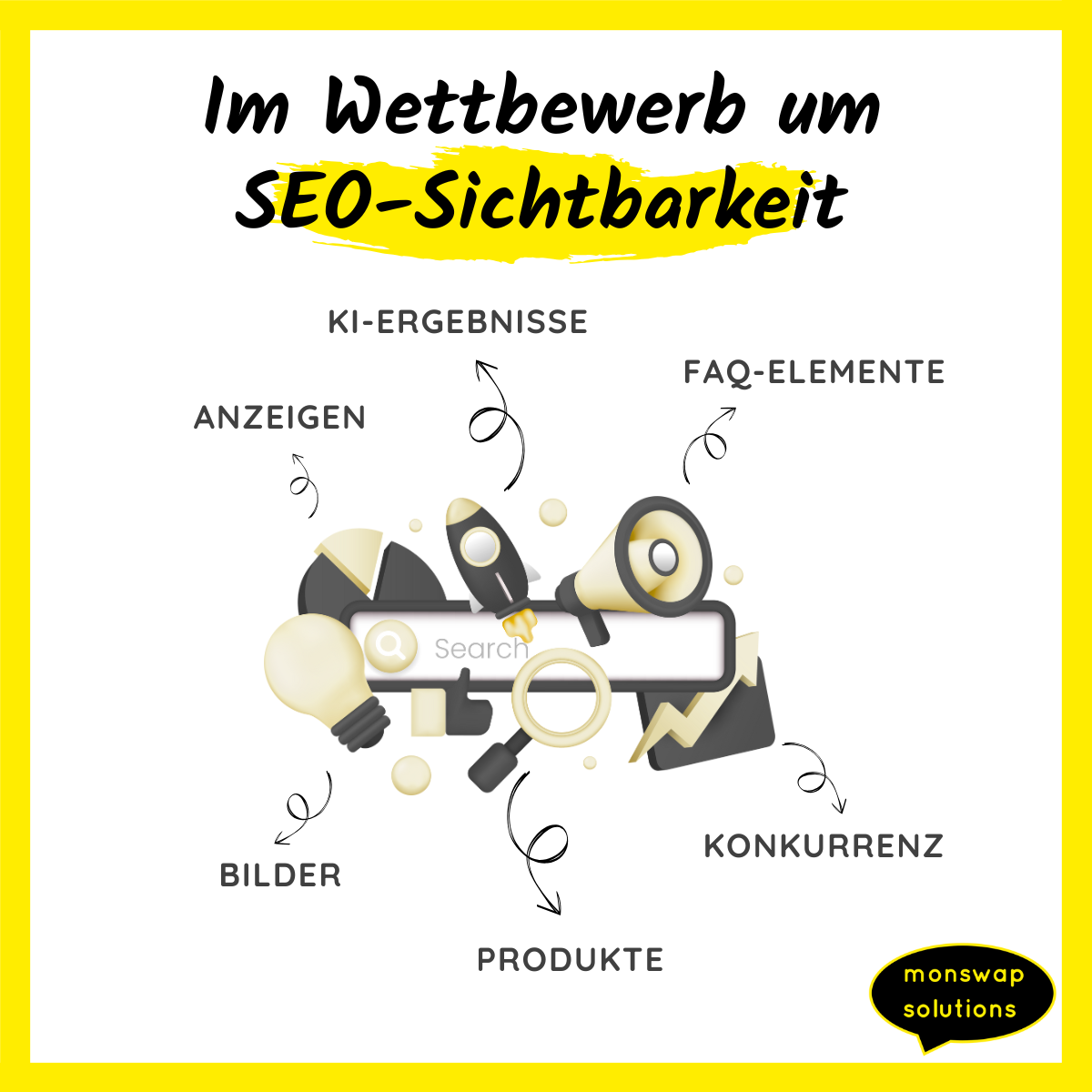
Making one's way through this jungle is becoming increasingly challenging.
Good SEO texts deliver something that AI alone cannot: perspective, practical knowledge, real-world experience. They are strategically written, boast a well-thought-out structure, thoroughly researched content, and easy-to-read language.
Those who ignore this might still end up in the index – but certainly not in the top 10 search results.
8 tips on how to distinguish between bad and good SEO texts
Not every SEO text is automatically good. But how can you tell at a glance whether a text works or needs revision? Here are eight clear questions to help you immediately filter out bad SEO texts.
1. Does the text contribute to your SEO strategy ?
Does the content align with overarching marketing and business goals? Or is it just a "Google text" that offers no real business benefit? An SEO text is only truly effective if it pursues a clear objective: visibility for relevant keywords, increased traffic, or conversions.
2. Does the text address the right target group ?
The best SEO text is useless if it appeals to the wrong readers. Does the text strike the right tone and get straight to the point, addressing the content that interests your target audience? If no one feels addressed, you won't achieve top rankings.
3. Does the SEO text read smoothly?
A good SEO text is easy to read and logically structured. It alternates between short and medium-length sentences to improve readability. In this way, it engages readers – and definitely doesn't sound like a machine-written instruction manual.
My tip: Read the first three sentences of an SEO text aloud. Does it draw you in and make you feel engaged? Or do you stumble over certain phrases? Do you have a clear understanding of the content after three sentences? If not, it's not a good SEO text.
4. Are the keywords integrated effectively?
When checking an SEO text, pay attention to whether keywords are used unnaturally or too frequently. Do individual sentences sound strange, or does the text seem cluttered? Then it's probably keyword stuffing.
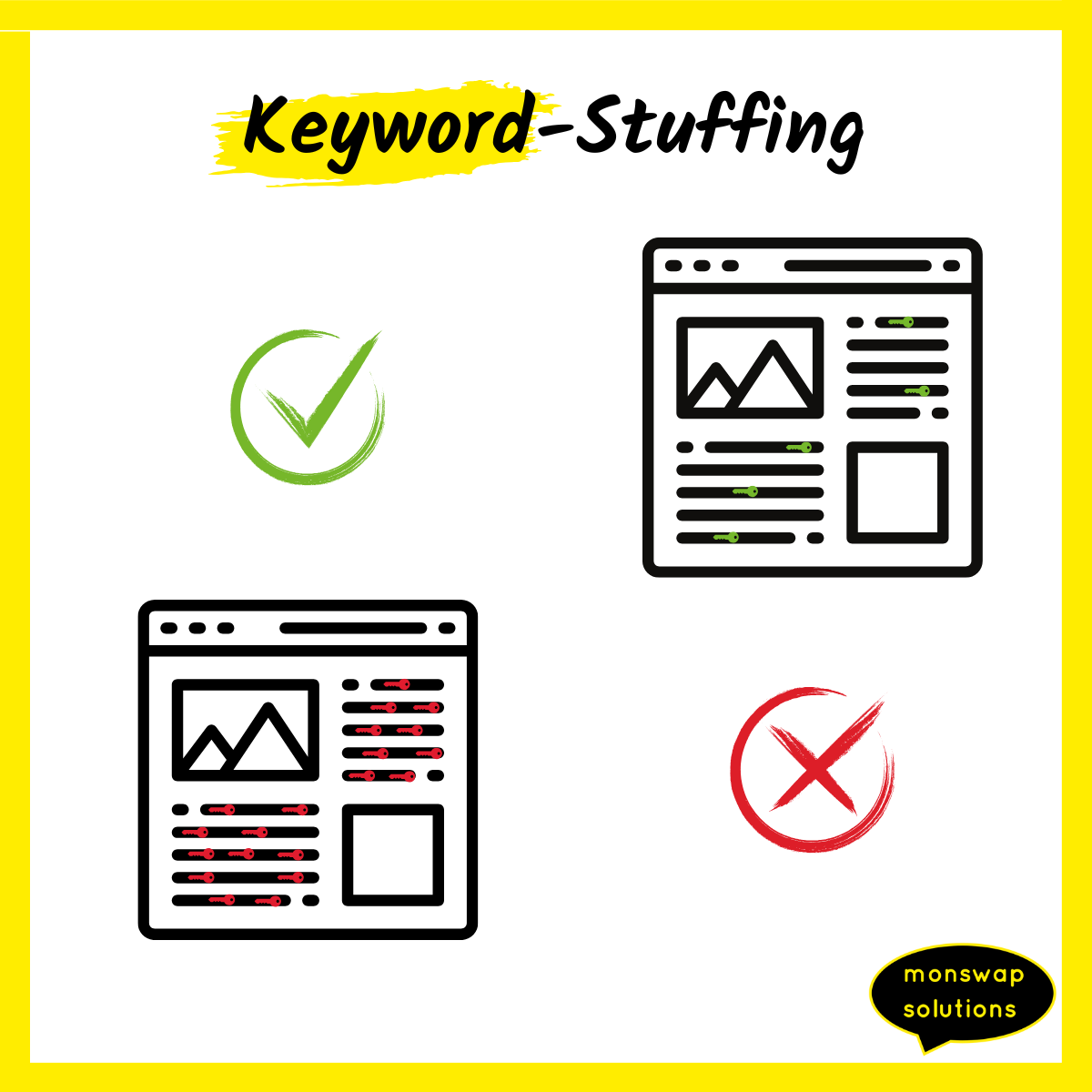
And that will no longer be possible in 2026.
5. Does the SEO text have a logical structure?
SEO texts must be easily scannable. Anyone reviewing an SEO text should look for clear subheadings, short paragraphs, and formatting such as bolding, lists, or quotes. If the text lacks a logical order or appears chaotic, then the structure urgently needs revision.
6. Does it contain first-hand expert knowledge ?
(Unverified) AI-generated texts or cheaply produced content usually repeat information that already exists countless times. Sure, it's faster and cheaper that way.
If a text doesn't say anything concrete, it's 1) poorly researched and 2) lacks first-hand experience. Good SEO texts question the topic, offer their own perspective or a fresh approach, and are often controversial. They make clear statements, use real data, and draw on knowledge directly from experts.
This not only increases relevance for Google, but also the chance of being displayed in AI search results.
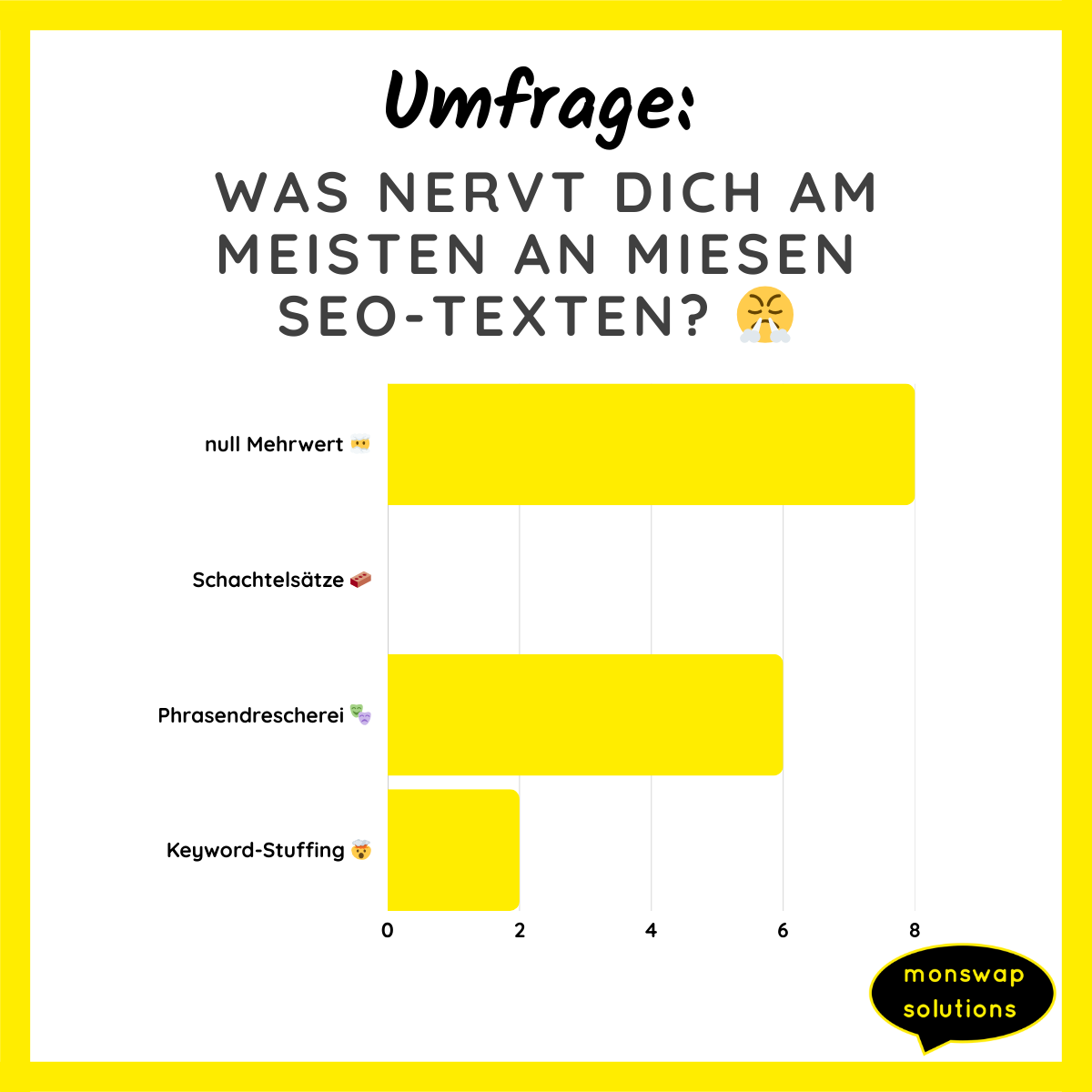
Incidentally, my LinkedIn survey showed that the most annoying content is content that offers no added value whatsoever.
7. Does the text match the search intent?
Does the SEO text accurately reflect the search intent outlined in your brief? Readers have clear expectations when searching online: If someone needs information or instructions and is shown a product page instead, they'll leave. That's not a sign of good SEO text.
8. Does the text contain filler words and generic phrases?
Phrases like "SEO is important for online success" are meaningless and don't help readers. Strategic SEO texts get straight to the point, provide relevant context, and offer concrete information. The result: Website visitors find everything they're looking for on your site and stay longer. (Thanks to UX.)
These tools allow you to check the quality of SEO texts
You can spot a bad SEO text immediately: too long, too stiff, too generic. But how do you know if a text truly meets all the requirements to rank on Google – and also to appear in AI search results?
These four tools will help you:
Yoast SEO
Yoast SEO is a free WordPress pluginthat performs basic SEO checks. It analyzes metadata length, keyword density, readability, and sentence length. It also indicates, for example, whether texts contain too many passive constructions or paragraphs are too long, and displays a corresponding indicator: red, yellow, or green. Perfect for a quick SEO check directly within the CMS.
Additionally, Yoast supports structured data formats such as FAQ Pages or How-To. AI preferentially accesses content that is clearly structured and technically well-marked.
This increases the chances that your content will be used for AI answers.
ChatGPT & Co.
If you want to know how an AI system interprets your text, you can upload it to tools like ChatGPT and ask specific questions in an AI search simulation :
- "What questions does this text answer?"
- "Which terms are missing?"
- "How could the text be even more helpful for target group xy?"
This type of self-assessment shows you whether your content is truly helpful, clear, and relevant – also for AI search.
Sistrix
A comprehensive SEO suitewith the option to add a content module. WDF*IDF analysis lets you check if your text covers all relevant terms for a topic – or if your competitors are performing better. SERP snippet analysis also helps you identify which content is particularly prominent in search results.
Why this is important for AI search: AI systems work with semantic clusters and entities – that is, closely related terms. If your text not only includes the main keyword but also relevant terms in the context, it is more attractive to AI systems.
Sistrix is not a tool for beginners, but rather suitable if you regularly create SEO content. It is only available as a subscription and costs from €239 per month.
Unsure whether your text is original? I'll reveal information and tools for plagiarism checking in the article "Buying SEO texts: 3 1/2 things you should consider".
SEO audit
As an experienced SEO copywriter, I review your texts individually ; either as part of a comprehensive SEO strategy or on a case-by-case basis in 1:1 coaching sessions starting at €250. Because good SEO text needs more than just the right keywords and the appropriate text length. I check:
- Is the structure well thought out?
- Does the tone fit?
- Does the text meet the search intent – even in the age of AI?
- Does the text offer real added value?
You will receive clear recommendations for action without falling into typical SEO traps.
Want to have your SEO text checked? I'll show you what's important. Book an SEO audit with me now: Click here for my calendar.
Your (work) time? Too precious for bad content
Every round of revisions costs you time. And nerves. You need texts that work perfectly from the start – not generic content that needs to be improved countless times. Or an AI-generated text wasteland that drives you crazy.
I write high-quality SEO content that delivers immediate results. No wasted time. This allows you to focus on what matters most: your strategy and your projects.
Let's work together. That way you'll get SEO texts that work – without any detours.
What clients ask me about good SEO texts…

Can I write (or have written) good SEO texts using AI?
Yes, AI can help you write really good SEO content. The important thing is not to simply copy the output verbatim. Good SEO text needs clear statements, readability, and strategically placed keywords. AI can provide a great foundation for this, but everything ultimately depends on human fine-tuning. This is especially true if you want your texts to appear in AI search results like AI Overviews.
In my free AI prompt series for SEO texts, I'll explain how to do it right.
Do I really need an SEO strategy?
Yes, especially if you to be found for competitive search terms . A clear SEO strategy helps you find good keywords and use them B2B content that fits your company. It shows you which terms have search volume, what your competition is, and which synonyms are relevant.
Without a strategy, you're just writing aimless content. With a strategy, you know exactly what kind of content your target audience is looking for and how to convince them with valuable information. This is how you create unique contentthat not only ranks well but also wins customers.
How many keywords should a good SEO text contain?
The ideal keyword density is 0.5–1.5% of the total text. This means that your main keyword can appear approximately 3–9 times in a 600-word text
More importantly, the keyword should be incorporated naturally. A keyword should never disrupt the flow of the language or the grammar. And: keyword stuffing now only brings disadvantages.
So instead of simply stuffing something like "cost of having SEO texts written" directly into the text, you can definitely change the word order – without it negatively impacting visibility. At least, that's been my experience.
Example:
Bad: "Cost of having SEO texts written"
Good: "How much does it cost to have SEO texts written?"
A good SEO text also uses synonyms and related terms to increase readability and relevance.
How long should an SEO text be to rank well?
My typical consultant's answer: It depends…
For a simple product description with little competition, you can rank with as few as 300 words (or even fewer). A good blog post or landing page sometimes needs 800–3,000 words to comprehensively answer a search query.
What matters is not the length of, but what the SEO strategy says (keyword: Skyscraper vs. Ranch-Style SEO), whether the text meets the search intent and delivers real added value.