What decision-makers in marketing should know about GEO – and what is nonsense


What decision-makers in marketing should know about GEO – and what is nonsense
ChatGPT recommends products and brands today. So does Copilot. And Google AI Overviews certainly does. Those who are recommended sell. Those who aren't recommended quietly lose customers. Generative Engine Optimisation (GEO) is changing the rules of the game in marketing. Younger target groups and early adopters are already searching and comparing using AI systems. With AI optimisation, you can also make your website recommendable to AI systems. Will it all pay off for you? This article will give you clear guidance. Read on – before your competitors do.ChatGPT recommends products and brands today. So does Copilot. And Google AI Overviews certainly does. Those who are recommended sell. Those who aren't recommended quietly lose customers. Generative Engine Optimisation (GEO) is changing the rules of the game in marketing. Younger target groups and early adopters are already searching and comparing using AI systems. With AI optimisation, you can also make your website recommendable to AI systems. Will it all pay off for you? This article will give you clear guidance. Read on – before your competitors do.
What you can expect in this post
Generative Engine – what? How AI systems decide whom to recommend
Geo-marketing has two meanings. Here we're talking about the newer one: Generative Engine Optimisation – optimizing your website for AI systems.
But what exactly does that mean?
When potential customers ask ChatGPT, Copilot, or Google AI Overviews for a comparable product, the AI should recommend your brand as the top result and cite your website as the source. Websites (and other sources) can be optimized for this.
In short: SEO has made you visible on Google. GEO places your brand where your customers are already searching.
AI systems assess which brands provide reliable, specific answers to a given topic – and have established recognizable authority in this area (according to EEAT (Experience, Expertise, Authoritativeness, Trustworthiness), Google's central quality framework). Crucially, it's not just the amount of website content you have that matters, but whether the structure, depth, and concontent of your content allow an AI to draw a clear conclusion.
What Generative Engine Optimisation actually brings to marketing
When ChatGPT or Copilot recommends a product, it's more than just a click on your website: it's a clear purchase recommendation. Being visible in the final selection of 3-5 products at that moment gives you a distinct advantage. People who consult AI systems when making purchasing decisions are usually already well into the process. They're no longer comparing – they're deciding.
An AI recommendation is worth real money.
Furthermore, GEO is a young field. Those who are among the first to enter the industry now gain immediate visibility and secure a head start until the last competitors take action in two to three years.
And the good news is: what AI systems demand makes sense anyway: helpful content, a clear website structure – and trust through reviews from real customers instead of just self-promotion on the website. Those who strategically use GEO in their marketing also appear credible to human customers and simultaneously contribute to traditional Google rankings. Win-win-win.
What is hype and what you can safely ignore
Some statements in GEO magazine sound (almost too) tempting. That's precisely why I want to make it absolutely clear what is nonsense from today's perspective – and what is true instead.
Hype #1
AI recommendations can't simply be bought like ads. Currently, there's no traditional ad space where you can place your offer in ChatGPT, Copilot, or AI Overviews. Visibility comes solely organically through your website, relevant third-party sites, reviews, social media, and more.
What's true: Trust can't be bought – neither by people nor by AI systems. You gain this trust with a consistent, credible image across all channels. This takes time, but it's also the reason why your success won't be so easy to replicate later.

Hype #2

Likewise, there's no plugin that magically does GEO for you, or any other shortcut. Tools can analyze, compare, and provide marketers with insights. The strategic work remains: What questions does your target audience ask? What answers do you provide? And why should an AI system identify or recommend you as a reliable source?
What's true isthat GEO isn't a technical problem that can be magically solved with fairy dust. It's a question of content: Do you really have something to say – and are you saying it clearly enough and through the right channels so that AI systems believe you and want to recommend you?
Hype #3
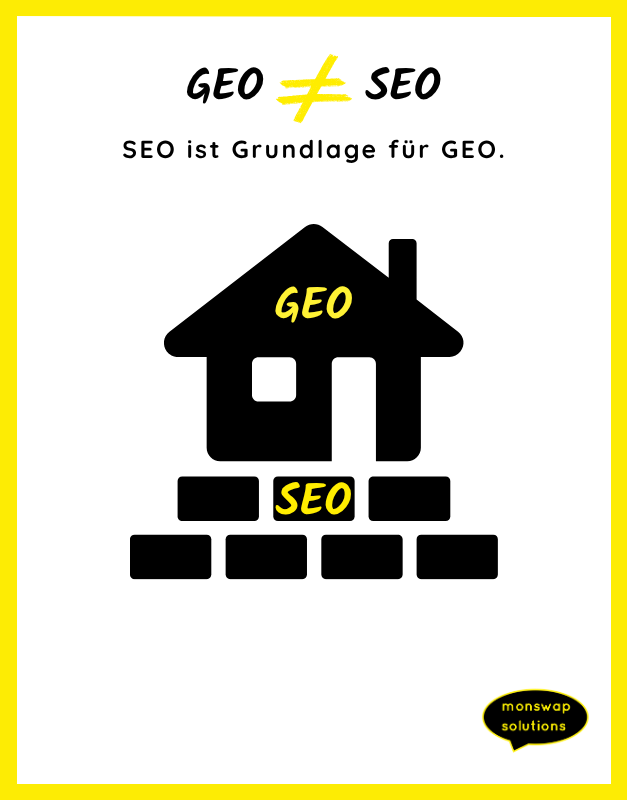
The statement "GEO = SEO" is also too simplistic. Sure, at its core, GEO builds on SEO: website structure, sound technology, helpful content, authority. However, GEO expands on this by adding concontent: it's less about individual keywords or topics – and more about presenting a compelling overall image as a brand across all channels.
What's true: SEO alone is no longer enough. GEO is brand building with an SEO foundation that extends beyond the website. Those who already have a clear positioning for traditional search engines, strong content, and relevant external links are well-positioned for GEO – and can take further steps from there.
When GEO is worthwhile for your marketing – and when it isn't (yet)
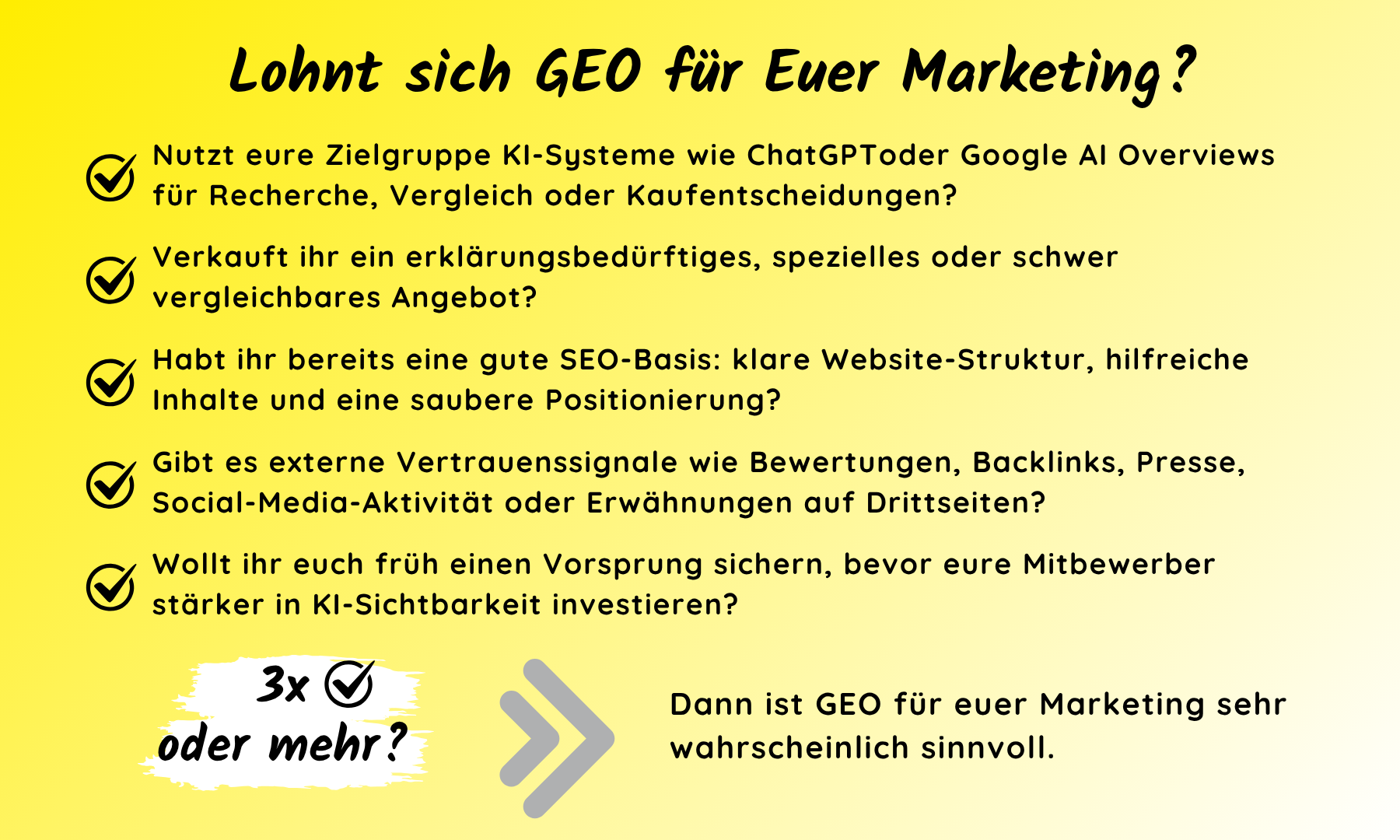
GEO is worth it now if you can answer at least three of these questions with "yes":
- Your target audience is young or tech-savvy – and uses AI systems as a search engine
- You sell something that requires explanation, is special, or difficult to compare: SaaS, IT, consulting, complex technology, travel – products where people cannot directly compare and therefore ask AI for recommendations.
- Your on-page SEO is in place: clear website structure, good content, clean positioning with an SEO strategy.
- You want to build a lead before your competitors even start with AI optimisation
- Your brand is already visible in AI systems: active social media, reviews, mentions on third-party sites, and backlinks are good indicators. (Whether it's actually visible can be determined by checking your preferred GEO tool.)
Not a definite yes? Then SEO basics are the right next step for you.
Your next step towards GEO?
Many marketers know that AI visibility is becoming increasingly important. However, they often lack the time and know-how to properly assess whether GEO is already relevant for their brand, where they stand, and which measures truly need to be prioritized.
This is exactly where I come in: with a GEO audit, AI strategy, and helpful GEO contentthat makes your content more easily categorized for people, Google , and AI systems. I offer targeted GEO support or ongoing services that free up your in-house resources and strengthen your long-term visibility.
If your marketing team is currently discussing whether Generative Engine Optimisation is relevant for you: I would be happy to answer this question specifically for your brand.
What customers ask me about German GEO content …
By GEO content, I mean content optimized for search queries to generative AI. The goal is for systems like ChatGPT, Perplexity, or Google AI Overviews to understand your products or services and recommend them in their responses.
Unlike traditional SEO, GEO marketing relies on more than just the content on your own website. Mentions on external websites—so-called off-page—play an equally important role: comparison websites, review portals, social media, newspaper articles, and paid media are examples.
If the overall picture is right, your brand will not only be found on Google but will also appear in AI-generated results—precisely where more and more people are searching for information.
Website content for AI search follows many of the same quality criteria as good SEO content: It is clearly structured, understandably written, engaging, and offers genuine added value to the reader.
For AI systems, additional aspects play a crucial role:
– On-page: Formats such as FAQs, teasers that make expectations transparent upfront, and a clear description of your services.
– Off-page: Consistent company information, credible mentions on other websites, genuine reviews, and relevant content across different news formats or social networks.
Furthermore, all information – off-page and on-page, in German and English – needs to be coherent. Otherwise, this will put your brand at a disadvantage.
Of course! I've developed a free AI prompt engine for this purpose over the last year and a half. With it, you can write GEO content faster and better.
Check it out!
Yes, in many cases, existing high-quality SEO content effectively optimized for search engines. Often, it's enough to strategically expand these pages and structure them more clearly.
This includes, for example, precise definitions, clearly formulated answers to typical user questions, and formats like FAQs. Additional concontentual information, such as internal and external links, also helps AI systems better understand a website and use it as a source.
Off-page signals play a crucial role in GEO because AI systems don't view content in isolation. They also analyze the concontent across the entire web: Which sources mention a brand? Where is a company, product, or area of expertise being discussed?
Mentions on other websites, in media outlets, on review platforms, or in social networks help AI systems better assess a brand's credibility and relevance. The more frequently a company appears in relevant thematic concontent, the more likely it is to be perceived as a trustworthy source.
For GEO, this means that not only the content on your own website matters, but also the concontent in which your brand is mentioned online.
Yes, monthly GEO monitoring makes sense. Why?
Your website cost a lot of money and may be top-notch. But without monitoring it, you don't know how well it's really performing and what your ROI is.
Monitoring this development makes sense as soon as you start with GEO optimisation – so that successes are immediately visible and you can make data-driven decisions about where to invest your energy and resources.
Furthermore, GEO (just like SEO) isn't a one-off task you can check off your list after launch.
GEO means staying on top of things continuously. This works best with targeted monitoring and reporting.
In my article "SEO Monitoring – Or: How Hard Is Your Website Content Working?", I show you what you need for monthly SEO monitoring, which tools are suitable, and how you can use them to permanently improve your content. This principle also applies to AI optimisation of your website.
Or you could simply book a live GEO report every month with concrete recommendations for action, for example from me starting at just €249/month. 😉
Yes, GEO is already worthwhile today. Those who start early will be among the first companies whose content is recognized and recommended by AI systems. Early adopters benefit from the fact that many competitors haven't yet optimized their content for AI search.
Furthermore, there's a clear trend in search behavior: younger target groups, in particular, are already using AI extensively for their information searches. Studies show that around 35% of Gen Z users regularly use AI chatbots for search queries, significantly more than older generations. At the same time, over 80% of Gen Z prefer AI tools that provide direct answers instead of searching through traditional search engine results pages.
Therefore, those who focus on GEO early in their marketing have a good chance of appearing among the first in AI-generated results – and being visible precisely where many users' search behavior is already heading.