How I use AI: Writing SEO texts faster (and better)


How I use AI: Writing SEO texts faster (and better)
Tools like Claude, ChatGPT, or Neuroflash already deliver usable text drafts. However, in their current form, they aren't valuable enough to rank well on Google or in AI search. What these tools excel at, though, is supporting you throughout the entire text creation process – from brainstorming and metadata to checking for SEO and geo-optimization. That's precisely why I've developed a structured […]
Tools like Claude, ChatGPT, and Neuroflash already deliver usable text drafts. However, in their current form, they aren't valuable enough to rank well on Google or in AI search results. What these tools excel at, though, is supporting you throughout the entire text creation process – from brainstorming and metadata creation to checking for SEO and GEO suitability. That's precisely why I've developed a structured prompt sequence: 15 steps that guide you through the SEO and GEO text creation process. You'll find most of them in this blog post. The complete, continuously updated prompt sequence is available for download – for anyone who wants to get from keywords to finished website text faster and more easily.
What to expect in this article
A word beforehand about my AI prompt sequence for SEO texts
AI tools are constantly evolving: Currently, probably nothing is being worked on as much as making Google's AI Mode, ChatGPT, and similar tools even better, faster, and smarter. The requirements for SEO texts (and GEO content!) are also constantly changing.
Good AI prompts must adapt to these changes on a daily basis. Accordingly, this prompt sequence might still work tomorrow – but will certainly be outdated the day after.
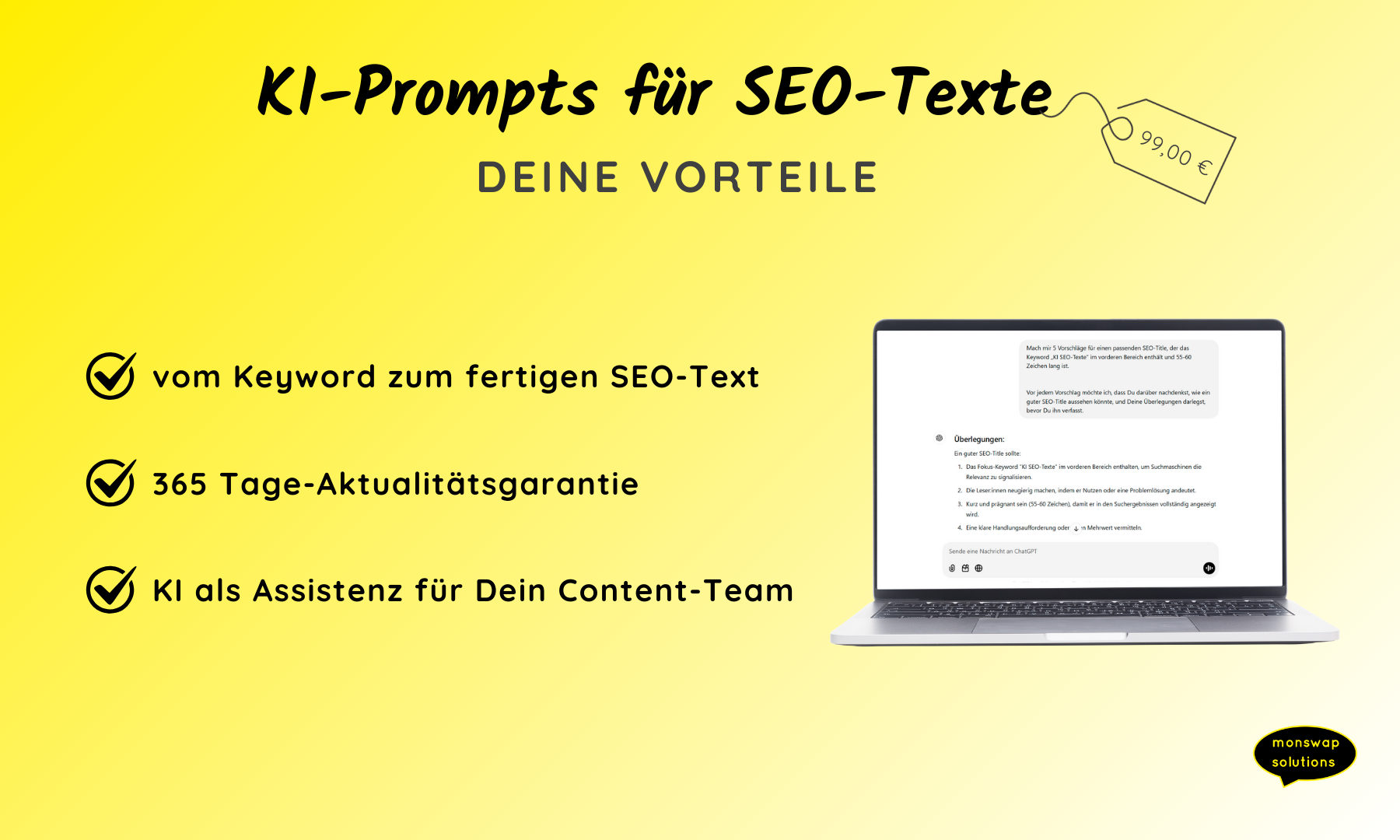
To ensure you always have access to up-to-date AI prompts for your website texts, I'm offering access to my personal prompt suite worth €400 – for just €99.
How to use AI prompts correctly
Attention: You should meaningfully complete all terms that I have marked with “” or “xxx” in the prompts before submitting.
These AI prompts are no substitute for a sound SEO or GEO strategy, nor do they relieve you of the actual writing work. They don't provide content that you can simply copy and paste. AI is a tool – you determine the content quality with your input, experience, and fine-tuning.
What this prompt sequence does, however, is support you throughout the entire writing process and takes care of many of the accompanying tasks for you. This allows you to work in a more structured way and saves you time.
Carefully review all AI-generated text before publishing. As the author, you are responsible for the content, message, and quality.
(If you would like to learn more about legal issues surrounding AI-generated content, e.g., liability or intellectual property, this article on e-recht24.de .)
15 AI Prompts for Really Good SEO Texts (2026)
0. Briefing (always give it to the AI at the beginning)
You are an "experienced SEO copywriter for a German SEO/GEO consultant". Your task is to write "particularly helpful blog posts on various topics in the field of search engine optimization (SEO) and generative engine optimization (GEO)".
The texts should be "engaging, explanatory, and concrete, but not just sticking to the obvious." The target audience is "marketing managers in companies, agencies, and startups." They are "generalists, not SEO experts." Their pain points are "lack of time and resources, as well as a lack of SEO/GEO know-how.".
Each text consists of:
- “an H1 (60-70 characters, should promise added value & arouse curiosity)”
- “a teaser (60-90 words)”
- "a sensibly structured H-structure"
- “logically placed CTAs and internal links”
- “an SEO title (55–60 characters)”
- “a meta description (135–140 characters)”
Let's text him together, step by step. Are you ready?
1. Idea generation
I want to write a blog post/landing page for the website "xxx". The blog post/landing page should rank on Google for the focus keyword "xxx" and also cover the secondary keywords "xxx", "xxx", and "xxx". The post should be xxx words long.
Target audience: xxx
Give me three suggestions, each in about three sentences, on how to write a helpful and engaging blog post around the keyword.
Before each suggestion, I'd like you to think about what a good blog post topic might look like and explain your reasoning before writing the suggestion.
Do you need any further information before you can start with the first suggestion?
2. Text structure
Add the keywords and adapt the tone to the tone of voice of your company, start-up or customer.
AI prompt for SEO text structure
Create a heading structure (based on the following keywords, among others) for a blog post/landing page with a text length of approximately xxx words. The focus keyword "xxx" or one of its synonyms must appear in 1/3 of the headings. Include well-placed calls to action (CTAs).
Content:
"Insert the idea generated in step 1 here and adjust it if necessary"
Keywords:
xxx
Please note:
- Short headings with a maximum of 8 words
- Addressing readers with "you", capitalizing on the "you"
- The sender is "me" or "me as an SEO copywriter"
- Simple language, no foreign words
- Write actively, address readers directly, and actively involve them
- Be specific and give details (numbers, names, facts, measurements)
- Do not use exclamation marks
Do you want to work directly with all 15 prompts?
With the complete prompt sequence, you can write AI-powered SEO texts faster, in a more structured way, and with better rankings.
Get the complete prompt sequence here.
3. Generate SEO texts
Now revise the text structure that the AI suggested for the SEO text. Then you can start writing.
I prefer to work paragraph by paragraph here because with longer SEO texts I tend not to revise all AI-generated texts thoroughly enough.
Again, adjust the tone to match the tone of voice of your company, start-up, or customer.
AI prompt for SEO texts
This is my structure for a guide/blog post/landing page on the topic of "xxx". Let's fill it in together:
—
Please write a paragraph for the guide/blog post/landing page "xxx" under the heading "xxx". Address xxx in this paragraph. Write about xxx as your target audience.
Please note the following:
- Addressing readers with "you", capitalizing on the "you"
- The sender is "me" or "me as an SEO copywriter"
- Simple language, no foreign words
- Write actively, address readers directly, and actively involve them
- Be specific and give details (numbers, names, facts, measurements)
- Do not use exclamation marks.
- short sentences with a maximum of 10 words
- 120-150 words
- In the running text, start a new paragraph after each completed section of meaning (approximately every 2-4 sentences).
Use the keyword "xxx" and the secondary keyword "xxx" at least once meaningfully within it.
4. Content refinement
This is my solution. What do you think? Is it as user-friendly and helpful as possible?
Copy and paste the text (section) here – whether written by yourself or with AI
5. FAQ
FAQs are often underestimated – even though they are a powerful SEO tool. AI can handle the research, structuring, and wording if the prompt is well-designed. In my system, a single prompt takes care of all the FAQ logic for you.
You can find the complete FAQ prompt in the prompt section.
6. Intro Teaser
A strong opening determines whether your SEO text gets read. With this prompt, the AI formulates a clear, search intent-based teaser that perfectly leads into your article – without clickbait or filler words.
From this point on, the AI process becomes truly valuable.
The next steps transform AI output into truly search engine optimized content.
Secure your copy of the complete prompt sequence.
7. Spelling check
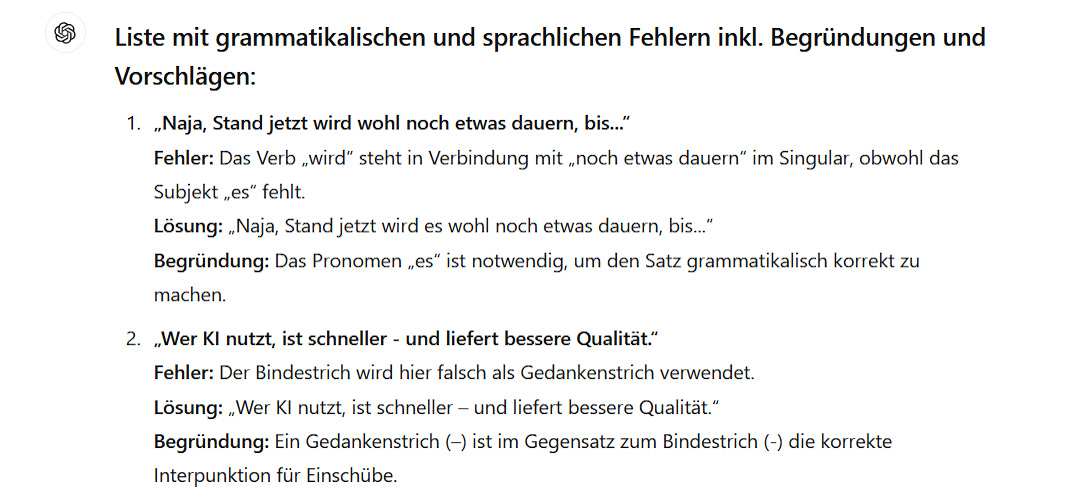
This feature works better or worse depending on the current state of AI development. I'd still recommend trying it out, though. So far, the AI has found a typo in my SEO texts every time.
AI prompt for spell check
Here is the completed draft text for the guide/blog post/landing page on the topic of "xxx". Please proofread it and create a detailed list of grammatical errors and your suggested solutions. Please provide a brief explanation for each error.
8. H1 heading
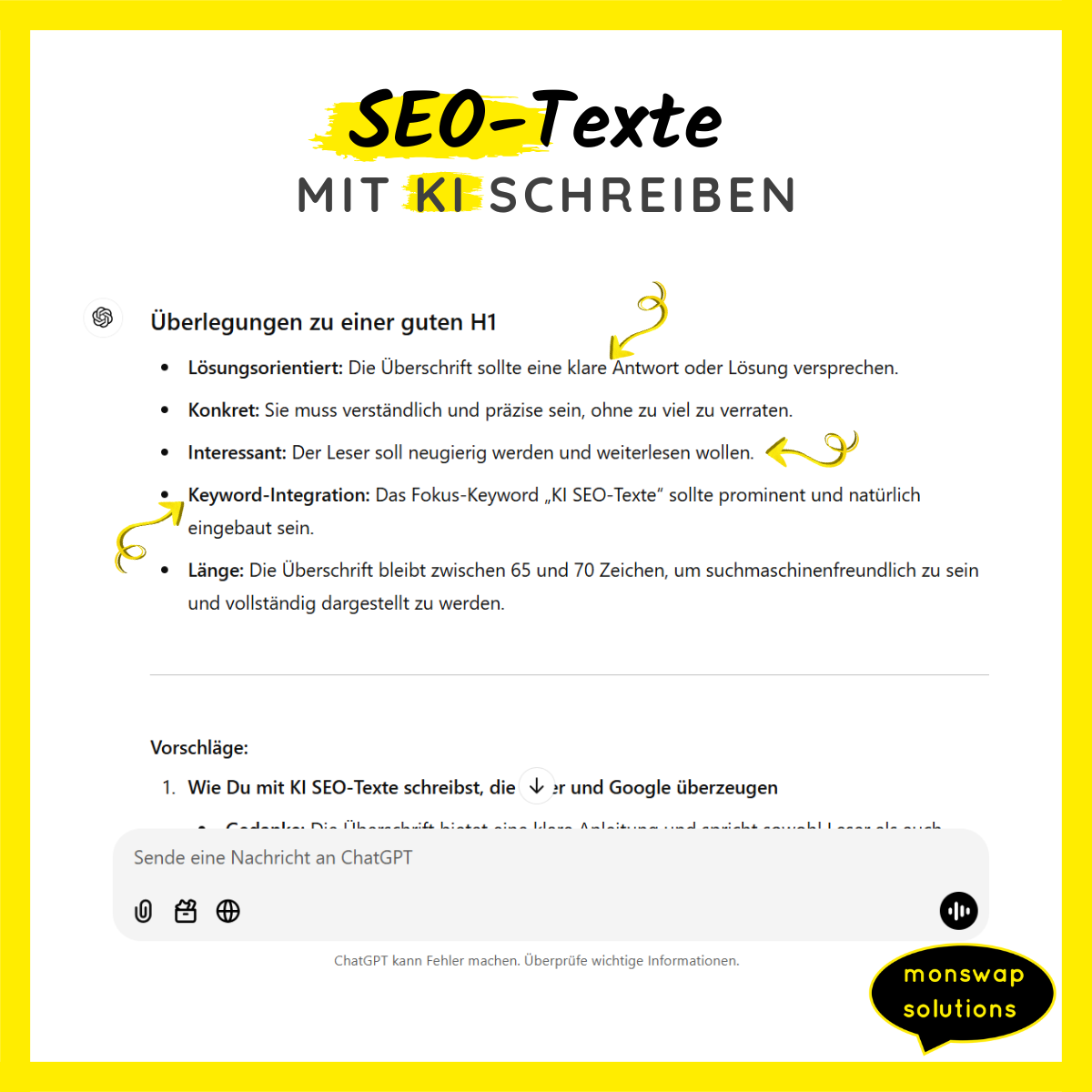
Did you know: H1 ≠ SEO Title? While the SEO title is meant to stand out in the search results (SERPs), the H1 heading already has interested readers in front of you. The goal now is to entice them to read on with compelling arguments.
AI prompt for the H1 title
Give me 5 suggestions for an H1 heading that fits the text, contains the focus keyword “xxx”, and is 65-70 characters long.
Be solution-oriented, specific, and interesting.
Before each suggestion, I would like you to think about what a good headline might look like and explain your reasoning before writing it.
9. Check for uniqueness, SEO & GEO suitability
Here is my draft text:
[Insert full text from H1 to end of text here]
What do you, as an SEO and GEO expert, say about this? Is this text valuable enough to be recommended as a source by Google and AI search?
10. Check for AI prompt
Here is my draft text:
[Insert full text from H1 to end of text here]
If someone enters the following prompt into the AI search – will this page be listed as a source and will monswap solutions be recommended to them? If not: What can I change on this page so that it is recommended?
This is the prompt: xxx
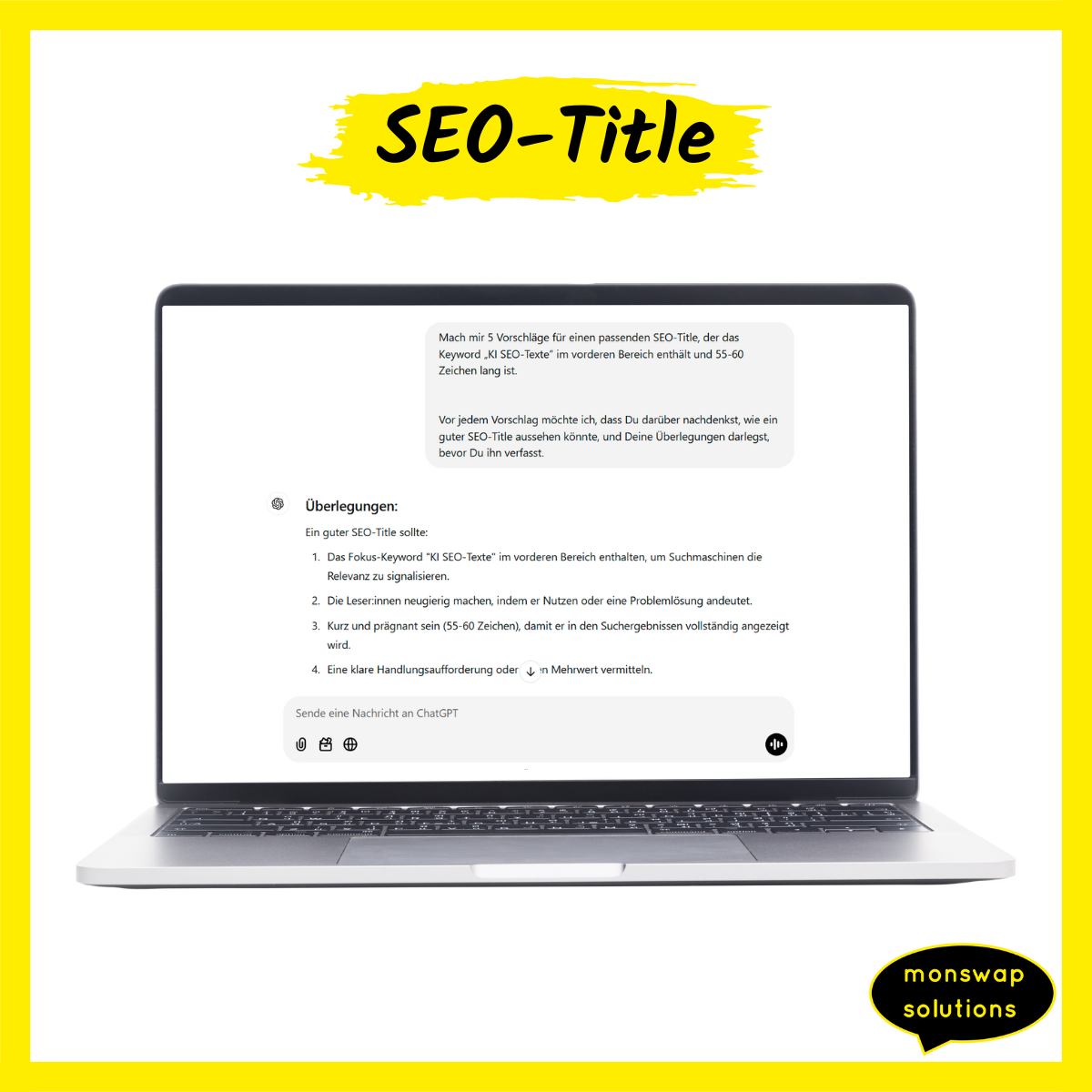
11. SEO Title
The SEO title significantly determines your click-through rate. My prompt combines keyword placement, SERP comparison, and tone of voice – so that the AI develops variations that actually work.
My prompt is:
"Give me 5 suggestions for SEO titles that fit the text, semantically include the keyword 'xxx' at the beginning, are 55-60 characters long including spaces, and end with 'xxx'.
Before each suggestion, it is crucial for success that you think about what a good SEO title could look like and explain your reasoning before writing it."
By the way: I regularly check the performance of my SEO titles to find out which changes are actually making a difference. You can learn how I set up this monitoring and why it's so important in the blog post "SEO Monitoring – Or: How Hard Is Your Website Content Working?".
12. Meta Description
Good meta descriptions are short, clear, and search intent-oriented. This prompt generates several variations that you can test directly or use as is:
"Please give me 5 suggestions for a meta description that fits the text and..."
➥the focus keyword “xxx” is semantically meaningful in the first third, but not among the first 3–5 words
➥135-140 characters including spaces is
➥contains a compelling CTA at the end, preceded by a special character such as ➥
Before each suggestion, I'd like you to think about what a good meta description might look like and explain your reasoning before writing the description. It's a very important task that's crucial to the success of the entire website.
Your proposals must follow the following examples in terms of length, style, and structure:
"Insert three good meta descriptions here"
13. Internal links
Internal links help Google understand the context of your content. Based on this information, the AI suggests relevant pages, anchor text, and placements.
The entire Prompt is contained within the Prompt route.
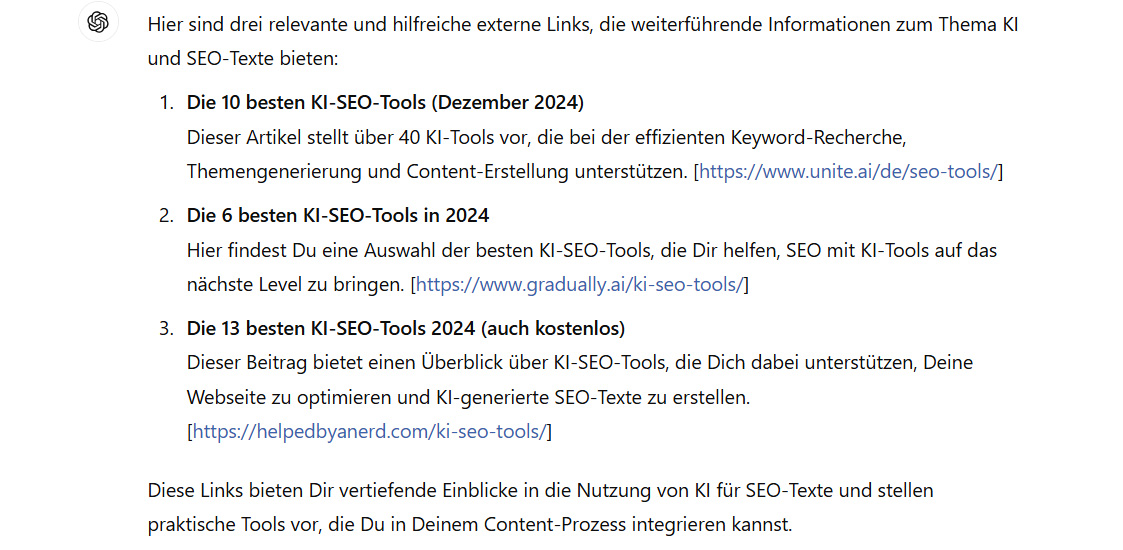
14. External Links
Relevant external sources strengthen credibility and thematic depth. This prompt assists with researching, selecting, and formulating suitable sources.
You will find the prompt for optimal external links in the prompt section.
15. Image SEO
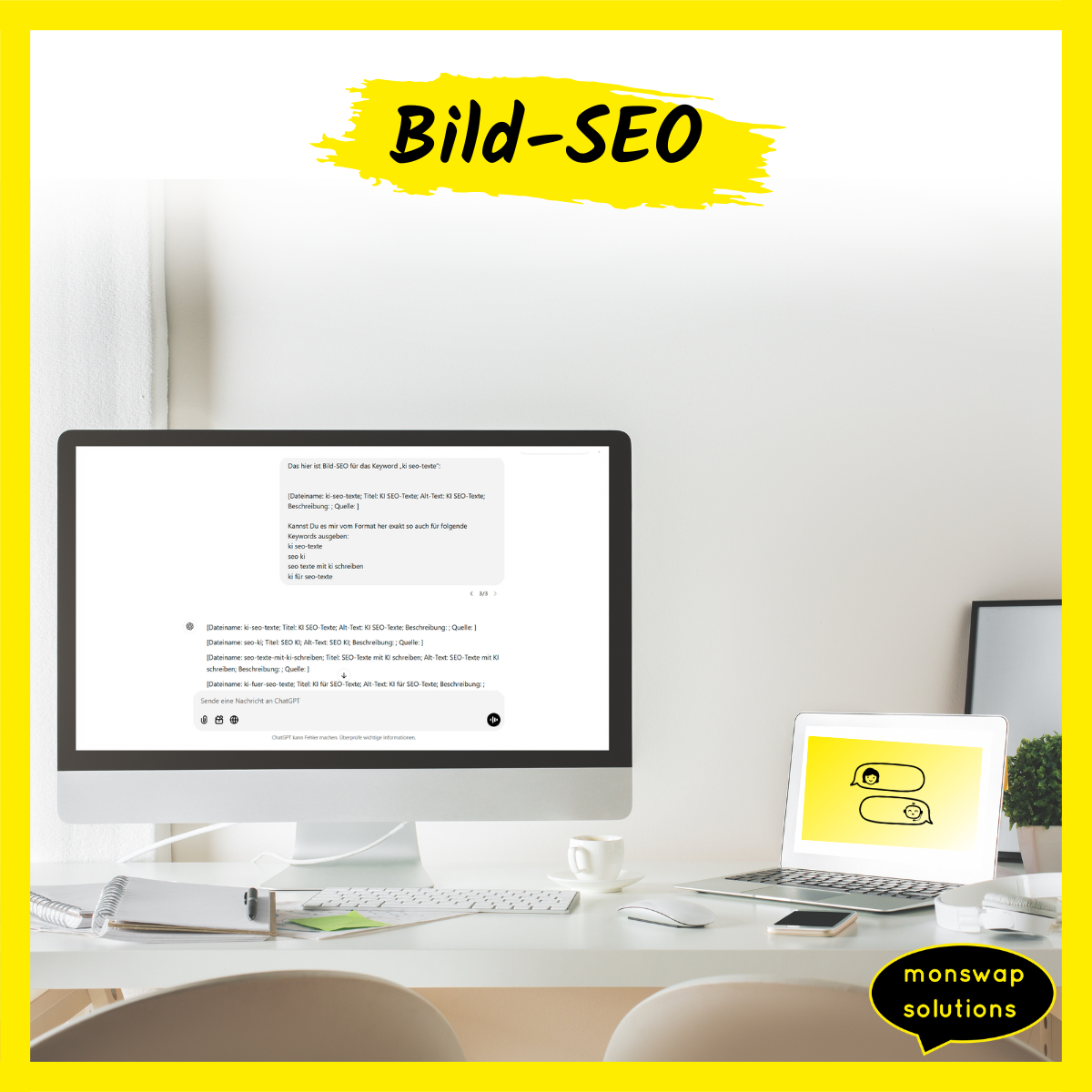
Once the text is finalized, it's time to optimize the images: After all, depending on the topic, customers will find you through your stunning visuals. (Especially in tourism, fashion, or other B2C sectors, image search is indispensable.) It's great that AI now takes most of the work off your hands.
You only need to change the alt text and description and add the source code.
AI prompt for image SEO
This is image SEO for the keyword "ki seo-texts":
Can you output it to me in exactly the same format for the following keywords:
xxx
yyy
zzz
Ready for professional AI SEO texts?
Over 120 marketers are already using the prompt sequence for consistent, high-quality SEO content – in less time.
👉 Get the complete prompt sequence.
Finally, you can copy your finished SEO text into the AI and ask if it has any suggestions for improvement. If it only comes back with nonsensical nonsense, you've done it: your AI-generated SEO text is finished.
Hooray!
Done ✔ Any questions?
Perhaps you don't yet have an SEO strategy. Or maybe you'd like to redefine your tone of voice beforehand. Or perhaps you'd like me to develop an AI prompt sequence for your company that takes specific requirements into account.
In that case: Let's talk about it!
What clients ask me about AI-supported SEO texts…
How does AI change SEO texts?
The flood of unedited AI-generated texts online shows that they often seem generic and impersonal, and are not very helpful. They lack details, added value, and a clear target audience. And AI search engines …
As an SEO copywriter, I use AI differently for my SEO texts : AI supports me with the text structure, provides me with the foundation – and thus saves time. This allows me to selectively supplement the texts with relevant facts, concrete figures, and emotional fine-tuning.
The advantage for my clients: I'm faster, so the texts are cheaper. A win-win situation.
Can ChatGPT write SEO texts?
Yes – with limitations. AI tools like ChatGPT deliver quick text drafts that also contain the right number of keywords. At least if the prompts are correct.
The limitation: Unprocessed AI texts often read generically = boring and offer little help to readers: They lack exciting first-hand information, new insights, and a connection to the needs of your target group.
In my work, I use AI very deliberately: as a tool for structuring and saving time – not as a replacement for copywriters. ChatGPT provides the foundation, based on my own AI-powered prompt sequence for SEO texts. But I take care of the finishing touches. I supplement the texts with relevant facts, concrete figures, and language that suits your company.
The advantage: You get texts that are created quickly, yet still incorporate my extensive experience as an SEO copywriter . No copy-pasted texts, but content with depth, personality, and a clear SEO focus. This way, your content hits the mark with search intent – and is also enjoyable to read.
What is the added value of an SEO copywriter in the age of AI?
AI is a tool, a means of communication. Only in the right hands does it become a work of art. AI-generated SEO texts deliver quick results, but they don't contribute to SEO strategy and company goals, nor do they reflect your tone of voice.
As an SEO copywriter, I give your texts depth, relevance, and personality. This way, your website will not only convince readers, but also search engines.
Where can we get AI prompts for our SEO texts?
I'd be happy to develop a custom AI prompt process that's a perfect fit for your marketing. With these prompts, you can use AI to write targeted SEO texts that contribute to your goals – and sound authentic to boot.
Questions that marketers ask me about AI & SEO texts
Yes, absolutely. Even if there are no clear unique selling points for a provider at first glance, a fresh perspective can almost always be found – for example, through a particularly helpful presentation, a bold stance, or content that deliberately stands out from the norm. That's precisely where the opportunity lies: to differentiate oneself through content, attitude, depth, or clarity rather than buzzwords.
It's a personal decision, of course. Personally, I find that with a clean setup (e.g., a good prompt sequence), I not only write faster but also significantly better. Sure, anyone who prompts aimlessly wastes time. But with experience, clear guidelines, and a system, I work more efficiently today than before – without sacrificing quality.
There are no penalties in the traditional sense. However, if a text offers no added value and is simply cobbled together from existing top 10 results, then it simply won't rank. AI search engines, as well as Google, are now very good at recognizing whether content is helpful, up-to-date, and unique – or not. Just like your customers, by the way.
Not at all. I think many copywriters know that feeling of cheating because they're not writing everything themselves.
I see writing with AI tools as working with a tool, similar to the switch from a typewriter to a computer: a way to make work easier. In the end, what matters to me is whether the finished SEO text is unique and truly helpful. And if you use your time to properly brief the AI instead of typing everything yourself – then, in my opinion, you're doing everything right.
I see AI-generated keyword suggestions primarily as inspiration. They don't replace thorough keyword research as part of an SEO strategy. For that, you need tools like Sistrix, KWFinder, or the Google Keyword Planner – and above all, an understanding of which terms are relevant to the target audience and their search intent .