
Developing an SEO content strategy – in 5 1/2 steps


Developing an SEO content strategy – in 5 1/2 steps
Imagine your website wasn't just a shop window, but a real revenue generator. That's exactly what can happen after you develop a well-thought-out SEO and content strategy. As an experienced SEO consultant, I'll guide you and show you how to create such a strategy yourself – in just 5 1/2 steps. Let's work together to take your content from "nice to look at" to "unbelievable how much we're earning now." Ready to let the numbers speak for themselves? Then read on!Imagine your website wasn't just a shop window, but a real revenue generator. That's exactly what can happen after you develop a well-thought-out SEO and content strategy. As an experienced SEO consultant, I'll guide you and show you how to create such a strategy yourself – in just 5 1/2 steps. Let's work together to take your content from "nice to look at" to "unbelievable how much we're earning now." Ready to let the numbers speak for themselves? Then read on!
What you can expect in this post
SEO concept plus content strategy = SEO content strategy
Perhaps you're wondering because you've heard of SEO strategy or content strategy before – but never of an SEO content strategy.
Imagine search engine optimisation and user experience (UX) having a baby. This powerful SEO-UX creation combines all the strengths of its two "parents"—attracting potential customers online and then turning them into satisfied customers on the website.
With a professionally created content SEO strategy, you can build your website, blog, and newsletter in such a way that your company is found on Google, and your customers become your brand ambassadors.
As a content SEO consultant, I can tell you: It's doable. I promise!

Develop an SEO content strategy – Implement it – Enjoy success
If you develop content for your website or blog strategically, according to SEO and usability criteria, the following happens:
- Your website will be found on Google thanks to SEO content .
- Because you know their search intent , more and more visitors are coming to your website or blog. (Traffic)
- There you will find sensibly structured, up-to-date content with the right SEO content lengththat offers you added value.
- These people therefore stay on your website longer (time spent).
- Thanks to UX writing, they subscribe to your newsletter or share your valuable content.
- You increase the reach of your business online and offline…
- …and thus gain new customers (leads)
Have I piqued your interest? Excellent!
Now I'll tell you how I proceed when I create such an SEO content strategy.
5 1/2 Steps to an SEO Content Strategy – Here's How
You can roughly divide an SEO content strategy into 5 phases :
- analysis
- Goals
- Keyword research
- Strategy development
- Action plan
And what about 5 1/2?
(+ 1/2 This stems from my being a bit of a perfectionist when it comes to SEO consulting. Therefore, I don't want to neglect the actual content creation process, even if the implementation itself isn't directly part of the strategy
This is where the magic begins: We use all this planning to create content that is relevant and enjoyable for your customers.
You want your website to attract qualified customers. By following these five steps, you'll create a solid foundation for your online business growth.
1. SEO & Content Audit (Current State)
In the analysis phase, I'll first look at your website, if you have one. (If not, we'll skip directly to step 2.) My goal is to understand the current state of your content from an SEO and UX perspective.
For example, what content, images, and videos are you currently using? Is your existing content already SEO-optimized, and if so, what is its current status?
Is there already a keyword strategy in place? If so, has the search intent (SIO) changed since the original SEO strategy was created?
These questions are all part of a classic SEO content audit.
2. Vision (Goals)
Now that I understand the current situation, I'll create a list of questions. This will help me understand more precisely how you and your business "tick":
How do you envision the future development of your company? What are your key focus areas? Which topics or products are already performing well online, and where do you want to strengthen your position? Who exactly is your target audience?
We will work on these and other topics together – usually in an SEO strategy workshop.

3. Keyword research (targeting)
With all this information gathered, I now know what to look for in my keyword research .
Depending on the industry, I initially find around 100-150 keywords that are particularly relevant to your company. I use common sense as well as various tools for this.
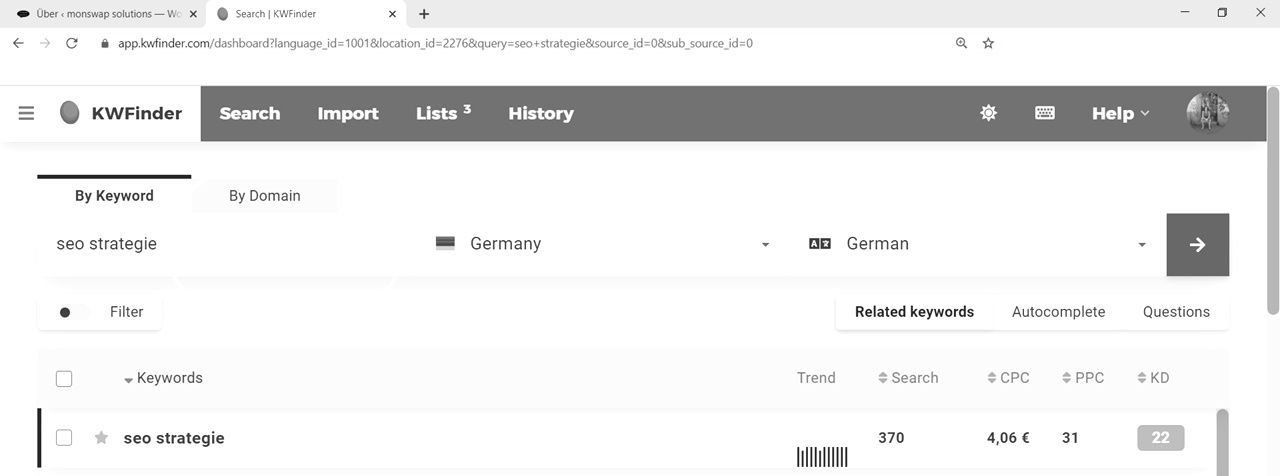
In my keyword research, I consider various factors: search intent (SIO), search volume and trends. And of course, what your competitors are doing.
Based on this, I develop a customized keyword strategy. To do this, I group synonyms and keywords with the same search intent.
4. Develop an SEO concept (This is how we proceed)
I'm now "translating" this keyword strategy and developing a concept for SEO content creation. In it you'll find information such as:
- Which search terms are generally relevant for your online marketing (“content prioritization”).
- Where can you start and in what order should you create (or have created) content for which keywords?.
- For which keywords do you need cornerstone content, and what content length is appropriate for the other keywords?.
- Which of these search terms is best suited for which type of content: blog post, landing page, product content, etc.
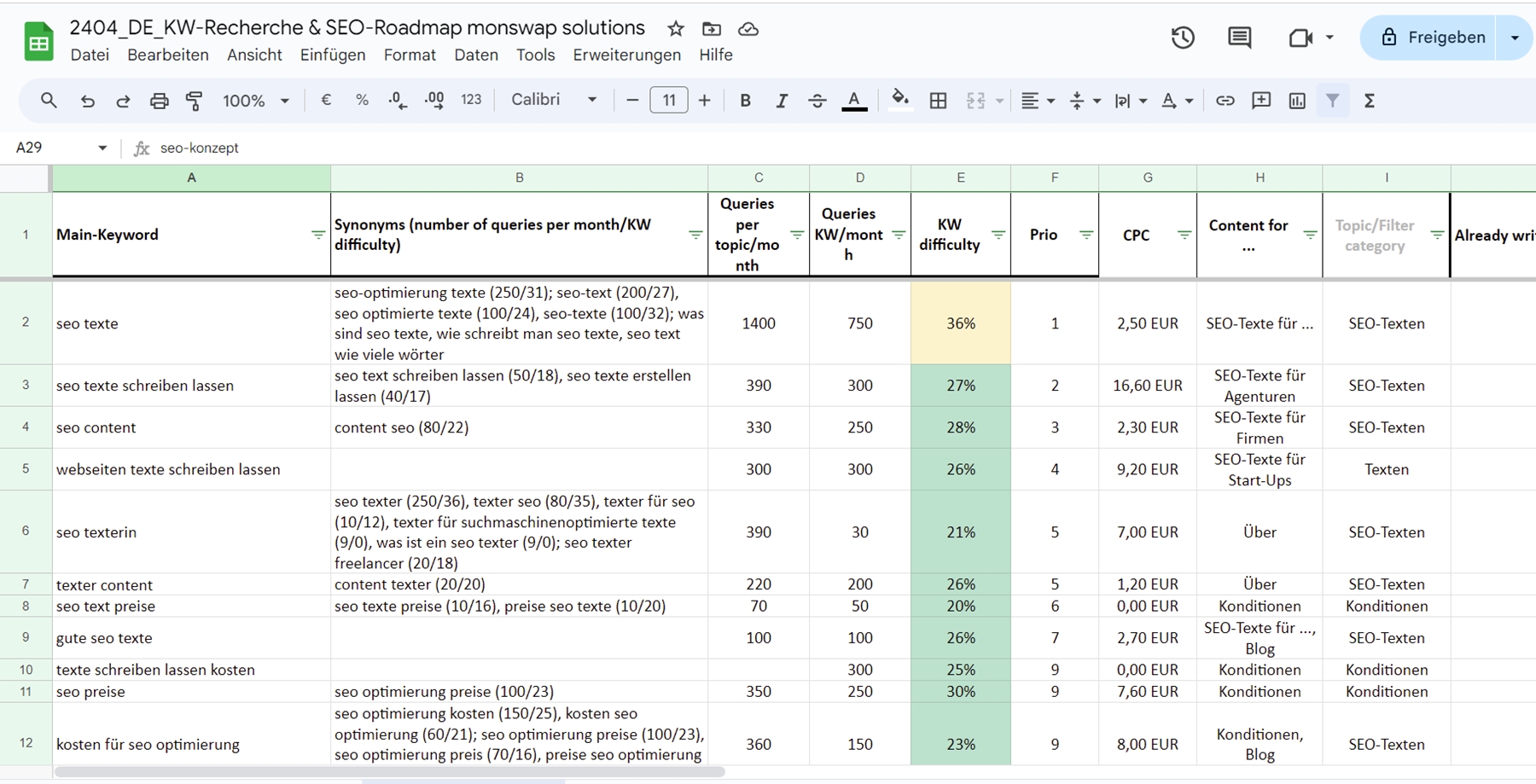
With this SEO content concept, you now have a guide at hand. You can build your SEO content strategy on this foundation, ensuring that your new content is relevant for both search engines and your users.
5. Define strategy and specific measures
Now we'll sit down together and create a concrete action plan based on budget, resources, and timeline. We'll develop processes, define responsibilities, and establish the specific steps for the "Content SEO Strategy" project. Specifically, we'll ask ourselves questions like:
- Who does which task, when, where, and how? From SEO content and image research to project management, translations, setting up a Google My Business account, newsletters, or web design…
- Which tasks can you handle internally, and where does it make sense to outsource tasks?
- Which content-related and conceptual topics belong at which point in the content strategy?
- Which tools would you like to work with?

For this final step, most of my clients choose an (online) workshop where I meet with all decision-makers and stakeholders.
5 ½. Implementation
Congratulations: Your brand-new SEO content strategy is now complete! Now it's "just" a matter of putting it into practice over the coming weeks and months. This means buying or writing SEO content, measuring their success, and continuing to drive their success in the long run.
Developing an SEO content strategy: Here's how I can support you
As a consultant, I develop content SEO strategies for companies on a daily basis. This sometimes involves emails in the form of questionnaires, sometimes SEO workshops, or (virtual) live meetings. I'm also happy to support you in implementing the strategy, for example, by revising existing content, creating new SEO content, or handling SEO translations.
Monika Weber on LinkedIn

How do you know you need a content strategy?
You have a blog, but you don't know how to fill it with content that customers will actually read (let alone share)? "Would a newsletter a good idea?" you've been wondering for months.
Perhaps your company is also planning a relaunch and you need SEO content or a sensible structure for the new website. Relevant content that you and your colleagues could easily share on LinkedIn or other social networks would also be very useful…
If you find yourself nodding along to one or more of these points, then it's a fact: creating a content and SEO strategy is now the next logical step for you.
Why an SEO content strategy?
Why does a company do anything at all? To increase revenue, obviously. With a professionally developed content strategy from an SEO consultant, you a) save costs and b) increase your profit.
a) Save costs
Without an SEO content strategy, you'll invest time and money to create or have created content for your blog, website, or social media. Unfortunately, nobody knows whether this content will actually convert (turn prospects into customers).
Because without a concept, there's no measurability. A large portion of your costs and working time is therefore wasted – no one can say why or where it goes. It's a completely different story if you approach your content strategically.
b) Increase profit
If you work according to a professional content SEO strategy, your marketing team only uses content that actually resonates. No wasted time, no unnecessary extra work. Instead, measurable results: more visibility ("impressions"), more website visitors ("traffic"), more clicks and interactions from your customers ("conversions").
If you approach your content marketing conceptually and strategically, it will advance your overall business goals. Instead of just being one part of the marketing mix that's "there," your website, with a perfectly tailored strategy, will increasingly contribute to increasing your revenue.
Do you have your own experiences, tips, or questions about developing a content SEO strategy? Share them! I look forward to your feedback.
What clients ask me about SEO & content strategy…
How do I know if I need a content strategy for my website?
You have a blog, but you don't know how to write blog posts that your customers will actually read—and take action on? Have you been wondering for months, "Would a newsletter a good idea?"
Perhaps your company is planning a website relaunch and you need SEO content, a content audit , or a logical structure for the new site.
Of course, engaging content in all relevant languages that you can share on LinkedIn or other relevant social networks is always a good idea…
If you're nodding your head right now, a content and SEO strategy is the next logical step.
Is an SEO strategy worthwhile for my website?
Counter-question: Do you want to be found on Google? I'd say yes. Otherwise, you wouldn't be here. In that case, an SEO content strategy for your website makes perfect sense.
Organic SEO works particularly well when you approach it strategically. How is that evident?
- Your website will be found for the exact search terms (keywords) you want to rank for. For example, "suspenders for children", "spa with swimming pool" or "ski hotel in the Allgäu".
- Your content meets or even exceeds your visitors' expectations: Someone searching for "suspenders for children" wants to find exactly that, not men's belts.
- You know exactly what your competitors rank for and why. Because they also want to be found on Google. You know their strengths as well as their weaknesses. And you strategically overtake them from the right (or left) with unique content
- Does content cannibalization mean anything to you ? If you've been doing content marketing for a while, you'll eventually notice that, for example, your blog posts keep revolving around the same topics. They use the same keywords, thus stealing visitors from each other. A clear case of content cannibalization – something that won't easily happen to you with a content strategy.
If your site doesn't yet meet all these points, now is the right time for a content SEO strategy.
This allows you to cleverly cover all relevant topics in the long run and keep your users happy – without repeating yourself.
How do I develop an SEO content strategy?
You can create a content SEO strategy in, for example, 5 ½ steps:
- SEO Content Audit
- Vision & Mission
- Keyword research
- SEO concept development
- Strategy Roadmap
(+ Creating content, which technically goes beyond pure strategy. Nevertheless, it's part of it).