
How to combine SEO with content marketing


How to combine SEO with content marketing
The time has come: SEO and content marketing will finally merge in 2024 to form SEO content marketing – practically the hottest thing in digital marketing. This brings together what has long belonged together: search queries and the relevant content across all marketing channels. How does it work? In this article, I've put together a guide for you: "How to SEO Marketing in 6 Steps.". Take 7 minutes to read, catapult your website to the top of Google and boost your sales. Let's go!The time has come: SEO and content marketing will finally merge in 2024 to form SEO content marketing – practically the hottest thing in digital marketing. This brings together what has long belonged together: search queries and relevant content across all marketing channels. How does it work? In this article, I've put together a guide for you: "How to SEO Marketing in 6 Steps." Take 7 minutes to read, catapult your website to the top of Google, and boost your sales. Let's go!
What you can expect in this post
The role of SEO in content marketing: A simple definition
Imagine: The internet is a huge shopping mall. Search engine optimisation (SEO) places your business at the very top of Google's search results. This way, potential customers find what they're looking for at first glance – right on your website.
This is the first step to bringing visitors to your website.
Content marketing perfectly complements this approach. Newsletters and various social media platforms allow you to bring customers who have already shown interest back to your website. In our shopping center analogy, they essentially enter through the "side entrances"—no less valuable, but precisely targeted.
SEO content marketing combines these two approaches: It ensures that your business not only attracts new customers through its shop window, but also specifically invites existing customers to make repeat purchases.
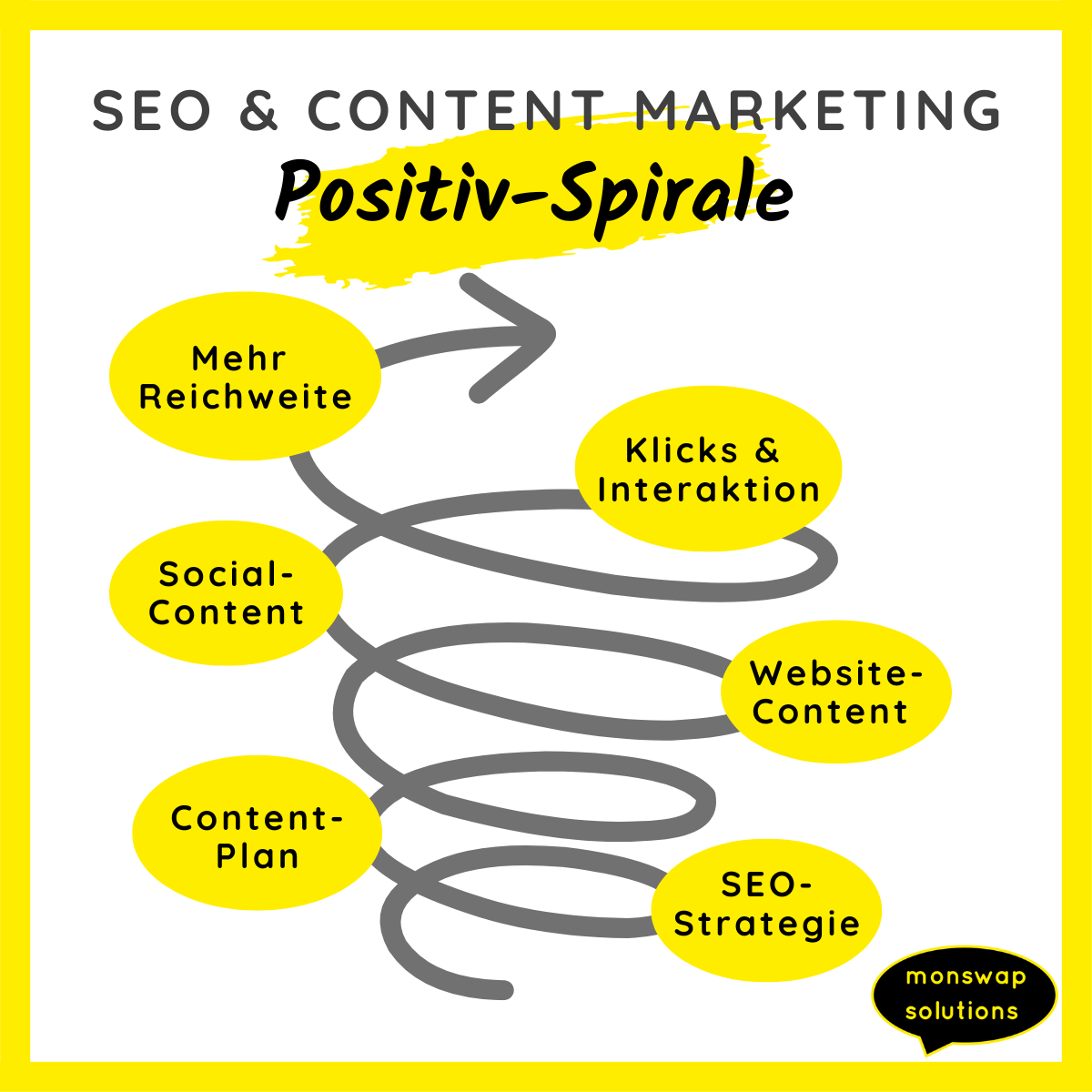
And: Through clicks and interactions from these "side streets," Google receives positive user signals in turn. So, through content marketing, your site also ranks better in terms of SEO. A perfect cycle.
By combining SEO and content marketing, you can increase your conversions in the long term – and thus your revenue. Here's how it works in practice.
The 6 steps of the positive spiral: How to bring SEO and content marketing together
In six concrete steps, I'll show you how I combine SEO and content marketing in my daily work as an SEO consultant.
Step 1: Keyword research – The foundation for your success
Keyword research is the first and most important step towards SEO content marketing.
In our online shopping center, keywords are the signs that guide customers to the right stores: They show potential buyers where to go and tell you a) what people are looking for, b) how often, and c) with what intention.
In practice, during keyword research, I collect approximately 50-500 relevant keywords – using SEO tools and common sense. For larger websites or online stores, this can sometimes amount to 1,000+ keywords (rarely significantly more). I then group these keywords thematically and search for all synonyms (keyword clusters) before ranking them from 1 to 100 according to their relevance to the entire website.
Experience has taught me that a keyword list without clustering and prioritization isn't worth much. Don't waste your money on it!
Solid keyword research lays the foundation for successful content that reaches exactly where your customers are searching.
Step 2: Topic architecture – How to bring structure to your content
Every company has structures. The challenge now is to a) identify these structures and b) define them based on SEO and usability criteria.
Sounds abstract? Here's an example:
An online shop sells sweets. Most customers who click on the online shop buy either chocolate, gummy bears, or hard candies. In this case, "sweets" would be the overarching theme, and "chocolate," "gummy bears," and "hard candies" would be subcategories that could later be found on the website, for example, as shop categories or filter categories in the blog. Under "chocolate," for instance, you would find the subcategories "chocolate pralines" and "chocolate bars.".
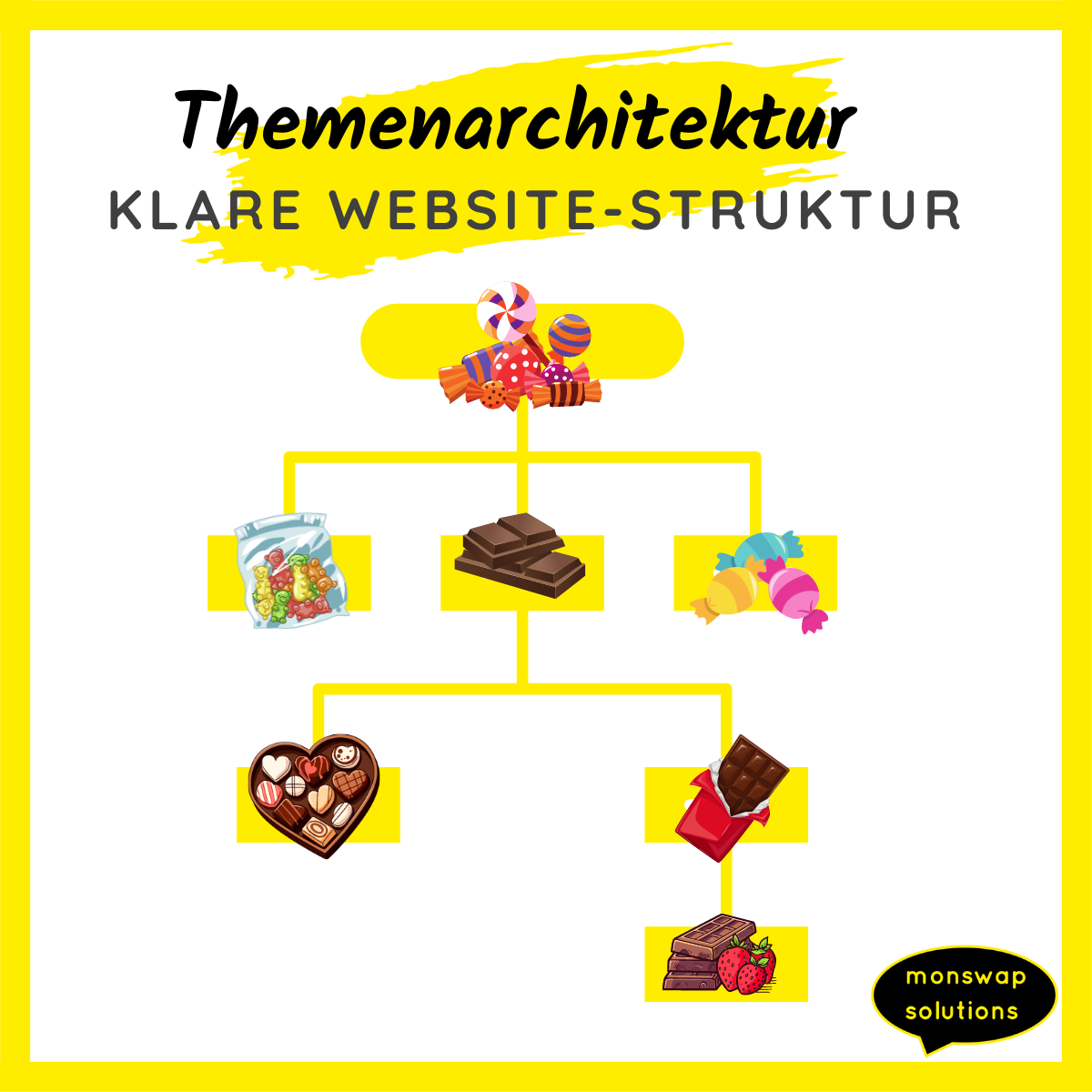
So far, so good. But back to the themed architecture.
SEO is wonderfully data-driven. We can now specifically decide which shop category is displayed first in the menu by looking at the search volume: the more people search for it, the higher it appears.
And so, from the needs of your users and SEO data, a user-friendly website structure is created that works for both users and search engines.
Step 3: Develop an SEO strategy – Reaching your goal with a plan
But back to the collected keywords. Now you divide your content according to the topic architecture into static pages, landing pages, and blog posts:
- Static pages are your fixed points of contact, e.g., "Services" or a category page for chocolate. You should optimize these specifically to rank well on Google in the long term.
- Landing pages rank for specific keywords. You can use them to generate targeted traffic for specific offers and also run ads on them (SEA).
- Blog posts, on the other hand, serve to deliver new content regularly. They target relevant keywords with lower search volume or long-tail keywords, or they respond to current search queries.
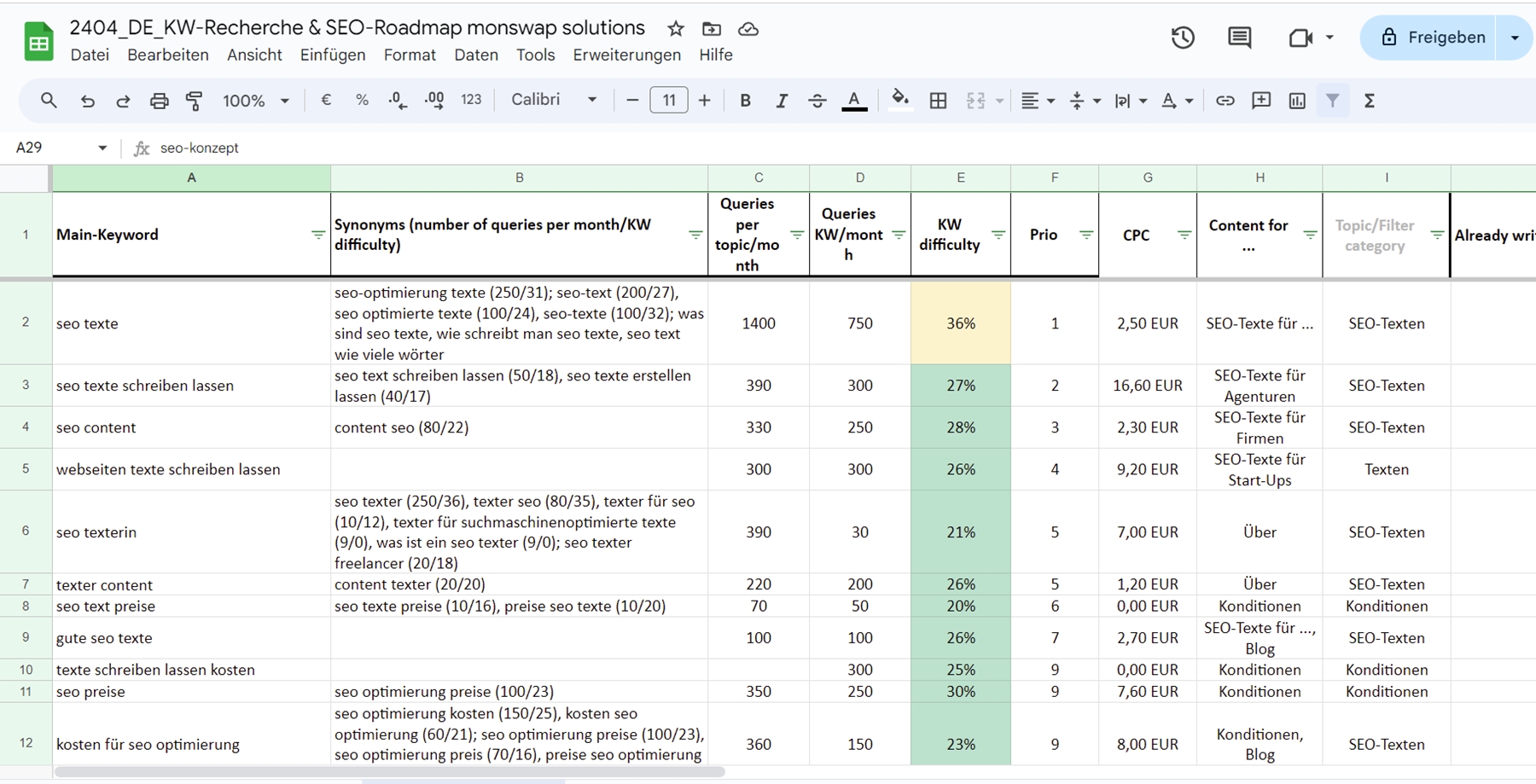
Depending on relevance, you can assign a suitable page to each keyword cluster. With such an SEO strategy , you ensure that every SEO content precisely targets the right keywords (keyword: content cannibalization) and that all pages contribute to the same, overarching goal.
Keywords are, incidentally, the basis for content production: they not only inspire the topics for your blog posts, but also determine the content creation for other formats and channels.
This is how your SEO content marketing becomes structured and efficient: Your target group finds exactly what they are looking for – in exactly the right place.
Step 4: Editorial plan for content marketing
A detailed editorial calendar is the ideal place to coordinate SEO content with other content formats – be they blog articles, social media posts, or newsletters. In it, you define exactly,
- when which content is published
- on which channel
- to what extent
- who is responsible
- whether there are dependencies.
You maintain an overview, know exactly when each piece of content goes live, and can react flexibly to changes. This plan gives you control over all channels and enables you to work purposefully as a team. Furthermore, you can use it as a basis to manage service providers such as SEO copywriters or web designers on schedule. This ensures that the entire content production process is optimally coordinated and runs smoothly. A powerful tool!
Furthermore, you always have an overview of which topics already have content, where there are gaps, or which content is outdated and needs to be revised.
Use tools like Trello, Asana or a Google Sheet to clearly organize your editorial plans and keep everyone on the team up to date.
With a clearly structured editorial plan, your SEO content marketing will be planned and implemented efficiently.
Step 5: Content production for various channels – creating added value that gets clicks
Now it's time to write. You create various content formats that are precisely tailored to your target audience – or have these content written by a professional:
- Static pages form the basis by providing detailed information and contributing to relevant keywords.
- Blog posts target long-tail keywords, informational search queries, and important secondary topics, thereby boosting organic traffic.
- Social media posts create reach on platforms like LinkedIn, Instagram or Facebook and bring traffic from there to your website.
- Newsletters summarize the most important content and directly engage your existing customers.
- Landing pagesprovide information on specific topics, are coordinated with your ad campaigns, and directly aim for conversion.
Each format serves a specific purpose in your SEO content marketing strategy – they all contribute to a common goal: creating added value that resonates with your target audience. And as a reward, ranking highly on Google.
Speaking of ranking highly: SEO content marketing also includes content maintenance. This involves regularly reviewing your content, using feedback, and adapting them to new insights and developments, updating keywords, and adding graphics or images. This ensures your content marketing remains future-proof.
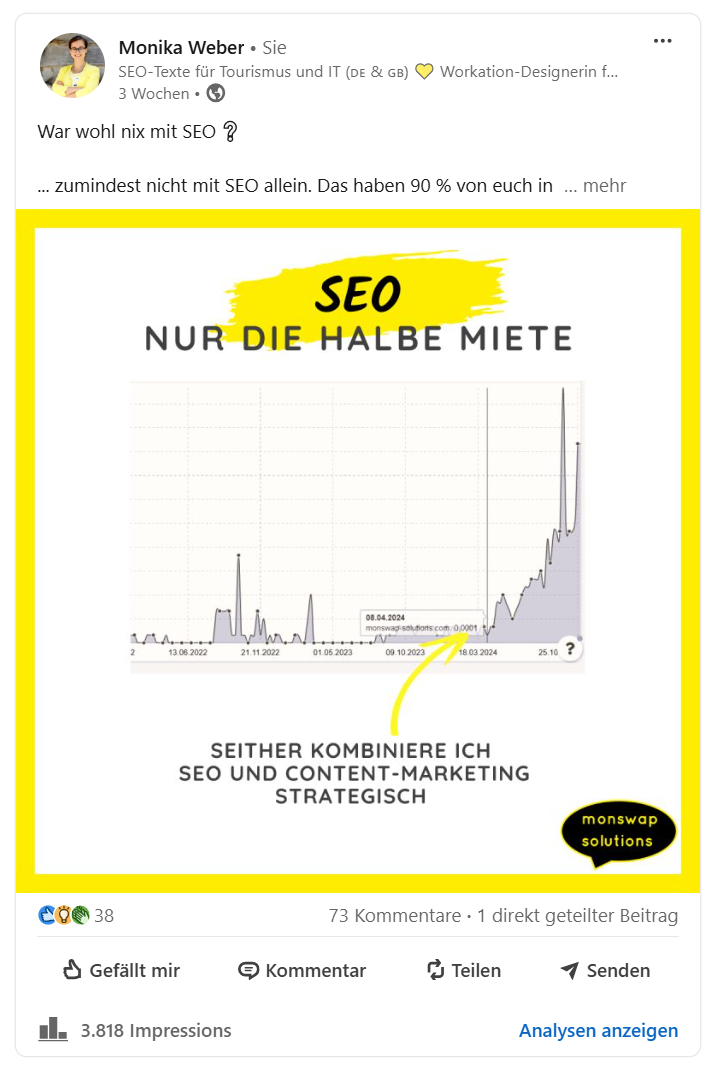
Step 6: Monitoring & Reporting: So you know what's working
Once the content goes online, you should use monitoring and reporting to measure the success of both SEO and content marketing:
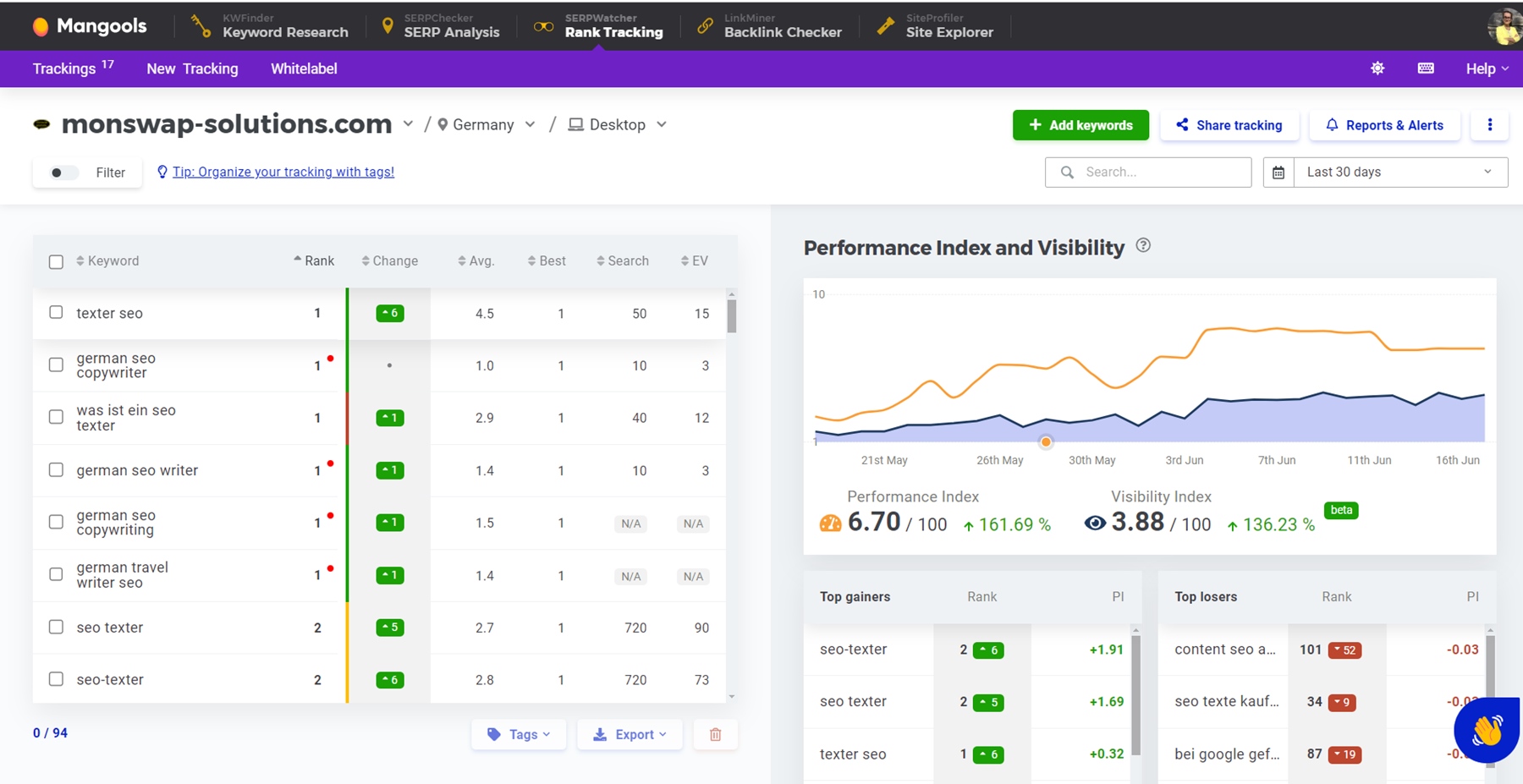
- Long-term monitoring allows you to track how well your keywords rank, which pages generate the most traffic, and which generate the highest revenue (conversion rate). This data provides valuable insights that enable you to accurately determine your ROI (Return on Investment) for SEO and content marketing.
- Clear and concise SEO reports allow you to summarize this data in a structured way, enabling you to make informed decisions and justify your budget. The ROI included in these reports clearly shows you which measures are truly worthwhile. You also gain insights into important KPIs such as the number of top 10 keywords, domain authority, and conversion rates.
This information shows you what works and where you should make adjustments to continuously improve your SEO and content marketing strategy and remain successful with your website in the long term.
How to get even more out of your SEO content
SEO and content marketing only reach their full potential when all channels are interconnected: A well-thought-out editorial calendar acts as a central hub, coordinating website content with social media posts – and even linking SEO with newsletter campaigns to achieve maximum reach (and impact). Sounds good? Read on!
Social media and SEO content: A powerful combination
On social media, you can share your elaborately produced website content or repurpose it in thematically organized snippets. The more thoughtful your approach, the more effective your SEO and content marketing will be.
A win-win situation, right?
When visitors come to your website via social networks, these social signals send additional positive signals to search engines. This not only improves your ranking but also ensures that your positive spiral accelerates even further: More traffic through content marketing leads to better SEO rankings.
Think in terms of topics and prepare your content – in a coordinated way – specifically for different platforms. B2B content works exceptionally well on LinkedIn for technical articles and in-depth insights, while in the B2C sector, depending on the target audience, platforms like Instagram or TikTok are suitable for visual content and storytelling.
You know best which channels are relevant for your business.

Newsletter marketing: How to benefit from SEO content
Newsletters are a powerful tool for providing your existing customers with valuable information: You can seamlessly combine topics from your blog, website, or social media into a valuable newsletter and reach an even larger target audience with the same content. Including links to your website generates additional traffic.
A well-thought-out newsletter plan, which you've aligned with your SEO content marketing strategy beforehand, will significantly increase the success of your entire email campaign. Experience shows this. It also saves you time, energy, and budget.
And now?
The best time to start is today: Take one of your most successful SEO-optimized blog posts and create 3-4 social media posts and your next newsletter around the same topic. Good luck!
And if you need support: you know where to find me.
What clients ask me about SEO & Content Marketing…
SEO content marketing combines two sub-areas of online marketing: SEO and content marketing. Based on relevant search terms (so-called keywords), content is created for various channels that precisely addresses the needs of the target group.
Both terms essentially mean the same thing. However, the term "SEO content marketing" is used more frequently. How do I know this? My SEO tool told me: about 20 times more people search for "SEO content marketing" than for "content SEO marketing."
Previously, "SEO content" was often associated with poorly written content, which still causes skepticism for some. Today, however, SEO content means high-quality, user-friendly content that is also optimized so that search engines can easily index it.
Content marketing focuses on creating content based on target audience analysis, experiences, or surveys. The goal is to produce valuable and relevant content that resonates with the target audience.
SEO marketing, on the other hand, optimizes this content specifically for search engines to improve its search engine ranking.
SEO content marketing combines both approaches: Every content and image is created based on detailed keyword research and a clear SEO strategy. This means that content is only produced when there is a concrete demand for it, ensuring it is both valuable to the target audience and easily discoverable by search engines.
SEO content fits well into your marketing strategy, especially if you want to grow online. Whether you
want to drive more customers to your online shop
, increase bookings for your services, or
improve the visibility of your physical business,
SEO content will help you achieve these goals. So, if your strategy focuses on greater visibility and engagement, SEO content marketing isn't just a good choice, it's an excellent one.