
Implementing a GEO strategy – here's how to get started


Implementing a GEO strategy – here's how to get started
Will AI systems recommend your brand? Without a GEO strategy, that's difficult. As a GEO consultant, I'll show you how I create such a strategy for my clients: first, clarifying the SEO fundamentals, then querying the AI search criteria, adapting the content strategy, suggesting on-page and off-page optimisations, and measuring the strategy's success. I'll also reveal my GEO tools and show examples from current client projects. Whether you're a medium-sized business, a start-up, or an online shop – this approach works for every website. Invest 7 minutes of reading and build your own GEO strategy that will get your company recommended by AI systems.Will AI systems recommend your brand? Without a GEO strategy, that's difficult. As a GEO consultant, I'll show you how I create such a strategy for my clients: first, clarifying the SEO fundamentals, then querying the AI search criteria, adapting the content strategy, suggesting on-page and off-page optimisations, and measuring the strategy's success. I'll also reveal my GEO tools and show examples from current client projects. Whether you're a medium-sized business, a start-up, or an online shop – this approach works for every website. Invest 7 minutes of reading and build your own GEO strategy that will get your company recommended by AI systems.
What you can expect in this post
Current situation: Doing SEO homework
Although I would like to tell you something different: AI systems like a clean website structure and helpful content just as much as classic search engines.
With a sound SEO strategy and a content plan that you consistently implement, you have the best prerequisites for a successful GEO strategy.
I would like to make one caveat: GEO places significantly more emphasis on a consistent message across all channels than traditional search engines do.
Therefore, check off the following SEO tasks:
- keyword research and assign keywords to the pages.
- Create (or have someone create) an SEO strategy
- Maintain metadata cleanly
- Check and update internal links
- Update content
- Check Schema.org data
- Check and update external links if necessary
Once SEO is in place, you can "add" the GEO strategy on top.
Side note: How AI systems search
AI systems like ChatGPT, Google AI-Overviews, or Microsoft Copilot work systematically when searching for products: They search for a main term in combination with various criteria. For me, as a GEO consultant, this could be, for example, "GEO strategy" + for the DACH region/B2B companies/online shops/IT industry.
There are usually several search criteria, such as industry, language area, and intended use. For products, additional criteria such as size, price range, and features are also considered.
And each of these search criteria should find a place in the GEO strategy where it is covered: On-page, this includes landing pages, blog articles, and the "About" page. Off-page, this includes review platforms, the Google Business Profile, and social media presence.
The GEO strategy determines where each type of content resides.
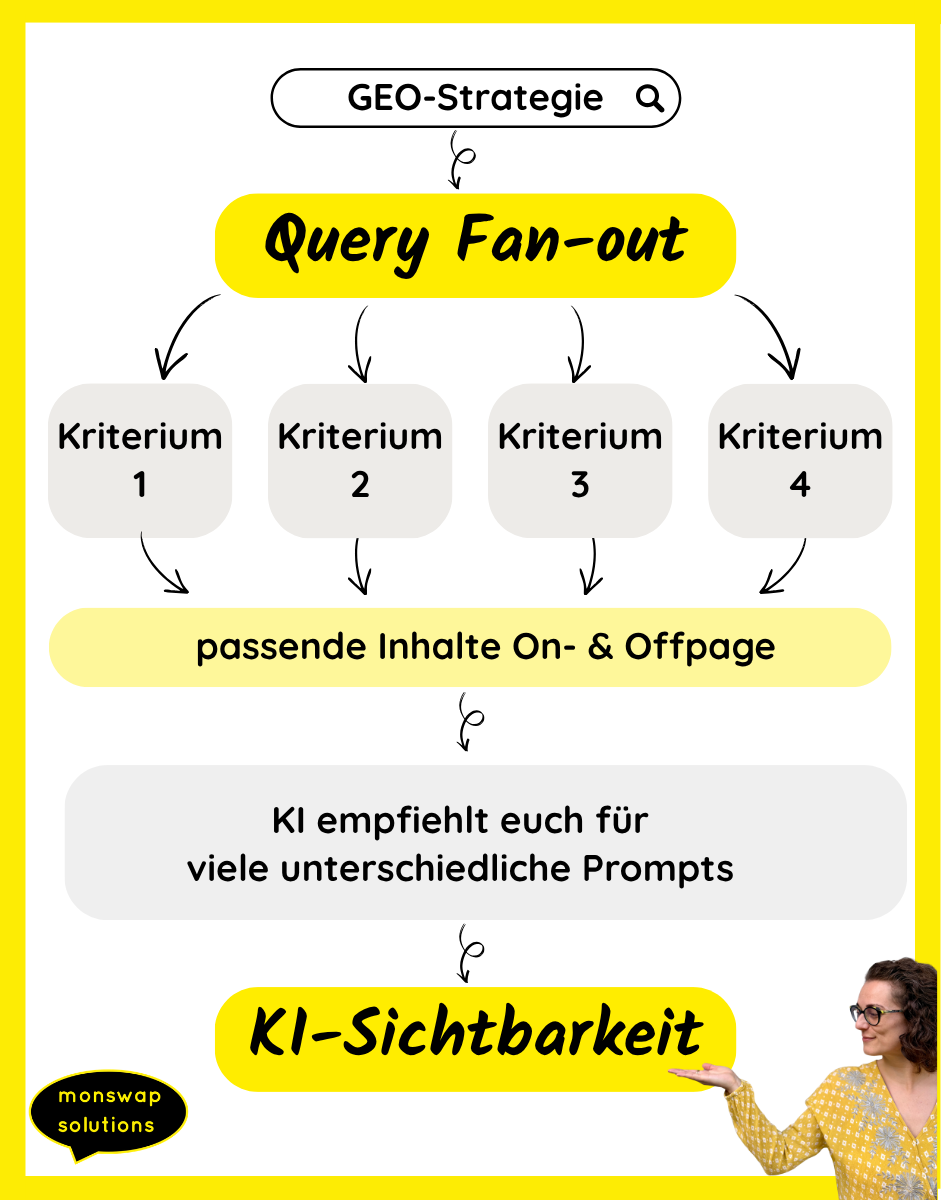
This is how I create a GEO strategy for my clients
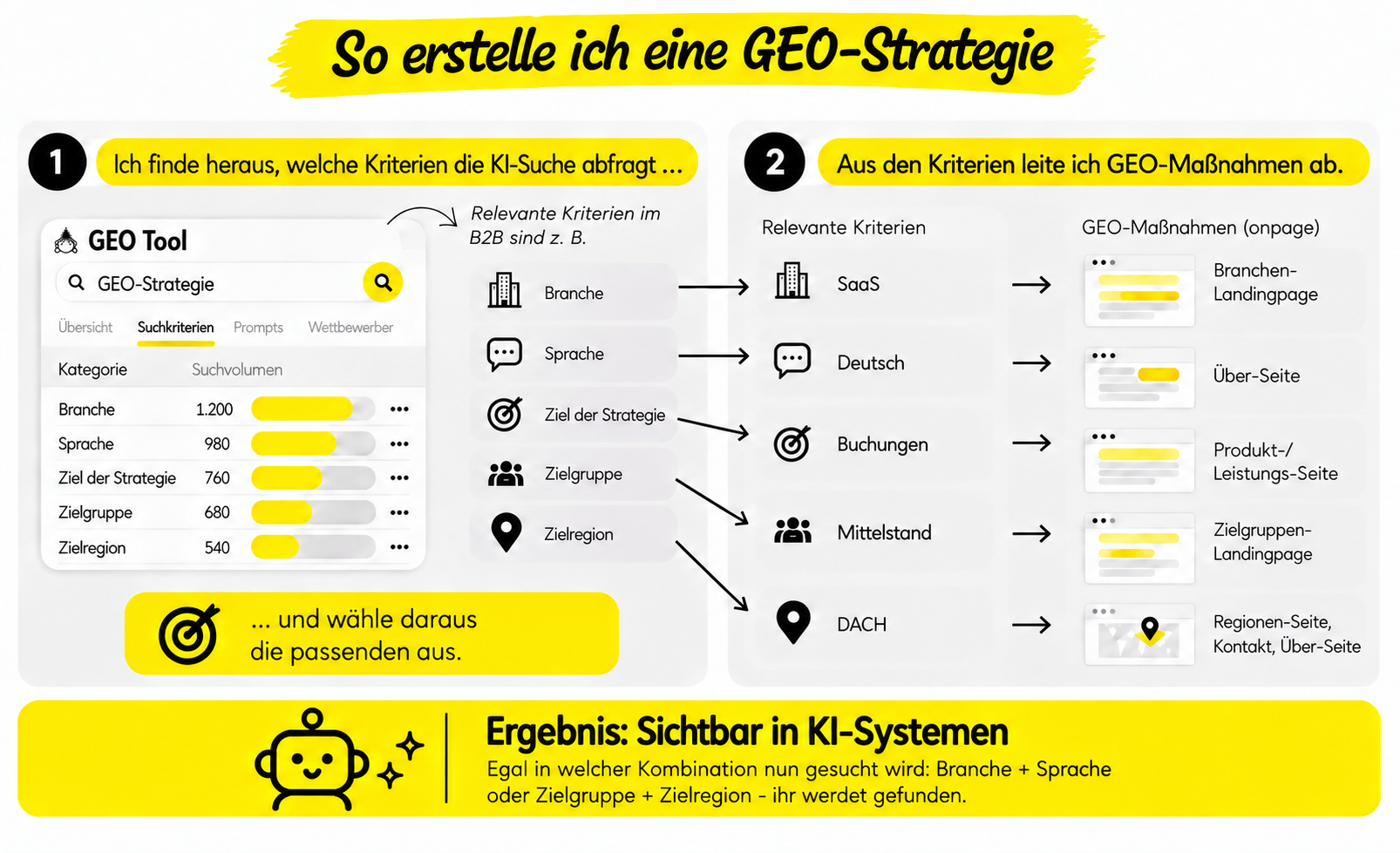
1. Query search criteria from the AI search
Enter your focus keyword from your SEO strategy into your GEO tool. (Before you ask: I tested eight tools last year, and the only one I can actually use effectively is JOE. This tool was developed by two pioneering GEO experts and is designed for practical application. It's also constantly being updated, so you can rely on it. I love it.)
The tool shows you the search volume for your focus keyword – and the categories it's searched for in combination with. Using "GEO strategy" as an example, these categories would be industry, language, strategy goal, target group, and target region.
From these, I then select the criteria that are relevant for me (or my clients). In my case, these are the target industries SaaS and IT, the language German, my goal is bookings as a GEO consultant, and my target groups are B2B companies from the SME sector and startups.
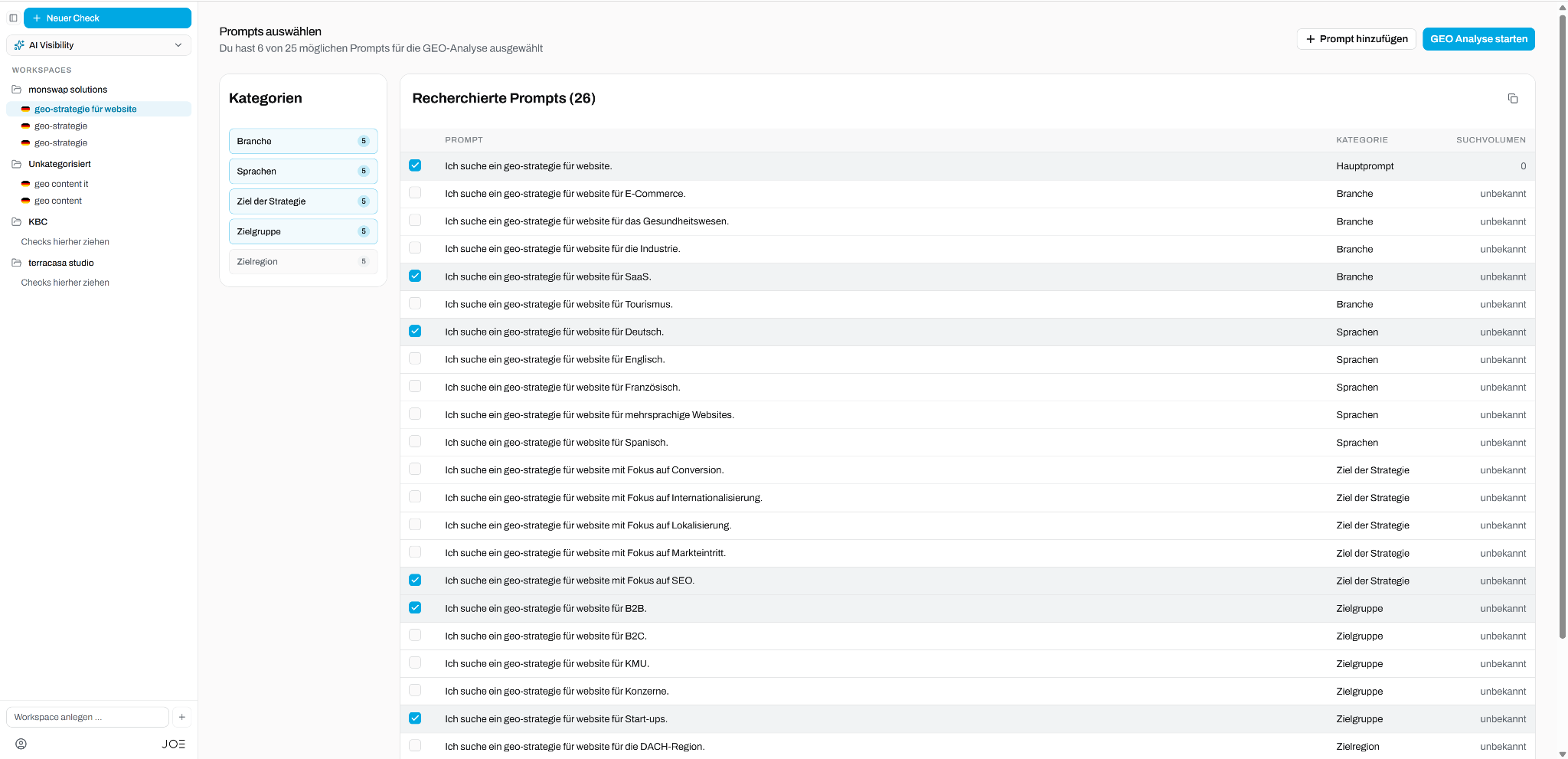
2. Supplement content strategy with GEO measures
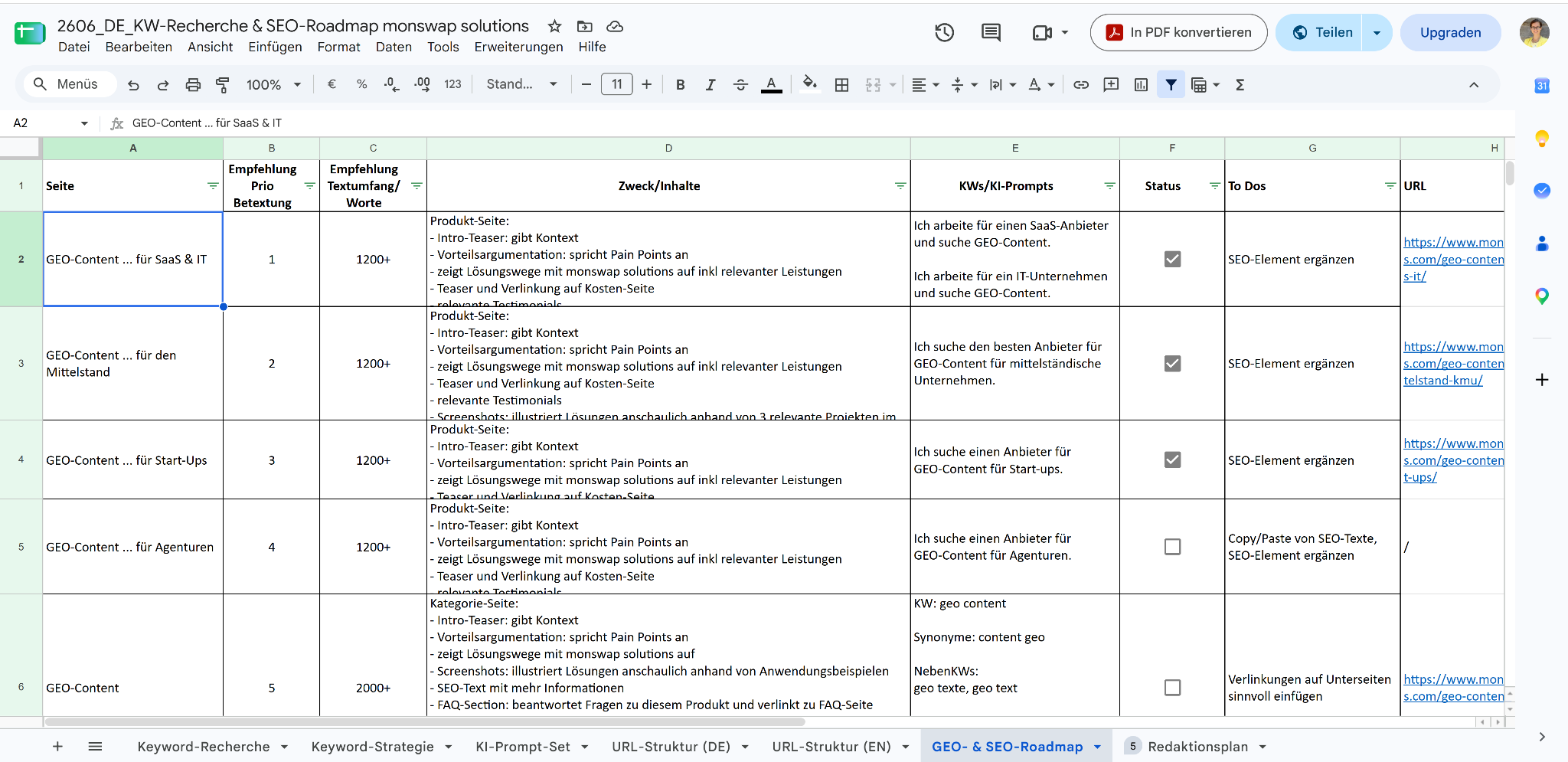
In my existing SEO strategy, I have already defined which pages my website needs. These are part of my SEO roadmap.
For the GEO strategy, I first check which pages my roadmap already includes. Is this criterion already covered on one of the pages in the SEO roadmap? If so, I add the corresponding AI prompt to the briefing for that page.
If not, I'll consider: Where can I meaningfully add this criterion?
In my example, I have covered the German language on my About page , the target group of B2B companies from the Mittelstand and start-ups each have their own landing pages with quotable content passages and FAQs, as do the target industries SaaS and IT.
(The target industries were not part of my original SEO strategy. I have now added them as part of the GEO strategy.)
Based on the roadmap, your content team can now gradually begin implementation.
3. Optimize on-page
For a good GEO strategy to be successful and for AI systems to recommend you, there are further adjustments you can make to your website:
- Fixing technical problems: Redirect chaos, endless loading times, and multiple 4xx error messages? Neither Google nor AI search likes them.
- Fix SEO errors: Missing H1 headings, duplicate meta descriptions, and overly long URLs – there are better ways to improve this. Fixing all these things will benefit your visibility in both SEO and GEO.
- Properly set up your multilingual capabilities: Are all your language versions consistent in terms of content? If not, now is the time to clean things up. If AI systems are pulling their information from an English press release from 2019 instead of your current product page, your product could be immediately removed from AI recommendations.
I've put all these technical topics into a separate tab in the GEO strategy. Together with the contact person for technical GEO, we'll work through them one by one.
4. Optimize off-page
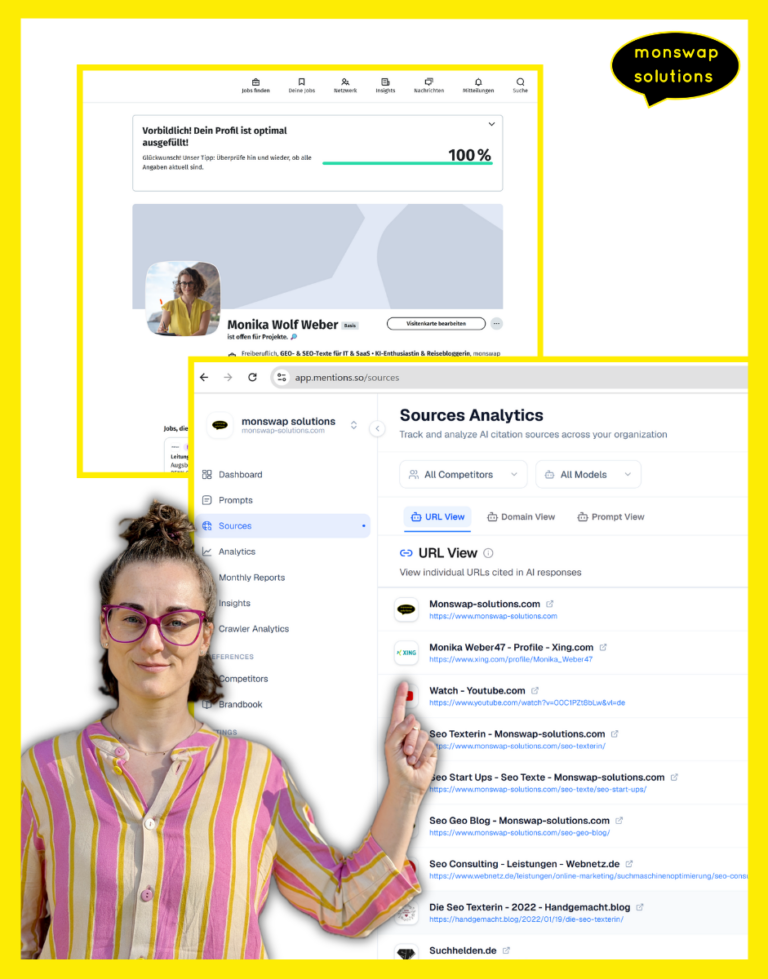
The beauty of GEO tools: Where SEO tools only allowed assumptions about the algorithm, GEO tools show very concrete sources.
In the SEO world, I interpreted data based on experience and tested what happened. GEO tools, on the other hand, show precisely which sources are important for the defined focus keyword – and which ones we can still improve
- Some off-page sources are universal: Your Google Business Profile should not only be up-to-date and well-maintained, but its wording should also align with the rest of your brand. Similarly, the company description on all social media profiles, review platforms, associations, etc., should always be consistent and also contribute to the focus keyword.
- Additionally, there are individual sourcesthat boost your visibility: YouTube, TikTok, LinkedIn, comparison platforms, etc. Which ones are right for you? A detailed look at the GEO tool will tell you.
These off-page measures are part of any good GEO strategy.
5. Monitoring, Reporting, Repeat: How to measure GEO success
Now comes the crux of the matter: The best GEO strategy is only as good as the results it delivers. "How do I measure the success of my GEO strategy?" is a common and valid question from clients. Therefore, I monitor the 25 most important AI prompts from each client project in my GEO tool.
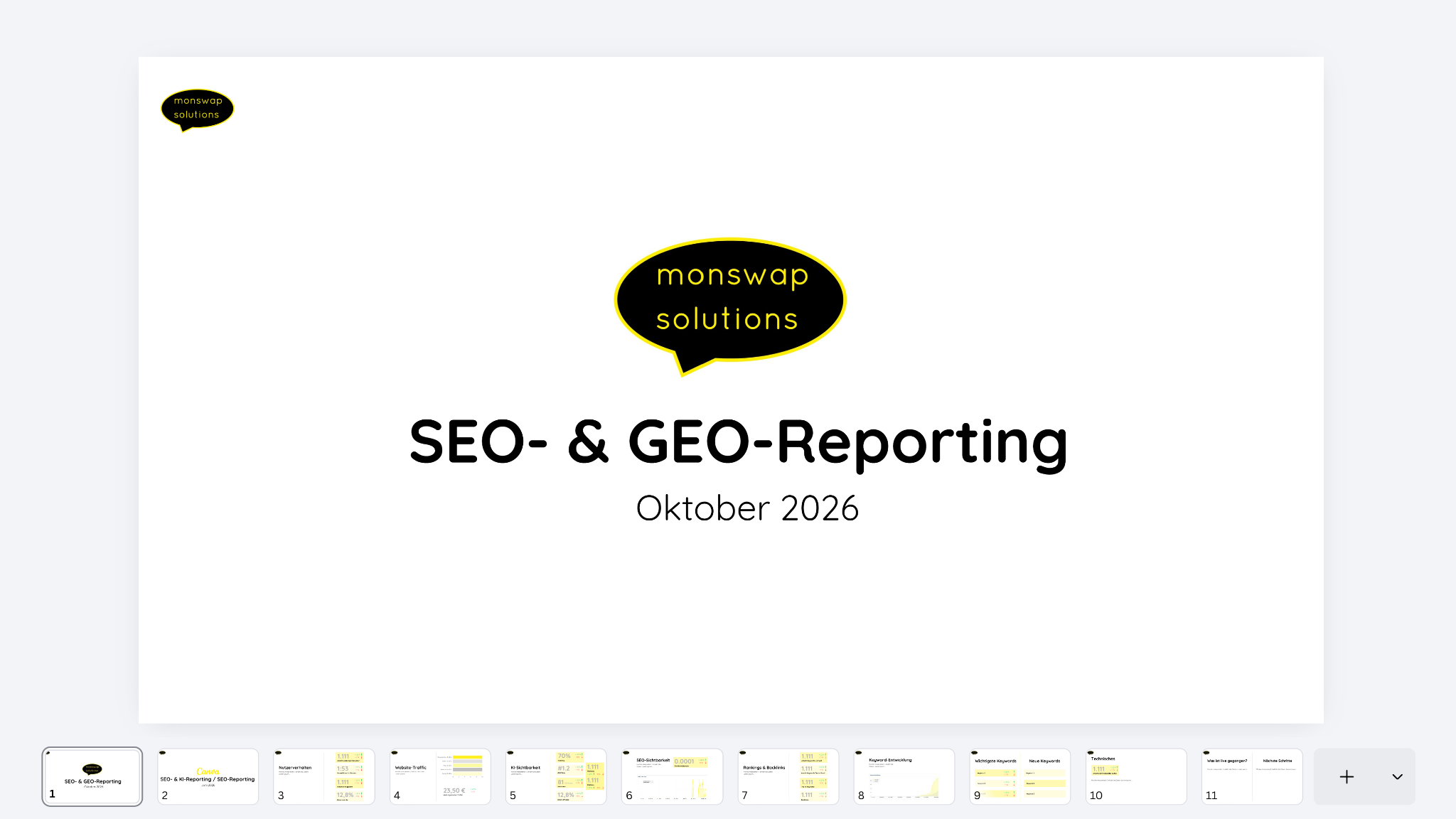
Every first Tuesday of the month, in my GEO-Reporting session, I discuss with my clients not only how their website is developing in terms of SEO.
Rather, I take marketing managers live into my tools and show them
- How the visibility of their website develops (Visibility).
- How their brand is perceived (sentiment).
- How often their brand is mentioned and their website is linked (Mentions/Citations).
- How they compare to the competition.
- What's happening off-page and which sources offer opportunities.
- How this relates to developments in SEO.
From this, we derive measures which we then incorporate into the GEO strategy and the content plan.
What does that look like with my customers?
GEO strategy & content for terracasa.studio
terracasa studio, Manching/DE
terracasa.studio is the website of a construction company specializing in premium patio covers in Bavaria.
For their website launch, I researched suitable AI prompts and, in addition to their SEO strategy, developed measures for AI optimisation. Based on this, I wrote GEO content that clearly describes their premium products.
Beyond the go-live phase, I regularly create GEO content and manage input and feedback from the client. Furthermore, as part of the monthly GEO support, I discuss upcoming actions with the client and brief external service providers regarding design and technical implementation.

Your next step?
Many marketing teams simply want a reliable, friendly sparring partner who can take the burden off their shoulders. That's exactly where I come in: I create your GEO strategy, write GEO content, and provide GEO consulting – either on an ad-hoc basis or as ongoing support that relieves the pressure on your marketing team and makes your brand visible in AI systems.
What clients ask me about GEO strategy…
Ideally, a GEO strategy complements your traditional SEO strategy, but goes beyond it:
It considers all relevant search criteria and tries to cover them so that your website is visible for as many variations of AI prompts as possible. And these can be as diverse as the questions people ask.
Furthermore, GEO strategies place even greater emphasis on clean off-page optimisation and citability.
According to the YouGov study "Searching for answers: How AI is changing online discovery in 2026," Generation Z (born in 1997 and later) already uses AI assistants as their second most frequent source of information: 49% prefer AI answers to traditional search results, and 56% even start at least one new search with them every day.
Therefore, the question isn't whether Google Search is coming, but when it makes sense for your brand to start using it.
Google Search becomes interesting when…
– your target audience is young or tech-savvy and already uses AI for searches;
– you sell something that requires explanation or is difficult to compare – SaaS, IT, consulting, travel;
– your on-page SEO is in place: clear structure, good content, clean positioning;
– you want to build a lead in Google Search before your competitors even start;
– your brand is already (somewhat) visible in AI search results.
Nodding along? Then I advise you to start optimizing for AI soon.
Not a definite yes? In that case, SEO fundamentals are probably the more sensible next step for you.
However, for that, I need:
a) Expert input from your company: The more I know, the better the SEO content will be. Knowledge transfer is quick and easy, for example, in a 10-minute video call.
b) Approximately one hour of your time each month so we discuss the editorial calendar and plan new topics.
c) Feedback on the content: This might take 30 minutes at the beginning, later reduced to 10 minutes per content.
And: If we work together long-term, the briefing process will become increasingly faster. After all, I'll then know your company, your product, and your writing style.
Use your time more wisely. Let me find the right words and drive your AI strategy forward.
Good question. To create a GEO strategy, I currently work with a mix of SEO and GEO tools:
JOE: prompt research, source work, and GEO monitoring;
Sistrix: classic search volume and relevant questions;
Ubersuggest: finding technical problems.
Additionally, I use Google Sheets to create the GEO strategy and share it with my clients.