
German SEO & Keyword Research: Find keywords, but do it right!


German SEO & Keyword Research: Find keywords, but do it right!
SEO keyword research? Forget the dry theory! As a German SEO consultant and copywriter, I'll show you in 3 easy steps how to find the exact keywords that will truly boost your reach. No unnecessary frills – just tools, tips, and real-world experience. Give me 5 minutes, and you can get started right away!SEO keyword research? Forget the dry theory! As a German SEO consultant and copywriter, I'll show you in 3 easy steps how to find the exact keywords that will truly boost your reach. No unnecessary frills – just tools, tips, and real-world experience. Give me 5 minutes, and you can get started right away!
What you can expect in this post
First of all: What makes SEO keyword research truly successful?
Many so-called keyword research projects consist of endless lists. These lists are unsorted and often full of (for you) irrelevant search terms. No one can do anything useful with them. Don't pay for that!
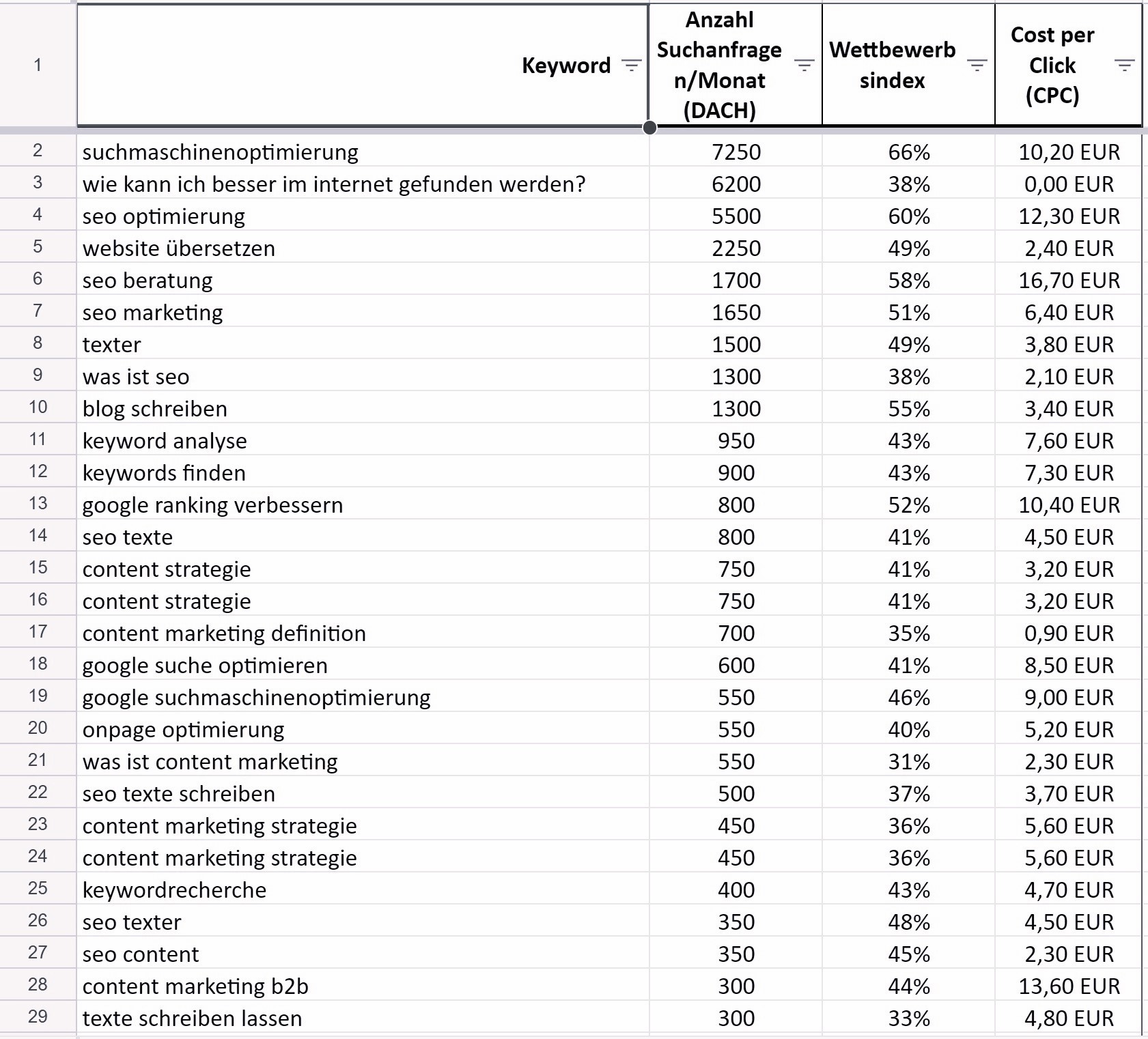
In a keyword research for SEO that's worth the money, you'll find the following three or four things:
- Relevant (!), thoroughly researched keywords including search volume and competition
- a clear order from important to less important
- Meaningful keyword clusters that reflect important topics
- Optional: Cost per click for SEA measures
I use these SEO keyword tools for research
There are countless SEO suites and specialized tools you can use for keyword research. There's no right or wrong way to do it – it's simply a matter of personal preference. The following keyword tools have proven effective for me:
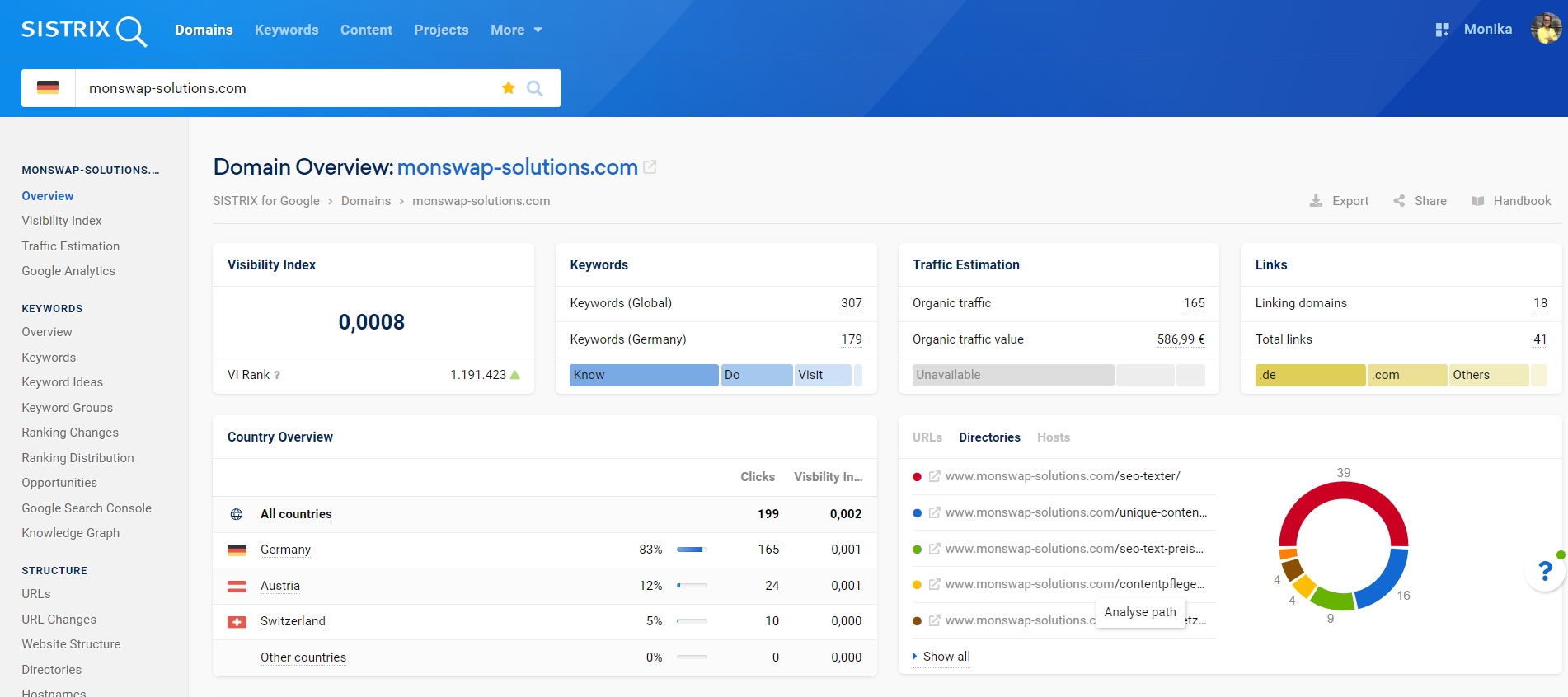
- Sistrix: Sistrix is an SEO suite that lets you cover pretty much everything from keyword research to monitoring and SEO reporting . I've been with Sistrix for ages and have a special contract for long-term customers. With that, I pay €153 per month. For you to get started, the starter package for €119 per month is sufficient.
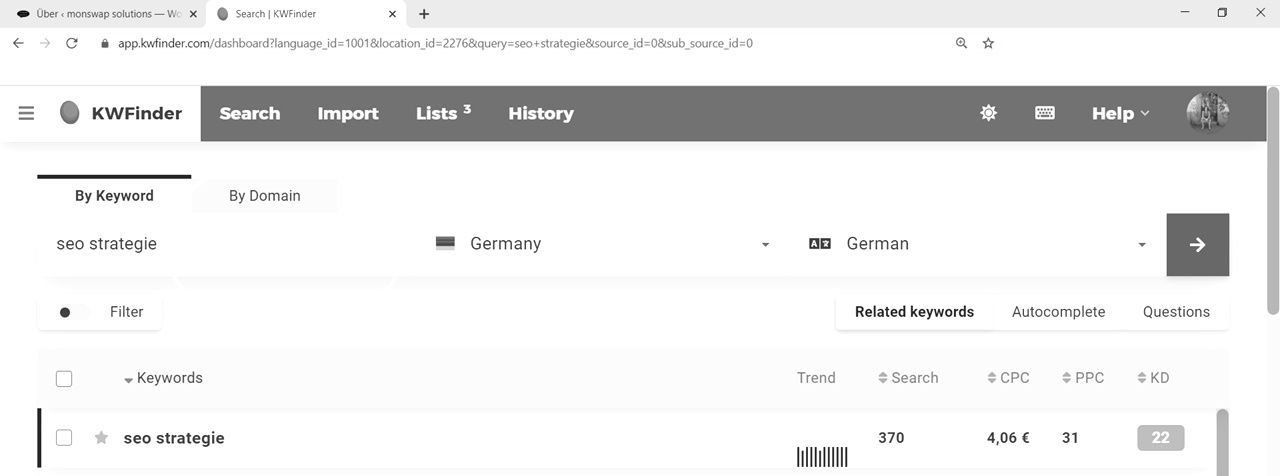
- Mangools' Keyword Finder: I enter keyword ideas into the Keyword Finder and get inspired by related keywords and questions. I pay €478.80 per year for my premium account. If you're just starting out with SEO: The basic account for €269.10 per year is perfectly sufficient to begin with. By the way, Mangools includes various apps that allow you to monitor rankings and optimize SERPs in addition to keyword research.
Of course, you can also find relevant keywords using free tools like the Google Keyword Planner or the Keyword Shitter . It's just more cumbersome and somewhat less accurate.
However, for me as an SEO consultant, working with paid tools makes my life easier.
Step 1: Find keywords
There are several ways to find relevant keywords. I always use all four of them. This ensures that I don't overlook any important search terms and that my keyword research is comprehensive.
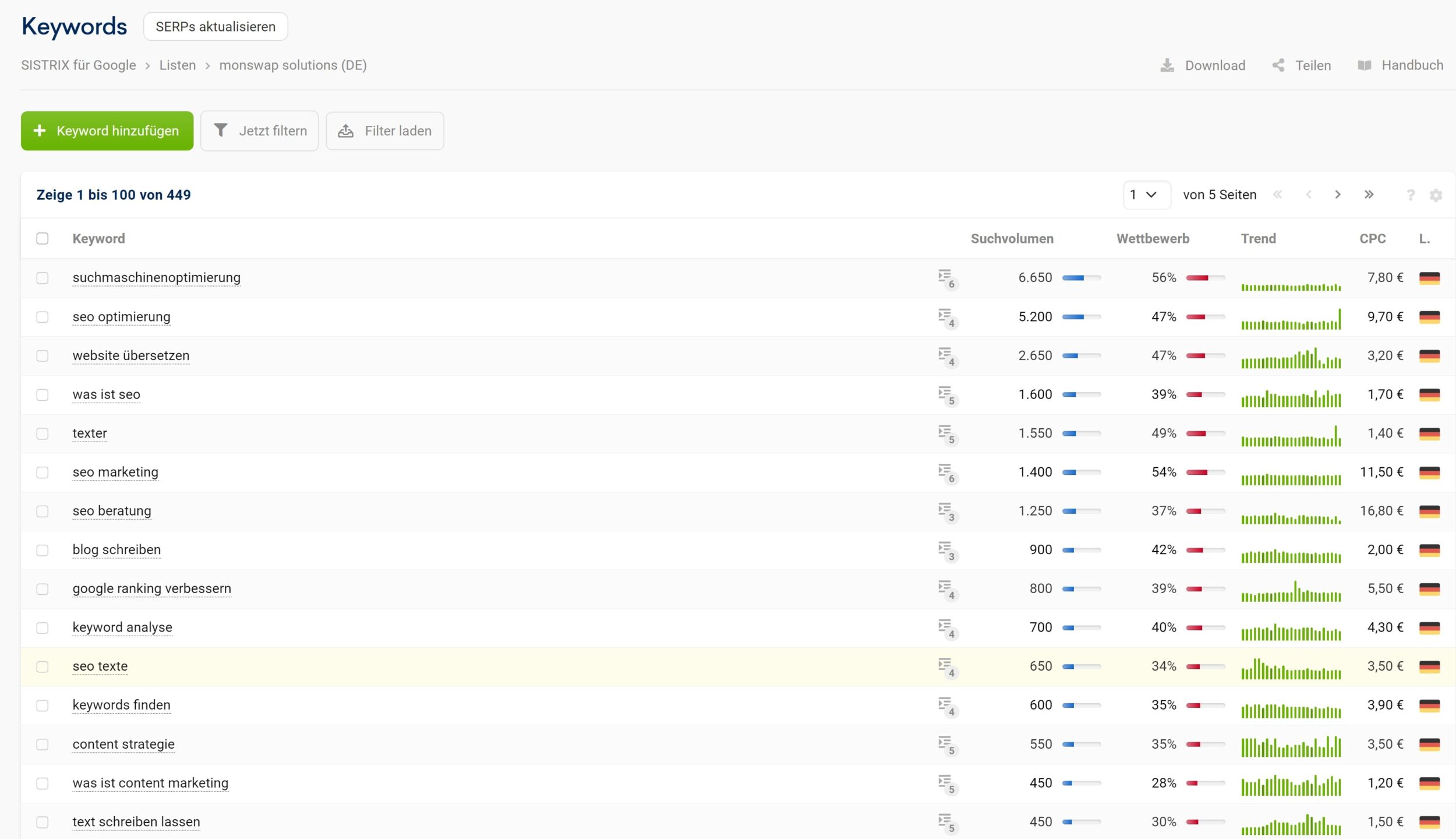
Before I start, I create a new keyword list in Sistrix.
a) Survey customers
Before developing any new SEO strategy, my clients receive a questionnaire. This tells me everything I need to know about their business and website to get them onto page 1 of Google.
One question is: "What search terms would you type into Google if you were a potential customer looking for what your company offers, without already knowing your company?"
I'll start my SEO keyword research with this list. I'll enter the keywords into Mangools. Is there search volume? Are there any interesting related keywords? If so, I'll copy the relevant search terms over to my keyword list in Sistrix.
b) Extract keywords from the existing website
Sistrix provides a wonderful overview of which keywords a website already ranks for. I take these keywords, highlight all the relevant ones, and add them to our keyword list. (I filter out the keywords that are not relevant for SEO at this point.)
c) Competitors' keywords
In my questionnaire, I also ask my clients about their competitors. The keyword tool Sistrix also suggests competitors to me. I enter these domains into Sistrix – one after the other – and copy the relevant keywords to my keyword list.
d) Common sense
I know this is a critical point, which is why I'm mentioning it explicitly. The questionnaire tells me what services or products my customers offer. If a topic isn't covered on their current website or by their competitors, we'd have a gap, a so-called keyword gap. And we definitely don't want that.
Therefore, I go back to Mangools and enter possible search terms that interested parties might use if they are looking for exactly this missing topic.
We now have a keyword list with 50-500 relevant keywords – depending on the industry, it could be more or less. If you don't find more than 50 or 100, don't be frustrated: especially in the B2B sector, for niche topics, or for startups, there often simply aren't any more.
That's okay. Work with what you have.
And of course: You can never find 100% of all relevant keywords. New search terms often emerge during the SEO strategy development, clustering, or even while writing SEO content . I then add these to the keyword research to ensure it remains up-to-date and my clients can work effectively with it continuously.
Step 2: Cluster keywords
Once I have found all the relevant keywords, it's time to cluster them, i.e., to summarize them.
a) Synonymous keywords
First, let me group together keywords with the same meaning: "seo keyword research," "keyword research seo," and "keyword research seo" are simply variations of the same thing. Anyone searching for one of these keywords has the same search intent .
In this case, the keyword with the highest search volume and lowest competition is the " Focus Keyword " in this cluster. I copy the other keywords into the "Synonyms" column and also arrange them within that field according to search volume/competition.
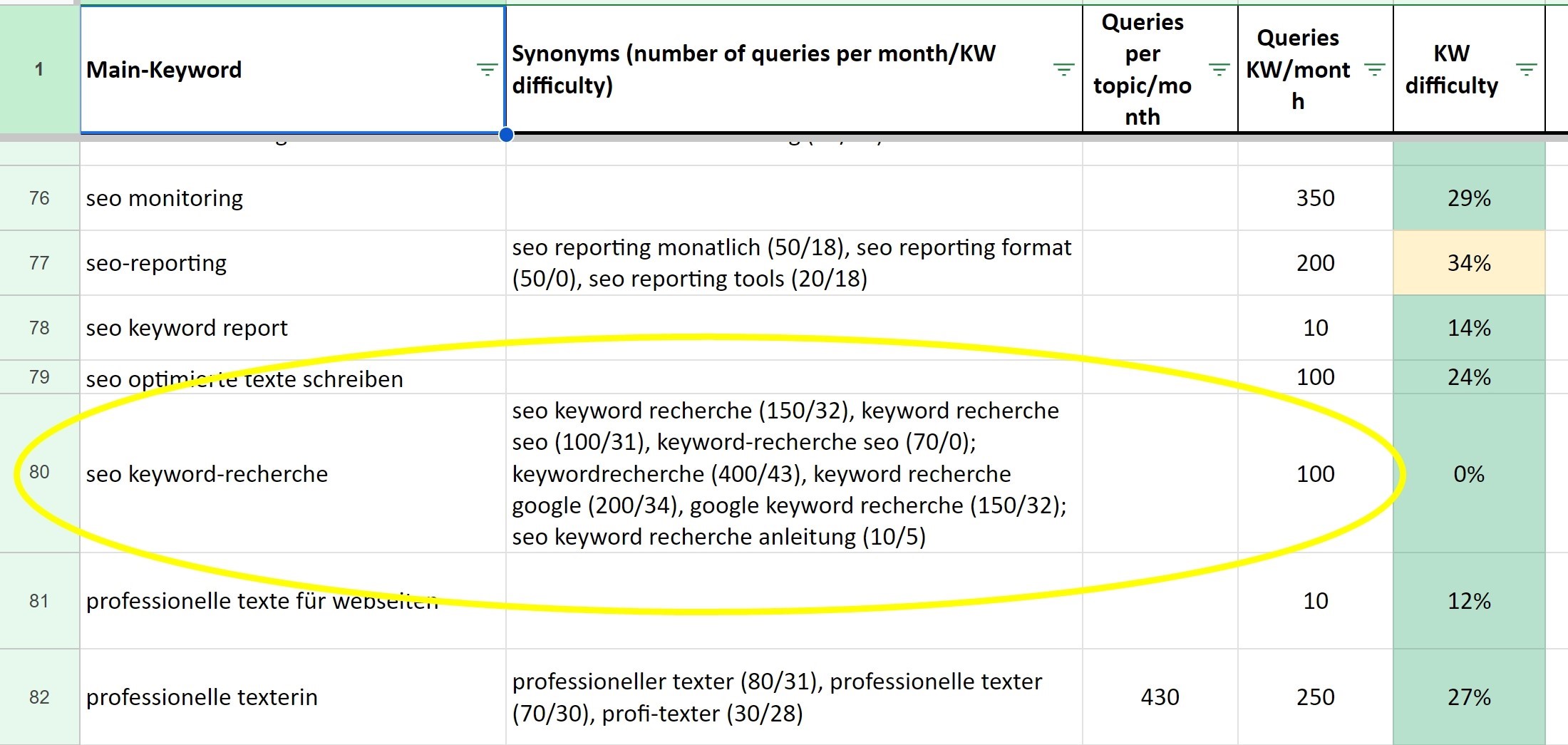
b) Related keywords
In my search, I also came across the SEO keywords "keyword strategy," "keyword translation," and "SEO keyword tools." These also belong to the broader topic cluster "keyword research," but they have very different search intentions.
And so I categorize them into different topics: strategy, translation, and tools.
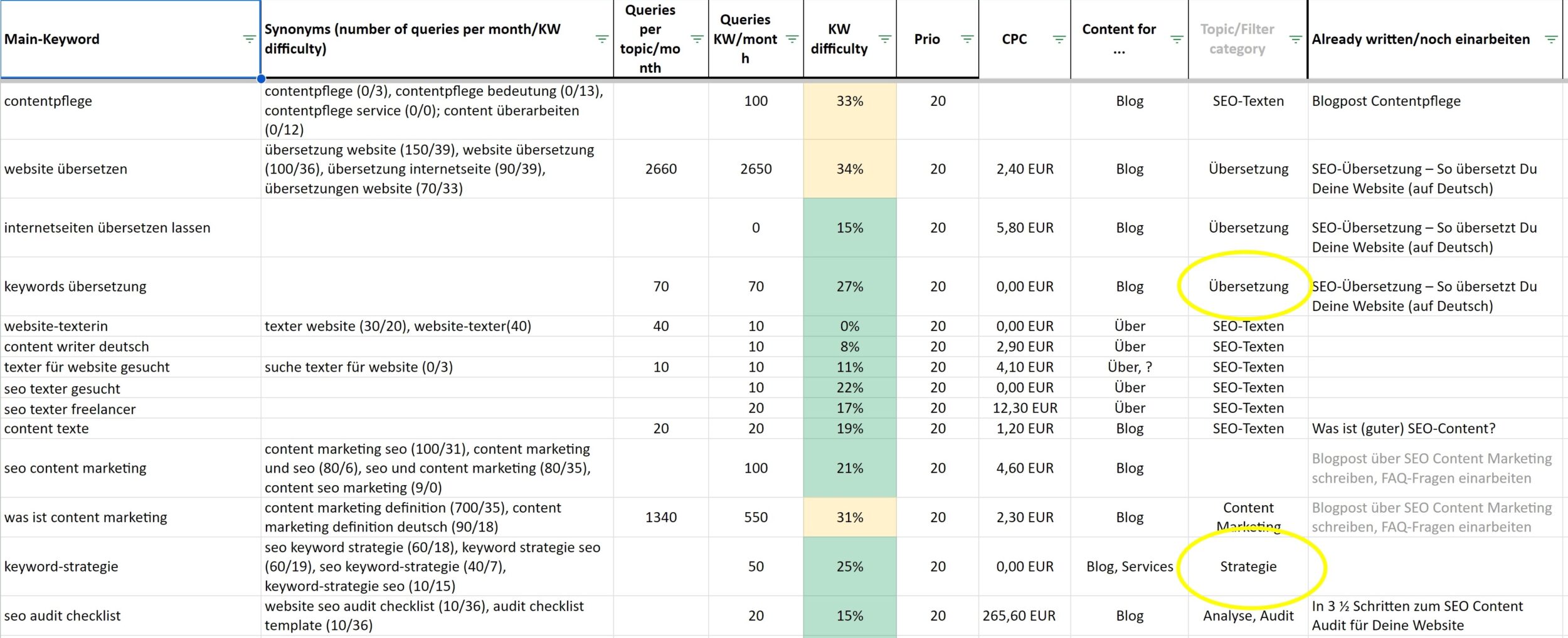
Eventually, all keywords are either assigned to a suitable cluster or topic, or they remain individually on their own because they cover a completely unique search intent.
This step is now complete.
Step 3: Arrange according to relevance (prioritization)
The next step is perhaps the most complex in keyword research:
Which keyword is the most important for your website, which is more of a peripheral topic – and which is irrelevant and can be removed?
An example from my own SEO strategy: "Have SEO content written," "have professional content written," and "write professional content" all sound similar at first glance. And for me, as an SEO copywriter, totally relevant.
Or?
"Have SEO content written for you"
This search is for a service provider who can write SEO-optimized content for the client. The client specifically wants to commission content.
Relevance: 100%
"Have professional content written"
This client is looking for a professional who can write content for them. All types of content. No mention of SEO or websites. After all, the client wants professionally written content .
Relevance: 70-80%
"writing professional content"
This is where it gets interesting! The searcher wants to learn how to write professional content. Since I don't (yet) have an academy for aspiring copywriters, this keyword isn't really relevant for my website.
Relevance: 20%.
I check every keyword according to precisely these criteria. Ultimately, the SEO keyword research is ranked from "1 = Ultimate keyword set" to "100 = unimportant, can be removed".

And now?
Congratulations, you now have a strategic keyword research project ahead of you!
At this point, I'll continue and create an SEO and content strategy. If you're interested, you can read more about my approach in the blog post "Developing an SEO Content Strategy – in 5 1/2 Steps"
And if you need advice or support: I'd be happy to do your keyword research for you. You know where to find.
What clients ask me about SEO & keyword research…
You should use keywords that match your offer and your target audience. You can find out which ones these are with SEO keyword research. (I explain how to do this earlier in this blog post.)
Make sure to choose search terms with high search volume and low competition. Also use long-tail keywords, i.e., combinations of several words, to target specific visitors.
A free tool for SEO keyword research is the Google Keyword Planner. With it, you can see search volume and competition for keywords. Ubersuggest also offers a free basic version.
These tools are perfectly adequate to get started when building your SEO strategy. If you research keywords more frequently, you should consider paid versions. These provide access to more data and features.
There are many platforms where you can learn how to research SEO keywords. This blog post already provides a brief guide.
I'd also be happy to show you in a one-on-one coaching session how I would find and compile keywords for your website.
Especially if you'd like to further your knowledge in other SEO topics, I highly recommend the SEO Academy . I regularly use it myself to expand my expertise.