
SEO Maintenance: Now it's time to stay on top of it – Interview with Ayla Grzegowski


SEO Maintenance: Now it's time to stay on top of it – Interview with Ayla Grzegowski
After going live, many marketing teams tick off the list – but SEO doesn't end there. Now the real work begins: Is the site converting? Is the content up-to-date? Is the technology working? "SEO maintenance only works if you think about it holistically," says Ayla Grzegowski. She explains which processes and tools she and the awork marketing team use daily – and which levers you can use to specifically improve your own website maintenance.After going live, many marketing teams tick off the list – but SEO doesn't end there. Now the real work begins: Is the site converting? Is the content up-to-date? Is the technology working? "SEO maintenance only works if you think about it holistically," says Ayla Grzegowski. She explains which processes and tools she and the awork marketing team use daily – and which levers you can use to specifically improve your own website maintenance.
Ayla, since when have you been responsible for the content on awork.com?
I've been with awork since September 2023, so I'm basically celebrating my two-year anniversary right now. I started as an SEO strategist, a combination of SEO and content strategy. That was also the moment we began to seriously develop SEO as a channel.
Previously, no one at awork explicitly focused on organic growth. Now I'm Team Lead Content & SEO and responsible for the organic part of our marketing – content, SEO, and everything that goes with it.
What role does SEO play for you compared to paid and social media?
SEO has become significantly more important to us over the last two years. We have an extremely strong paid advertising team that's really well-structured – and it works incredibly well. At the same time, we wanted to become less dependent on individual channels and increase our brand visibility.
That's why we said: Let's become more visible organically – not just through search terms like "project management tool," but also as a brand. Our goal is to be visible where our target audience is. And that only works if we present consistent messages across all channels.
That's why we in the marketing team work very closely together – paid, organic, and product – to move topics forward hand in hand. Because ultimately, good communication is essential, whether for ads or SEO. Both areas should be strong and support each other.
"Because in the end, good communication is simply essential, whether for ads or SEO."

What does awork understand by SEO maintenance?
For us, SEO maintenance is a combination of monitoring, reporting , and content management: We analyze how well a page is performing for us and make targeted improvements. Is it generating leads? Is the content up-to-date, unique, and highly helpful? If not, we revise the pages accordingly.
How do you integrate SEO maintenance into your daily marketing routine – do you have a fixed process for it, or does it run as part of your content routine?
We're a relatively young company, so things are constantly changing. Therefore, we don't have a rigid plan like "We have to update X pages every month." Instead, we take a situational approach, looking at what's currently needed.
For example, we have around 15 evergreen products that are central to our content. When a new product feature is launched, we integrate it directly into these relevant pages. We manage to implement this quite smoothly.
In parallel, we're always looking for new opportunities to increase brand visibility. I used to optimize far too many minor details – like the classic "rewrite the H1 or H3 again." But that's rarely the key to SEO maintenance once the SEO basics are solid.
For me, maintenance in relation to SEO content no longer means "optimizing even more drastically," but rather checking:
- Is this topic still relevant?
- Is the content up-to-date?
- Are the features and dates up to date?
- Are the internal and external links appropriate?
And of course: What do our reports say? If an important page sta:
What criteria do you use to decide which content needs an update?
In fact, we make these decisions entirely based on data: We look at the tools, at the reports: What's performing well, what's not? We're not just looking at classic SEO KPIs like rankings or visibility, but primarily at our SaaS KPIs. In other words: Which page is actually generating leads for our sales team? That's ultimately how we make our money
Sometimes it hurts to realize that a keyword is ranking highly but not generating any conversions. Then you have to be honest and say – it's not doing us any good. Especially as a small team, we have to prioritize carefully.
From my point of view, there are two starting points:
- Pages that convert well but have too little traffic – here we create more reach through SEO optimisation.
- High-traffic pages that are not converting – here we revise the conversion elements: additional call-to-action elements, clearer structure, stronger arguments.
It's always important to honestly ask yourself: What is the search intent of the users? If someone is looking for a template, they want a template – period. There's no need for a long article about what a project plan actually is.
That's a bit of a marketing thing: we always think our content is perfectly logical. But for outsiders, it's not always that clear. Taking a step back often helps me tremendously to identify ambiguities.
Especially with calls to action, we really need to be bolder. Directly explain why our solution is good – and invite users to try it out. There's nothing unfriendly about that, quite the opposite. We're often far too timid.
What SEO maintenance measures do you regularly perform?
For us, SEO maintenance always depends on what's currently happening in the company. In our larger team, we work according to quarterly plans. Four times a year, we have a major planning meeting where we define our quarterly projects. SEO maintenance topics are automatically incorporated into these plans.
In these meetings, everyone – paid advertising, branding, design, content – reviews everything together and decides which topics to tackle. I don't go into these meetings with the goal of "optimizing a specific blog post," but rather we discuss which topics have potential. For example, if two articles convert very well but have too little traffic, then we prioritize those exact pages.
SEO maintenance is done strategically on a quarterly basis , and of course also "on the fly" when there's time in between. Whenever we have spare capacity, we look at what we can improve or update.
"Maintenance can easily get lost in the daily grind. If you don't have set reminders, it simply doesn't happen – no matter how motivated you are."
We've also had quarters where our goal was to clean things up. Then campaigns were restructured, the design revised – and we updated our content in parallel.
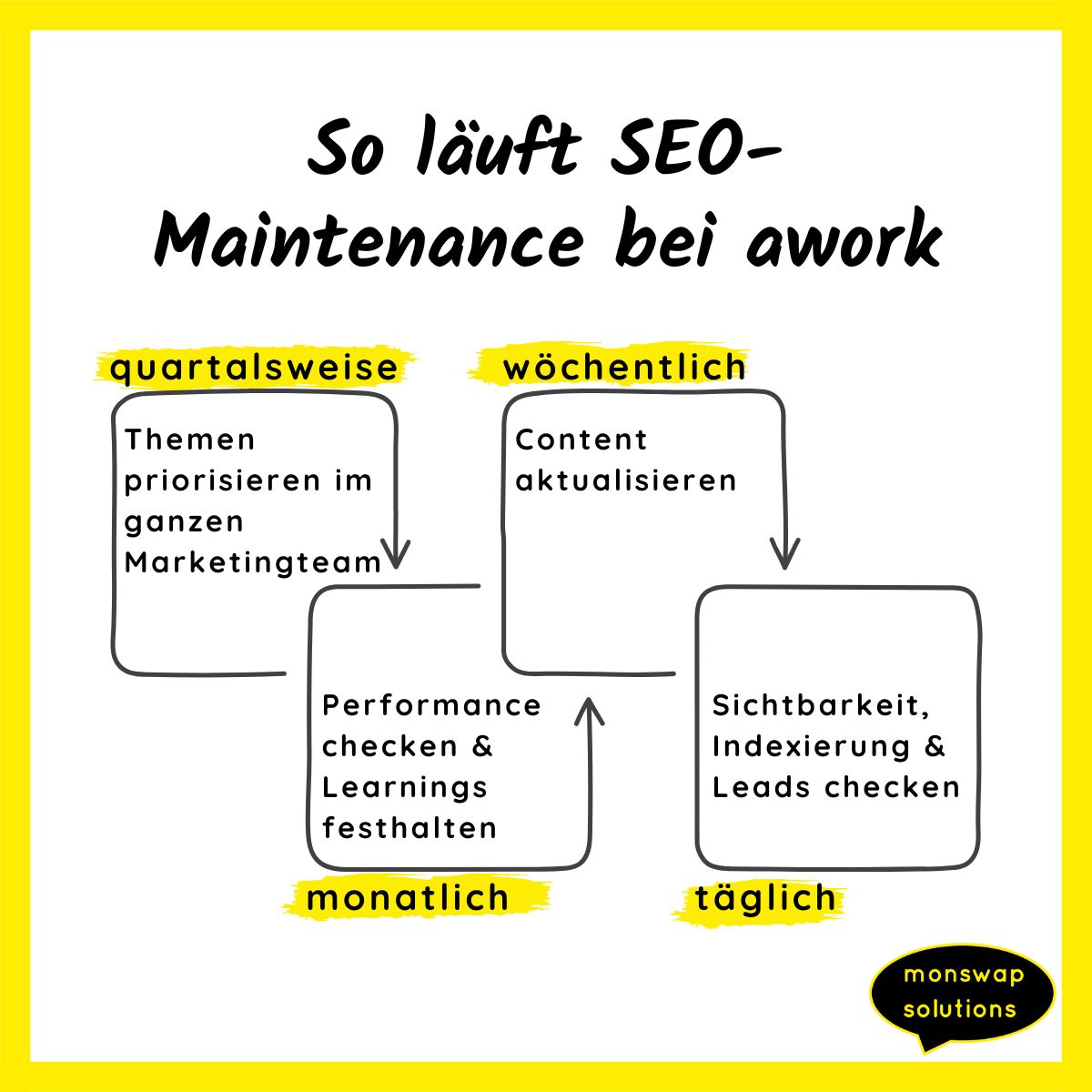
In addition, there are daily checks. As soon as I open my laptop in the morning, I check Sistrix to see how our visibility index is developing. Then I go to Google Search Console and Metabase to look at the SaaS KPIs. This only takes a few minutes and immediately shows: Is the visibility up to par? Is the indexing working smoothly? What do the organic leads from the previous day look like?
If I notice something in the crawler – 404 errors, indexing problems, broken redirects – I fix it immediately. I don't postpone things like that because they directly impact performance.
Our SEO maintenance is therefore a mix of daily monitoring, spontaneous optimisations and strategic planning.
Do you have some kind of SEO maintenance checklist that you use to update content?
Yes, we have a guideline that we always follow. Ultimately, it always comes down to the following four questions:
- Does the search intent?
- Is this topic relevant?
- Do we have something unique to say – in terms of content or form?
- And does the site fulfill its purpose?
Specifically, this looks like this: Before we even start working on the content, we first clarify the content-W questions:
- What do we want to achieve with this content?
- Who are we addressing?
- And what action do we want at the end?
With GEO, something else has been added: Do we really have something unique to say? If not, we need to consider what added value we can offer instead – be it a different perspective or a helpful presentation.
Then we clarify where the content should actually reside. We have various areas – product pages, blog, templates, hubs. Many simply cram everything into blog posts. For us, maintenance also includes considering: Where does the content strategically fit? Where does it complement other content? How do we link effectively?
When we're in the update process, we check the classic basics: structure, headings, metadata, internal and external links, schema markup such as FAQs. This makes it easier for Google and users.
And finally, let's look at whether we can enrich or further develop the whole thing. A video, an infographic, a calculator, downloads – such formats offer real added value and can make existing content come alive in a new way.
Have you had an "aha moment" in recent years that showed you how important ongoing SEO maintenance is?
Yes, absolutely. My biggest aha moment was actually during one of our all-hands-on-deck days. The entire marketing team works together on one topic for a whole day – literally everyone: paid advertising, video, design, content. I had a blog post at the time that was already doing quite well, but I knew: there's still room for improvement.
We completely revised the article that day: adding internal links, sharpening the content, producing a video, and embedding it directly. Everything went live that evening – and the crazy thing was: after just one week, the video was already visible on page 1. That's when I realized what happens when you approach updates strategically and really implement them as a team.
"I used to optimize a lot for the sake of optimizing. But simply rewriting H1 a little isn't the lever that will move us forward. If I optimize, then I do it properly – with a clear goal and a clear outcome."
The second aha moment was FAQs. I totally underestimated them before. Since Webflow added this Insights feature, I can see exactly where people click – and even on really long pages, a huge number of people scroll straight down to the FAQs. That was a real "wait a minute..." moment for me.
Since then, we've built our own FAQ library with clear, consistent wording. These sections not only contribute significantly to SEO, but also work very well for GEO, because the AI finds clear, unambiguous answers there.
Both of these experiences have shown me that maintenance is not just "a quick fix," but a real lever if you approach it consciously and properly.
What KPIs do you use to measure the success of your SEO maintenance?
For us, the classic SEO metrics aren't the most important; our SaaS KPIs are. In other words: Which pages actually generate leadsthat reach the sales team? That's our key metric. Of course, we still look at rankings and visibility. But if a page ranks highly but doesn't convert, it's ultimately useless to us.
In Google Analytics, we have our own funnel setup that allows us to see exactly how users reach our site, which channels they use, how they behave, and whether they convert or leave. This is our central foundation for measuring SEO impact.
We don't use traditional A/B testing, but rather a "best guess – then measure" approach. This means that if a page isn't performing well, we analyze what we want to change, implement all the adjustments at once, and then measure the results. In the B2B sector, we would otherwise usually have too little traffic for proper A/B testing.
I review the performance every four weeks. This allows me to see how bots are reacting and whether user behavior is changing. A second check often follows after eight weeks.
"I think this is a classic example: You conduct monitoring and look at the numbers – but then you do nothing with them. Numbers without consequences are simply useless."
If a measure performs well, it becomes a blueprint for similar pages. This is how we transfer insights and create consistency.
To make sure I don't forget anything, I've automated everything in awork. For each optimisation, I create a task, document the initial KPIs, and set the status to "live." I automatically receive a reminder after four weeks – my SEO impact check.
On the reminder day, I open the task, compare the new figures, and enter the results. If a clear picture isn't yet apparent, I set another reminder after four weeks.
My impact checklist serves as a central hub for all optimisations. I also use it to record when new content goes live or when Google rolls out a major update – so it's clear which factors played a role.
What tools do you use for SEO maintenance?
My general opinion is that you have to be very selective in SEO. There are countless tools available, and it's easy to get overwhelmed. We prefer to work with a few tools that truly fit into our workflow.
Our CMS is Webflow. It has an insights feature that shows how many users interact with calls to action. This is directly visible in the system and very helpful.
For monitoring and reporting, I use Sistrix – I've been a fan since day one. I also use Google Search Console and Google Analytics for on-page data and traffic flows.
For technical checks, we use Screaming Frogto monitor status codes, structures, and errors. And we see all SaaS-related KPIs in the Metabase. There, we can see exactly how many leads from organic traffic were passed on to sales.
Of course, I also use awork. I organize all maintenance tasks in it, document the KPIs before and after optimisations, and automatically receive my impact reminders so that we don't forget any tasks.
In addition, we've been using peec.ai for GEO for some time now . The tool quickly gives us an overview of which prompts mention or cite awork and which pages are particularly prominent. It's ideal for our current needs.
What role does AI currently play in your SEO work – does it support you in monitoring or updating content?
Of course. Surprise: As a tool company, we like tools. AI is now integrated into our daily work everywhere. I think there's hardly anyone on the team who doesn't use it in some form.
In the content team, we use AI more as a sparring partner: We first consider what we want to say, give that to the AI as input, and let it help us to sharpen the structure or challenge ourselves.
When revising content, we have them check, for example, whether a content answers all relevant questions or what aspects could be added. This helps us identify gaps without relinquishing content responsibility.
Another exciting project is our own internal AI, which we're currently training. It understands our core brand and product messages and helps maintain a consistent tone – regardless of who on the team is writing. This is especially useful for SEO maintenance: The AI automatically adjusts certain wordings in outdated content and checks whether our current statements are accurately reflected within them.
In the long term, it should also be able to detect whether new product features are already appearing in all relevant content. This is a huge issue for us right now because rolling out a new feature across all channels is incredibly complex.
In the area of monitoring and reporting, we're not quite there yet. Our paid team is already working intensively with AI automation. They've built processes that pull reports directly from the tools and consolidate them.
In our SEO department, this is currently still a manual process – I do my monthly reports by hand to stay close to the data. But I'm already on the waiting list with our automation expert. The goal is that eventually I can simply say, "Give me my monthly SEO report," and the system will compile everything automatically.
Are there any topics you consciously not to let AI touch?
No, not really, as far as pure maintenance issues are concerned. But of course there are areas where we clearly say: AI shouldn't do anything there.
Everything that customers or experts have said remains as it is – we don't want the AI "embellishing" it because it thinks it sounds better that way. We're talking about nuances here, and we only allow humans to handle those.
How does AI search or GEO change your strategy regarding content maintenance?
AI search is changing a lot for us right now. It used to be enough if our own pages were clean and up-to-date. That doesn't work anymore, because GEO doesn't just read our website, but everything about us on the web. And if outdated information is floating around somewhere, the AI will simply pass it on later.
That's why digital PR has become much more important for us. We actively monitor: Where are we being mentioned? Is the messaging still accurate? Are the features and positioning correct? This is essentially classic off-page work – just with a new focus. It's not about collecting backlinks, but about ensuring that the AI receives consistent signals across all channels.
Content maintenance no longer ends at your own domain. GEO forces us to take off-page optimisation at least as seriously as on-page optimisation.
"Content maintenance doesn't stop at our own website. GEO draws training data from everywhere – and if there's incorrect or outdated information about our product anywhere, the AI simply passes it on."
Do you believe that SEO maintenance will merge even more strongly with UX and conversion optimisation in the future?
Yes, absolutely. I think SEO and UX are inextricably linked anymore. Many SEOs still think: We bring in the traffic, and what happens after that is "someone else's job." That's such a typical marketing mistake. And GEO makes this holistic view even more important.
Internally, we have a lot of discussions about how to improve user experience, which calls to action (CTAs) work, and where a calculator or interactive element would be better than more content. SEO content alone simply don't work anymore. People need to be motivated to actually consume the content – especially now, with search behavior and SERPs changing so dramatically.
Good SEO maintenance always requires someone who adapts the content with a UX perspective
"SEO maintenance only works today if you think about it holistically. Not just through the lens of SEO – but also AI search, UX, conversion, product updates and real business KPIs."
About Ayla Grzegowski
Ayla Grzegowski is Team Lead Content & SEO at awork , where she is responsible for all SEO and content-related matters. She is a sought-after voice in the German-speaking SEO and content field: as a speaker at events like Future of Search, a panelist at OMR Reviews , and an interviewee on relevant SEO podcasts, including the Content Performance Podcast. At awork, she has been building the entire organic channel since 2023 – with clear processes, strong insights, and a holistic approach to SEO maintenance.

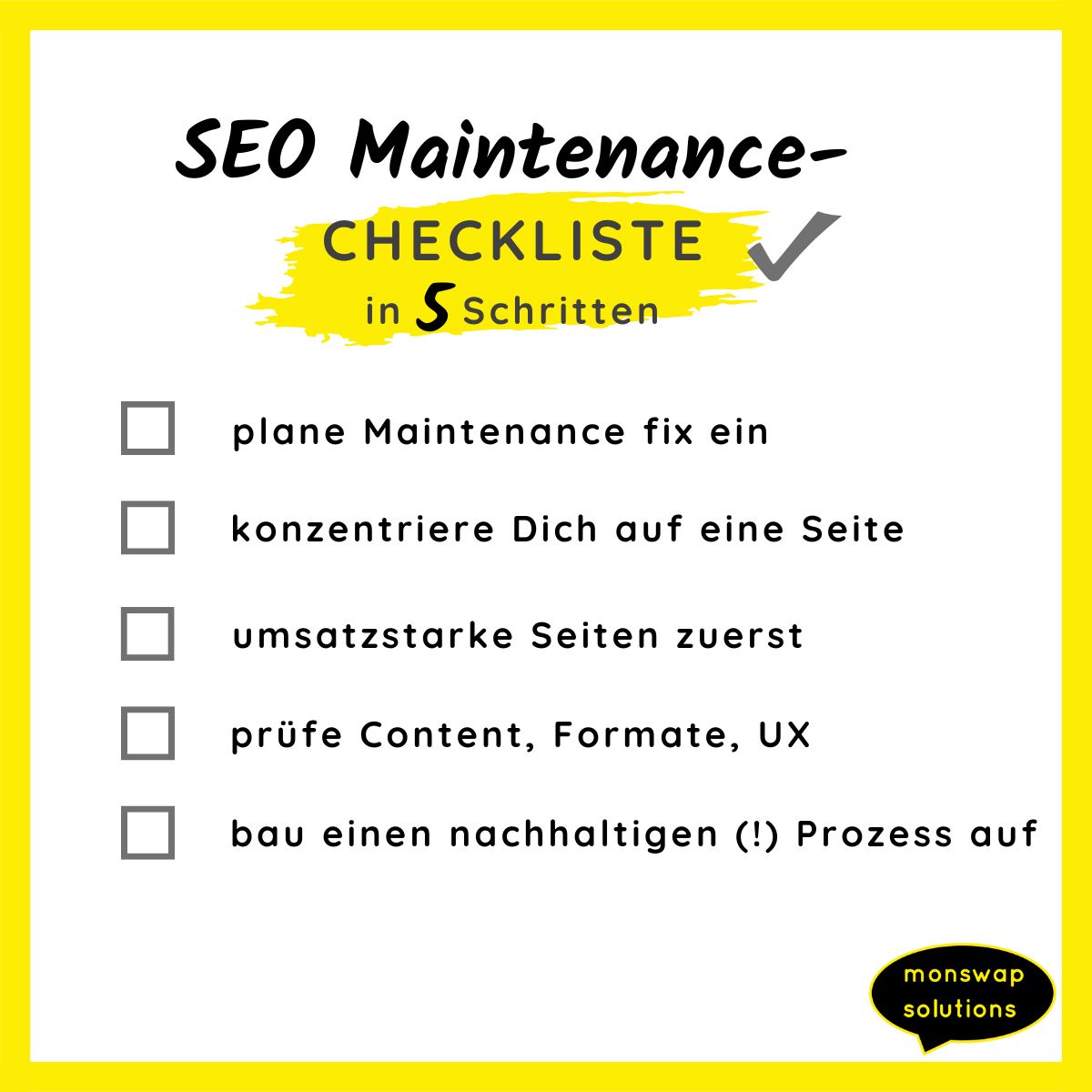
5 Takeaways for Your Own SEO Maintenance
1. Establish fixed routines: Regular reports, monthly deep dives, and quarterly prioritization are essential. Build buffer time into your daily routine in case something unexpected arises.
2. Go big or go home: It's better to update just one page, but do it properly: Check search intent, revise content, sharpen CTAs, enrich formats, add internal links – and then track it properly.
3. Prioritize by business impact, not (only) by rankings: What matters are the pages that generate revenue for your company.
4. Always think holistically about SEO: Content, technology, UX, conversion, and off-page optimisation are all part of a whole. A page only performs optimally when all elements contribute.
5. Build a process that you can manage in the long term: Rely on a few suitable tools, automate reminders, and keep your maintenance lean enough that you can reliably carry it out even during stressful weeks.
Your next step?
Many teams know exactly how important SEO maintenance is. They simply lack the time to consistently implement it in their daily work. That's precisely where I come in: monitoring, reporting, content updates, and technical checks – ongoing SEO support that frees up your resources and ensures stable rankings in the long term.