
Content management made easy: Tools + tips for top rankings


Content management made easy: Tools + tips for top rankings
As an SEO copywriter, I'm convinced that regular content maintenance is crucial for your website to rank well on Google in the long run. In this blog post, I'll explain why keeping your content up-to-date is so important, which tools can help you measure its performance, and provide you with a checklist of optimisation measures you can implement yourself. Finally, I'll answer frequently asked questions about revising content. Let's get started!As an SEO copywriter, I'm convinced that regular content maintenance is crucial for your website to rank well on Google in the long run. In this blog post, I'll explain why keeping your content up-to-date is so important, which tools can help you measure its performance, and provide you with a checklist of optimisation measures you can implement yourself. Finally, I'll answer frequently asked questions about revising content. Let's get started!
What you can expect in this post
What is content maintenance?
Content maintenance means regularly reviewing, updating, and improving the content on your website.
This includes SEO content on landing pages as well as blog posts, FAQs, product descriptions, images, graphics and more.
Is your content hard enough? Or is there room for improvement?
This involves not only correcting errors, but also inserting new information and removing outdated content.
The goal is to make this content even more relevant for both your customers and search engines.

Why is content maintenance important? 3 reasons
1) SEO boost through up-to-dateness
Search engines like Google love up-to-date content. "Fresh" content signals to Google that you are active on your website – and that your content are becoming increasingly relevant.
Regular content maintenance will therefore help you to appear higher and higher in the search results.
Studies show that websites with regularly updated content generate up to 30% more traffic.
2) User-friendliness
Your users also like up-to-date content: Nobody wants to read outdated information.
Well-maintained content creates a better user experience and will almost certainly increase the time visitors spend on your site.
Furthermore: Satisfied users return and share your content more frequently. Which in turn contributes to point 1).
3) Reliability
Have you ever shaken your head because the latest post on a company blog was about the 2016 Christmas party? (Or is that just me? #ContentNerd)
We agree that outdated content is simply embarrassing and unprofessional?
If you've nodded twice now, that's already the third good reason to regularly update your content.
This is what content maintenance has to do with your SEO & content strategy
To rank highly on Google, a well-thought-out SEO strategy is essential. (I'll show you exactly how to create such a strategy in the blog post "Developing an SEO Content Strategy – in 5 1/2 Steps".)
Why should you constantly churn out new content when you already wrote a fantastic content 1, 2, 3 years ago?
Exactly.
Revising is faster than rewriting.
Then update the keywords, check backlinks and add new ones if necessary.
It's that easy to supplement your content editorial plan with revised and polished content.
Clever, right?

6 SEO tools to measure content performance
All of these tools help you evaluate the effectiveness of your content and make targeted improvements.
Free tools
With Google Analytics or Matomo (if you want to be GDPR-compliant), you can precisely measure which content resonates with your customers and which doesn't. Time spent on page and bounce rate quickly show you where you can start improving your content.
Google Search Console gives you insights into search engine performance and allows you to identify and fix technical problems.
Paid tools
on Ubersuggest is the website analysis. This SEO tool gives you a great overview of which pages need improvement: 404 errors, missing or incorrect metadata, etc. It's incredibly useful for quick fixes and maintenance. And you can even download the data as a spreadsheet for easy further processing.
In Sistrix , I create detailed visibility and competitor analyses that help me develop SEO strategies or continuously adapt and optimize them. I especially appreciate the ability to monitor pages and create personalized reports. This way, you know exactly how hard your content is working for you every month – and where you can improve your content management.
From ' SEO suite, Mangools I like to use SiteProfiler. SERPChecker is my go-to tool for checking and revising SERPs. And LinkMiner is perfect for checking and maintaining backlinks.
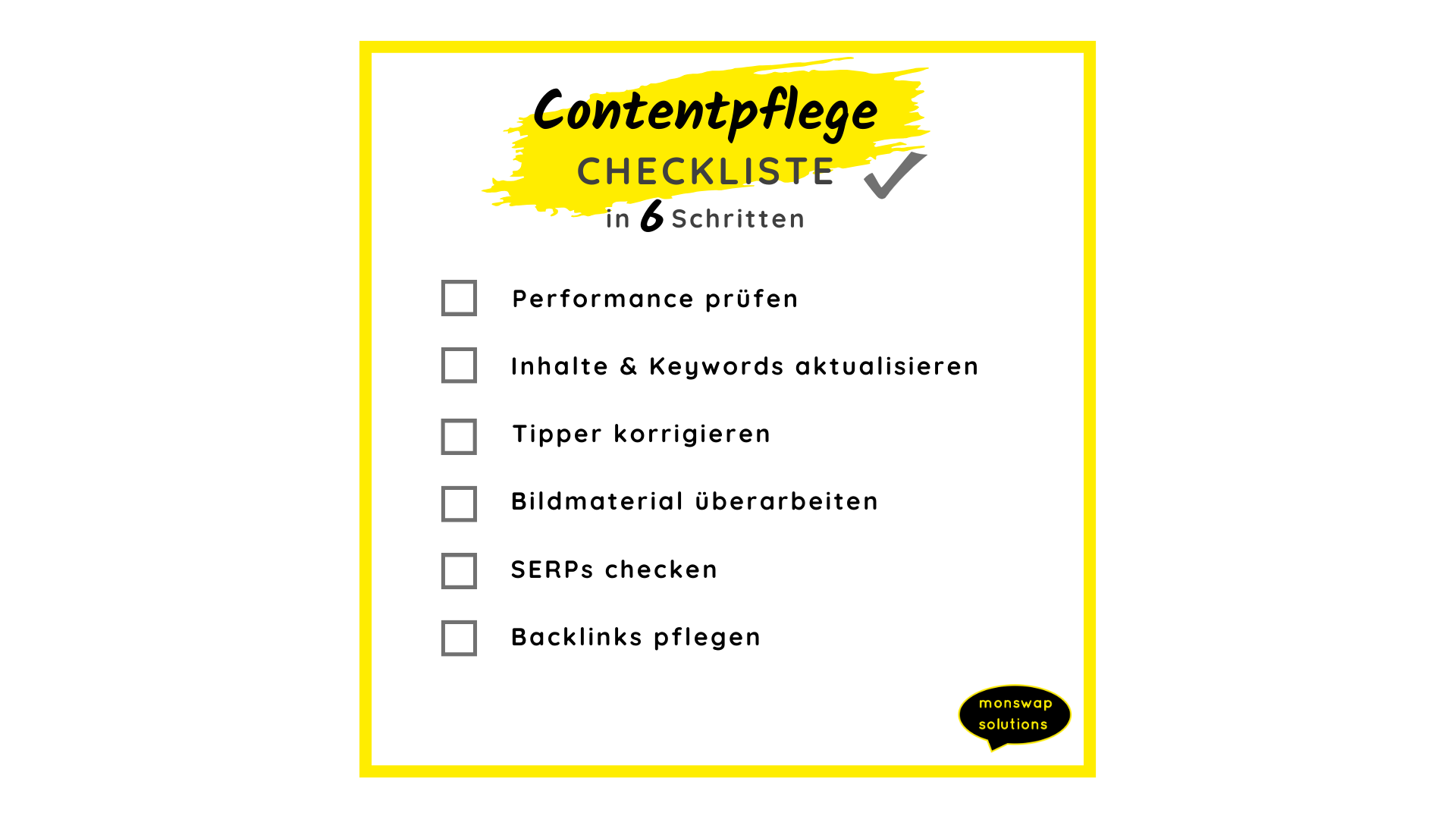
Content maintenance: 6 concrete measures
1) Check performance
Use the SEO tools mentioned above to measure the performance of your content. Analyze the data from the SEO reports and adjust your content accordingly.
If a blog post generates little traffic or ranks in 11th place, check and add keywords and optimize the content so that Google will soon rank it even better.
2) Update content and adjust keywords
Regularly check whether your content are still up-to-date. Add new information or keywords and remove outdated sections.
For example, enrich SEO content such as blog posts or landing pages with new data or graphics, or add new insights to existing FAQs.
3) Correct errors
Spelling and grammar mistakes look unprofessional and can damage your customers' trust. Use tools like Grammarly or AI tools to quickly find and correct typos.
4) Add image material
Of course, you also want your content to be found in image searches. To achieve this, regularly update infographics, create new videos, or replace stock photos with images from your latest photoshoot. Content maintenance means that your visual material will continuously improve.
5) Refreshing SERPs
The requirements for SERPs (Search Engine Result Pages), specifically SEO titles and meta descriptions, change frequently. Adjust the length and structure of your content accordingly.
Important: Always look at the SERPs of your top competitors beforehand. This is the only way to make your own SERPs better than theirs.
6) Maintain backlinks
Backlinks remain an important ranking factor. Therefore, regularly check whether your existing backlinks are still active and relevant – and build new ones.
Partnerships with interesting cooperation partners can be helpful, for example, for writing guest articles.
What clients ask me about content maintenance…
How often should I update my content?
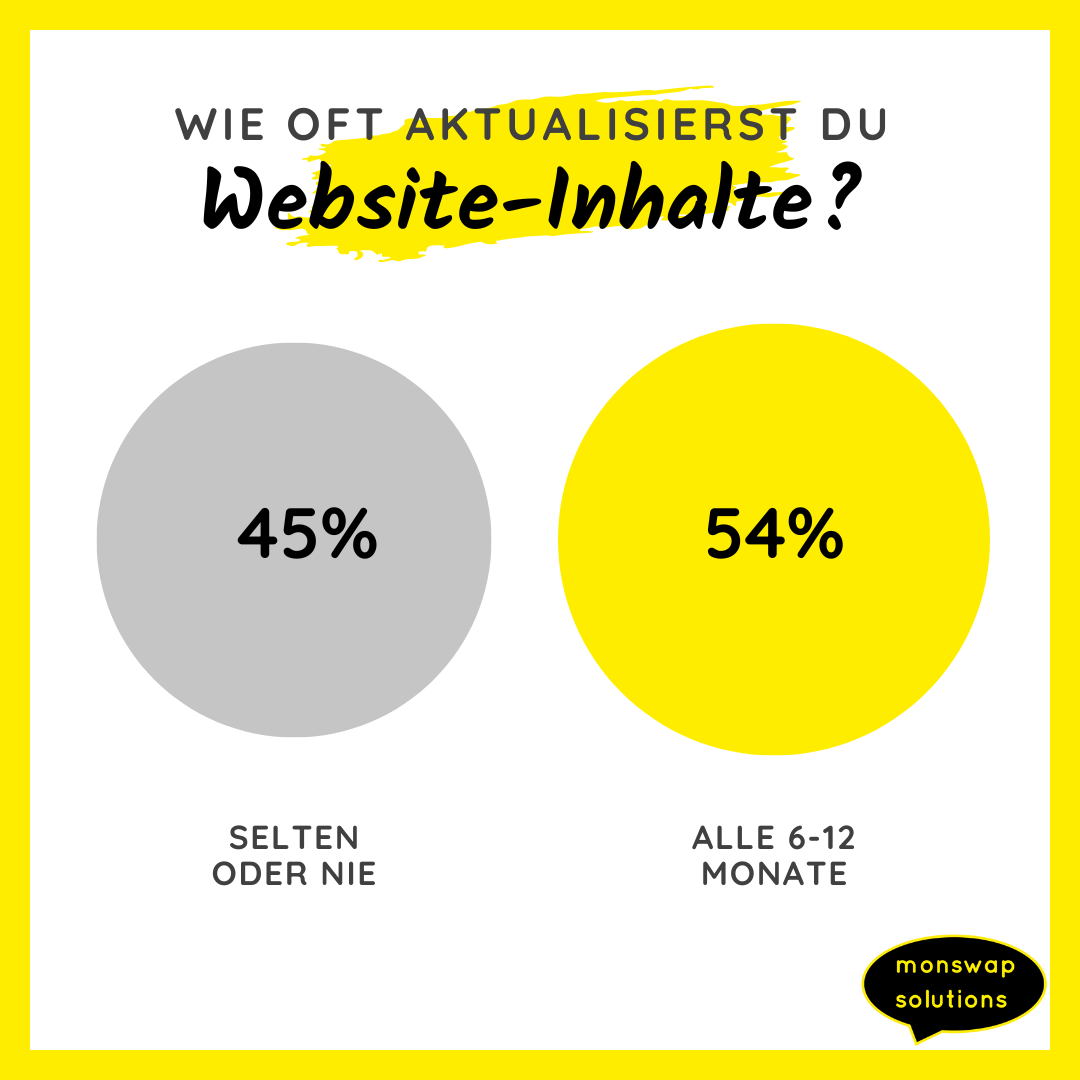
First of all: There's no hard and fast rule. As a general guideline, I recommend reviewing all content on your website about once a year – and updating it if necessary.
If you have more free capacity and changes make sense: Go for it!
Generally speaking, the higher the keyword difficulty (KD) of the focus keyword and the stronger the competition, the more frequently you should revise the content.
According to a study by Siege Media, on average, content with low-competition keywords is updated every 1.74 years, while content with highly sought-after keywords are revised more frequently than once a year (more precisely: every 0.87 years).
Which tools are best suited for content management?
For content management, I use Sistrix, Ubersuggest, and Mangools. Free tools like Google Analytics/Matomo and Google Search Console can also help you determine which content you should optimize.
By the way: You can also use the Yoast SEO plugin to, for example, optimize your SERPs or identify missing (internal) links.
Can I handle content maintenance myself, or should I hire a professional?
It depends on your knowledge and available time. If you want to delve deeply into SEO and content management, you can do a lot yourself. In that case, it's best to follow your SEO strategy and editorial calendar.
If you lack the time or know-how, it can be useful to hire an SEO copywriter like me to ensure that your content is always up to date.
I hope this blog post has given you a good idea of where to start with content maintenance for your website. And if you need support with maintaining and optimizing your content, I'm happy to help.
Schedule an appointment with us and let's work together to ensure your website remains successful in the long term.