SEO monitoring – Or: How hard is your website content working?


SEO monitoring – Or: How hard is your website content working?
My experience as an SEO copywriter tells me: Without SEO monitoring, you don't know how hard your website is working for you. Your content might be top-notch, but monitoring it won't give you any certainty about its true performance. In this article, I'll show you what you need for content monitoring, which tools are suitable, and how to set up your […]
My experience as an SEO copywriter tells me: Without SEO monitoring, you don't know how hard your website is working for you. Your content might be top-notch, but monitoring it won't give you any certainty about its true performance. In this article, I'll show you what you need for content monitoring, which tools are suitable, and how you can use them to continuously improve your content. I'll also answer frequently asked questions that are helpful for monitoring your own website. Let's get started!
What to expect in this article
SEO without monitoring = Hiking without GPS
Imagine you're going for a hike. You have a destination, but neither Google Maps nor signs. You just start walking and hope you find the right path.
You might discover beautiful landscapes along the way, but in the end you'll get lost, it will take forever, and you'll waste a lot of time and energy. You might even never reach your destination. #AktenzeichenXYungelöst
SEO and content marketing without monitoring is like hiking without a plan.
You don't know if your content is reaching its audience or where your website ranks. You can only hope and guess whether your content is delivering the desired results.
And hoping and guessing is not a good strategy.
Your monitoring tool is your compass. It lets you always know which keywords are working and which aren't. (Or you can leave the monitoring to a professional, like me.)
Based on this, you can later create an SEO report in which you can define the necessary measures.
This saves you time and gets you to your goal faster = You will be found on Google.

The foundation: Your SEO content strategy must be solid
Before you start monitoring, you need a solid SEO content strategy that aligns with your business goals and the search intent of your target audience.
This is the only way to monitor and optimize the right content.
(I'll show you how to create such an SEO strategy in the article "Developing an SEO Content Strategy - in 5 1/2 Steps".)
Only after you've determined which keyword set your website should rank for can you monitor the success of your SEO texts. SEO monitoring shows you exactly how each page performs for each keyword.
In the case of monswap-solutions.com, for example, it looks like this:
- My priority 1 keyword is "SEO texts".
- Other important keywords include, for example, "have SEO texts written", "SEO content" or "SEO copywriter".
- Furthermore, I would like to rank for my service with keywords such as "blog article writing", "SEO concept" or "content monitoring".
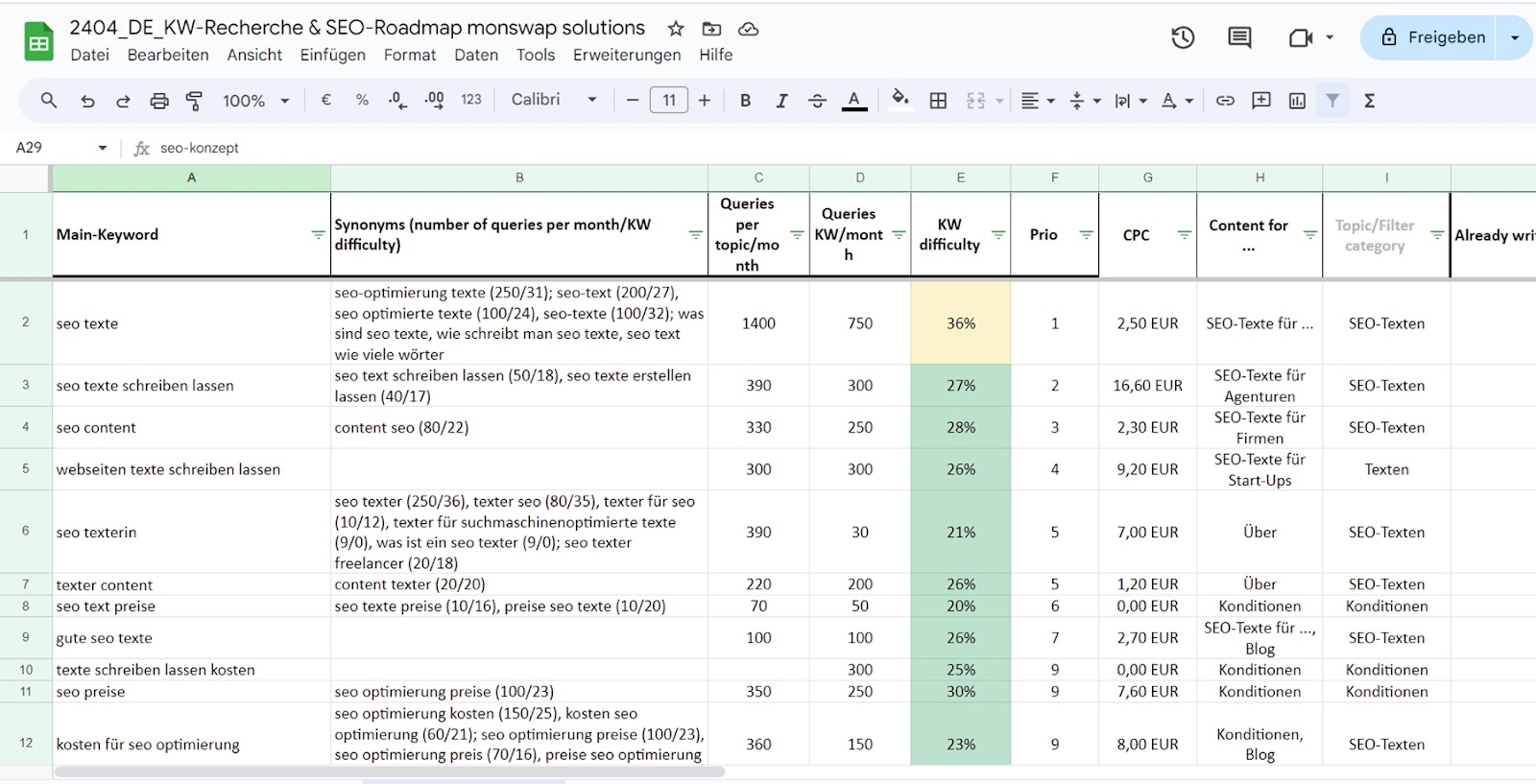
In the long run, content monitoring saves you a significant amount of time, allows you to use your resources more effectively, and enables you to improve your SEO texts where your website will benefit most. And you can create or revise content in a way that truly resonates with your target audience.
5 Top Tools for Your Content Monitoring: How Your Content Performs
One of the most frequent questions I get asked during consultations is: Which tools do you use for SEO monitoring? Of course, there are countless tools available worldwide for monitoring. Here are five software programs that have proven effective for me as an SEO copywriter .
Sistrix: The all-rounder for SEO monitoring
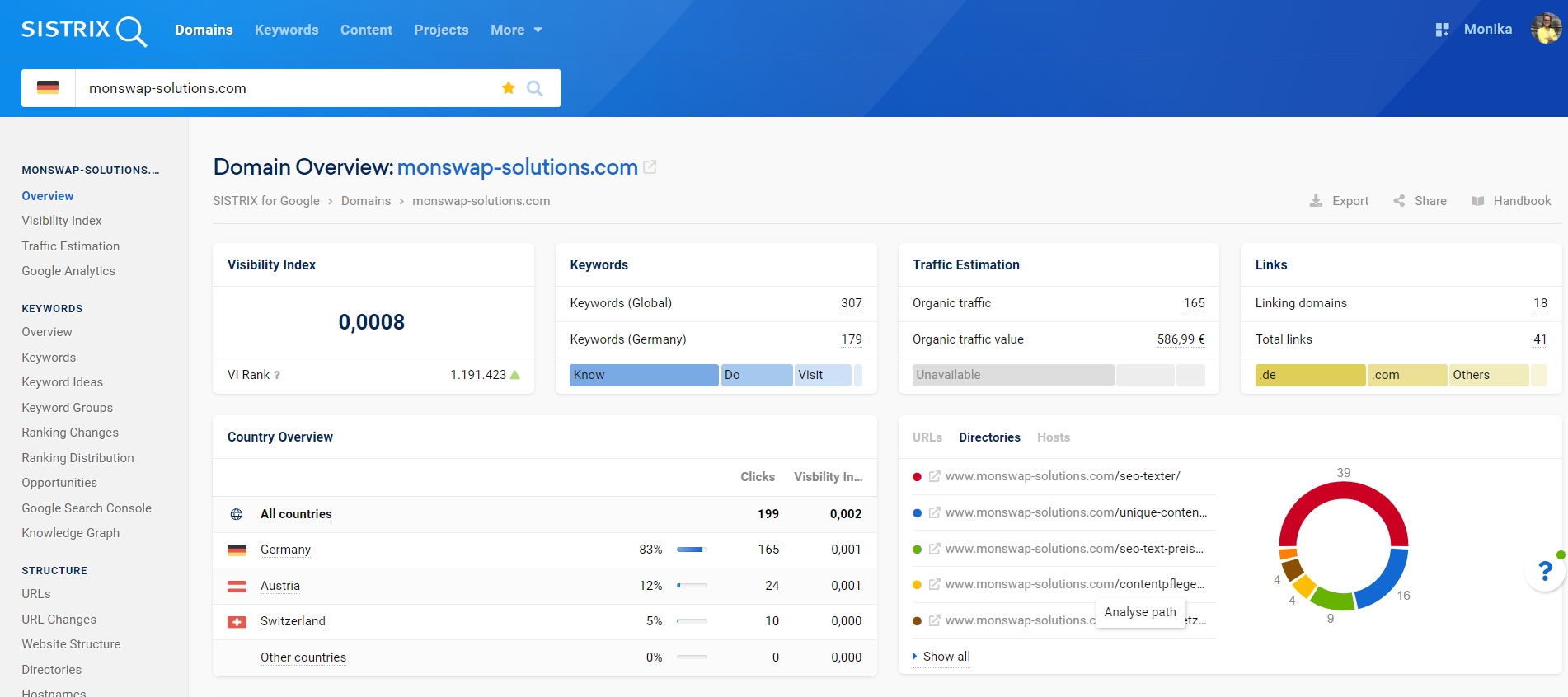
Sistrix is my favorite when it comes to content monitoring. (And for keyword research.)
With this tool you can continuously check the visibility of your website: It shows you which URLs rank for which keywords – and how your rankings change.
You can also clear SEO reports , containing exactly the information you need. Even branded with your own logo, if you wish.
Month after month, you can use this analysis to celebrate victories, identify weaknesses, and specifically improve your SEO content.
What I particularly like about Sistrix is the "Traffic Estimation" feature, and specifically the value of organic traffic: How many visitors have you brought to your website through SEO? And what would the same traffic cost if you ran ads? This metric allows you to perfectly estimate your website's ROI and justify budgets for SEO measures.
Mangools: Simple, affordable, effective
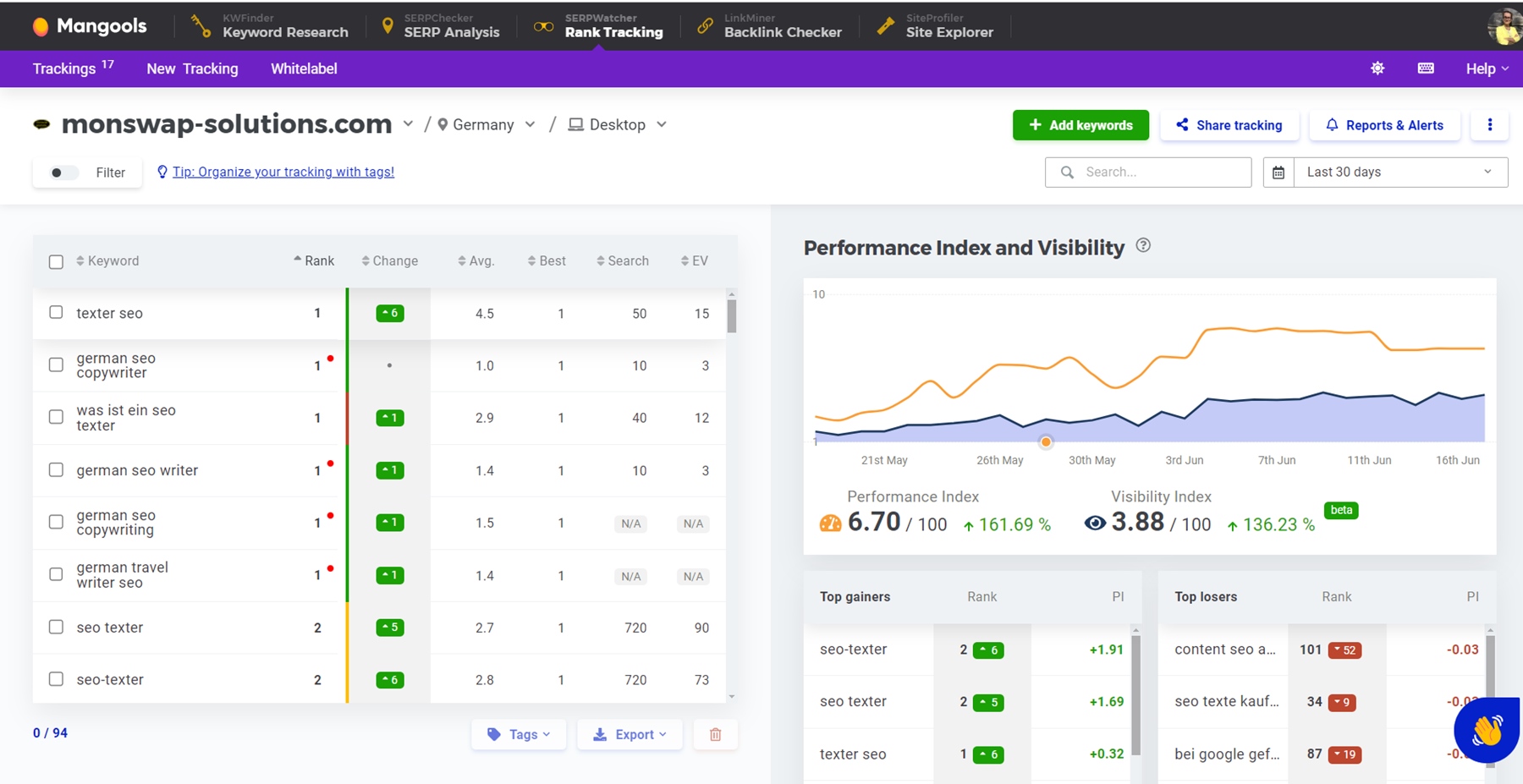
Simply copy your keyword set into Mangools' SERPWatcher – and sit back. With this tool, you can monitor your rankings daily. (By the way, checking this tool is the first thing I do every morning.)
As often as you like – every week, every month, every quarter – the tool automatically sends you an SEO report, allowing you to keep track of how your content is performing.
Even more monitoring tools: Ubersuggest, SEMrush & Ahrefs
Besides the tools Sistrix and Mangools, which are better known in Germany, there are other SEO suites that you can use to monitor content performance:
- With Ubersuggest you can research keywords and find content ideas.
- SEMrush offers detailed insights into competitive analysis and helps you optimize your SEO strategy.
- Ahrefs excels at analyzing backlinks and monitoring keyword rankings.
I use these tools to monitor and effectively improve my clients' SEO efforts.
Which one is right for you? It all depends on what else you want to do with it besides content monitoring and SEO reporting.
Stay tuned! Data leads to success
SEO is not a sprint, but a marathon. Stay consistent and regularly check your data. Only with the help of monitoring and reporting can you keep track of your data and ensure the long-term success of your website.
I'd be happy to help you with that.
What clients ask me about SEO monitoring…
Content monitoring means continuously checking and analyzing all text and image content on your website: static pages, blog posts, landing pages.
This allows you to identify which pages are performing well and which aren't. Monitoring helps you to continuously improve your website.
For content monitoring, you can use tools like Sistrix or Mangools.
These tools monitor your website: They show you how each of your pages performs and which ones generate how much traffic.
SEO monitoring also shows you how your website performs for your keyword set – and where there is still room for improvement.
Yes, you can measure the quality of your website texts.
Content monitoring allows you to check the performance of your content. Use monitoring tools to obtain concrete figures: visitor numbers, time spent on site, interactions, bounce rate. This data shows you whether your texts are well-received – or whether they need optimization. This way, you always maintain an overview and can improve your website in a targeted manner.
Monitoring helps you optimize your website. It allows you to see which content is performing well and which isn't:
Which blog posts are being read, which landing pages are getting the most clicks?
This enables you to make targeted improvements and continuously refine your SEO strategy.
The biggest mistake to make upfront: not doing it at all. So pay attention. Set up SEO monitoring. And avoid the following pitfalls as much as possible:
• Checking too infrequently: A common mistake is not checking your monitoring tool often enough. SEO data changes quickly, practically in real time. If you only check your data once a year, you'll miss important developments.
• Wrong metrics: Another mistake is monitoring the wrong metrics. Focus on the KPIs that are truly important.
• Frequent tool changes: Even frequently switching reporting tools or providers is a mistake: your reports aren't easily comparable. This makes it difficult to interpret trends. It's like comparing apples and oranges.
The important thing is to get started. Then the monitoring can run smoothly. And you can fine-tune the reporting gradually.