SEO in the age of AI: Where is it headed?


SEO in the age of AI: Where is it headed?
SEO is changing faster than ever. Since ChatGPT, AI Overviews , and similar technologies, many things have changed – from Google search results to visibility in AI-generated responses. As an SEO copywriter, I'll show you how to future-proof your website for 2026: for search engines, for users, and for AI systems like Perplexity, SGE, and Copilot. This includes 4+1 tools, examples, and insights into the current state of SEO. Read on to learn how to intelligently combine GEO, SEO, and AI.SEO is changing faster than ever. Since ChatGPT, AI Overviews , and similar technologies, many things have changed – from Google search results to visibility in AI-generated responses. As an SEO copywriter, I'll show you how to future-proof your website for 2026: for search engines, for users, and for AI systems like Perplexity, SGE, and Copilot. This includes 4+1 tools, examples, and insights into the current state of SEO. Read on to learn how to intelligently combine GEO, SEO, and AI.
What you can expect in this post
How SEO was before – and what remains
In the old days, SEO was straightforward: If you wanted to rank at the top of Google, you needed keywords – and as many of them as possible. SEO content were built around search terms, meta data was diligently filled out, and backlinks were collected like stamps.
Those who did their SEO homework properly could reliably rank on page 1 with good content and clean technology.
Some principles from the "old" days still apply today:
- Strategy is more important than ever – especially because creating content is becoming increasingly complex.
- Unique, helpful, first-hand content is a prerequisite for ranking.
- Keywords remain relevant when used strategically and aligned with AI prompts.
- The search intent is and remains the linchpin for content production.
- Website structure, loading time and technology play a central role.
What has changed, however, is the way content is found, evaluated, and delivered.
Today, simply including relevant keywords in a content is no longer enough. For years, user needs and search engine requirements have been converging – and anyone who wants to succeed with SEO in 2026 needs clarity, relevance, and an understanding of the rules of AI.
This is how AI search has changed SEO…
Since November 2022, we have been experiencing the biggest upheaval in SEO since the introduction of featured snippets: Since OpenAI's ChatGPT made AI and later AI search suitable for the masses, not only how people search is changing – but also where and when search results appear.
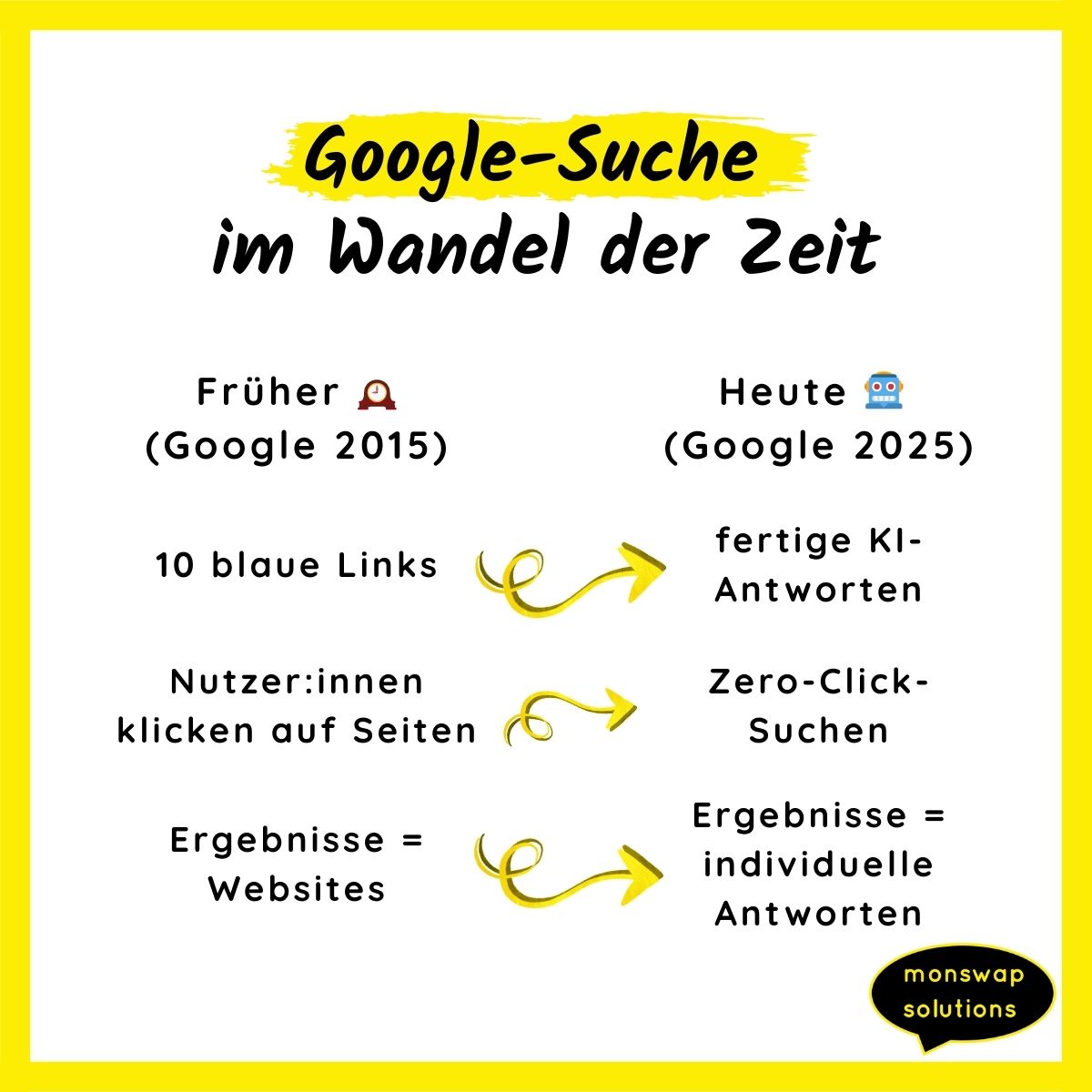
Google search used to return a classic results list : ten blue links, with a few ads above them. Today, AI snippets, SGE (Search Generating Experience), or chatbots like Perplexity provide the answer themselves . They summarize familiar content, combine sources, and make suggestions – often without users even having to click on a website.
For SEO, this means:
- Over 50% of all users prefer AI answers to classic Google search
- Fewer clicks (even today, traffic drops of an average of 30+% to position 1, depending on the industry even almost 80%)
- More zero-click searches
- Higher demands on content in order to even be considered in AI responses
- Classic rankings – such as 1st, 2nd or 3rd place – are becoming less important as a measurement factor
- Keywords become less important, prompts more important
Anyone who wants to achieve organic visibility in 2026 can no longer think about SEO solely in terms of Google, but should definitely keep AI search engines, voice search, chatbots and new interfaces in mind.
Where previously a clean content was sufficient to be found on Google, AI search requires a meaningful data structure, plenty of concontent, high credibility – and an understanding of how search intent and technological developments influence each other.
…and this is how AI will change SEO in the future
No one knows exactly how AI will change SEO. The entire SEO industry is learning on the fly – we're all constantly testing what works in practice. Only gradually are initial solutions and tools emerging.
One thing is clear: all developments indicate that SEO is currently undergoing a profound transformation.
Summary of key developments:
- Google is becoming a chatbot:
With AI Mode, Google is undergoing a radical transformation: AI answers replace search results – entirely without ads and traditional click logic. AI Mode was rolled out in the US in June 2025 and (almost) worldwide since August 2025 – it took a little longer in Germany. - Clicks are losing their power of measurement:
If ads disappear, click signals are missing. Zero-click searches are becoming more frequent. This makes traditional keyword evaluations less meaningful. Experts are now developing new approaches to engineer and track AI prompts. - Keywords could lose relevance:
AI systems prioritize semantic relationships over exact terms. Those who want to remain visible need a website where strong content, links, and URL structure work together effectively. - Response formats are gaining ground:
Unique content that provides quick and concrete information is in demand – quotes, data, research findings, FAQs. Long-form responses remain important, but should be structured strategically. - The content shift is real:
Anyone who wants to appear in the answers provided by AI tools needs substance: genuine experience, verifiable assessments, and unique content created with the help of expert knowledge. This is no longer a nice-to-have, but the standard.
In short: The more precise, credible, and structured a piece of content is, the more likely AI search will feature it. Good SEO – whether for online shops, B2B sites , or recruiting – will require not only keywords and prompts in 2026, but also substance and structure.
SEO & AI: First steps that make sense today
The SEO world is changing rapidly – and many marketing teams are asking themselves: Where do we even begin? What really works? And how do we keep our content relevant for AI searches?
Here are a few concrete steps I recommend as an SEO copywriter in 2026:
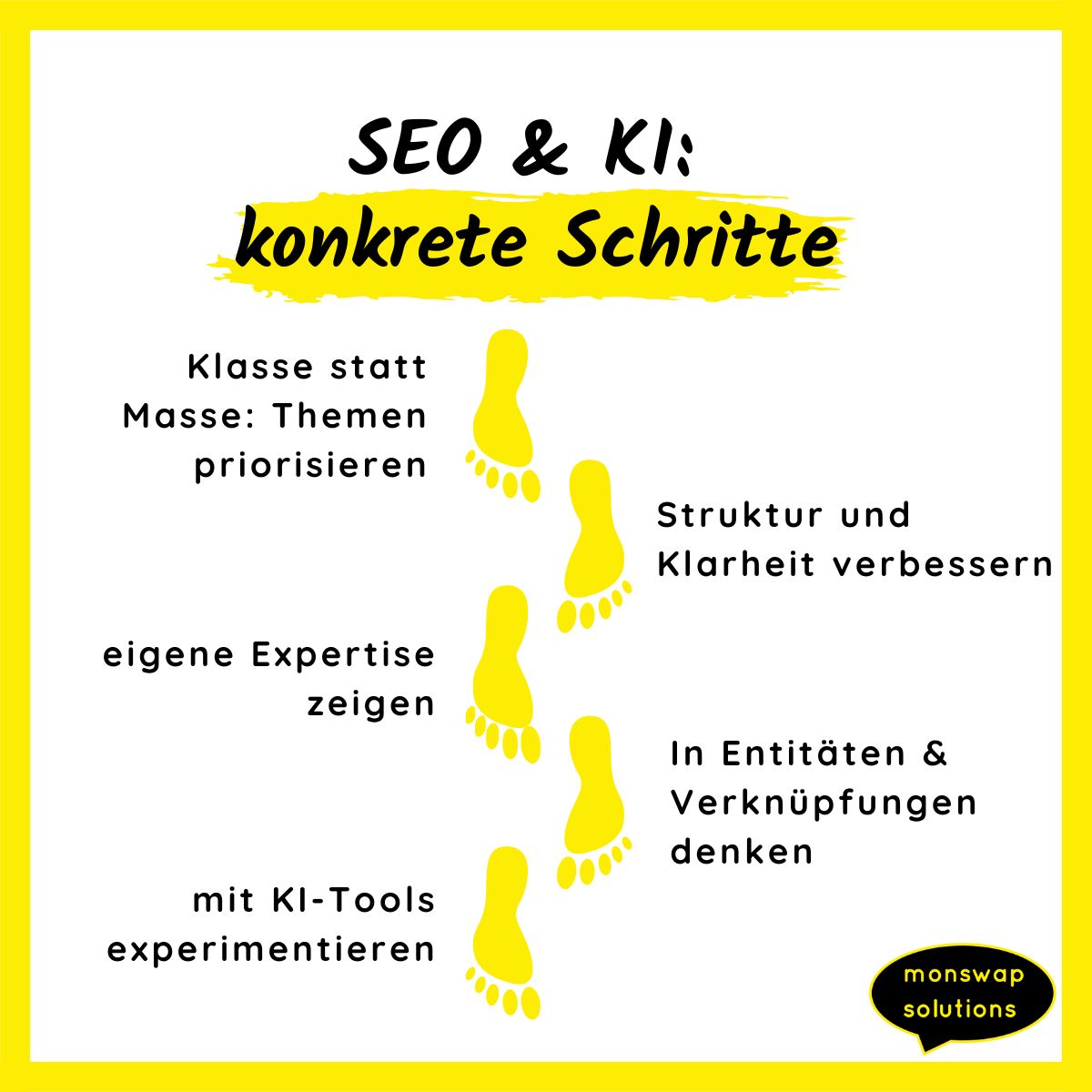
- Quality over quantity – prioritize topics: Start with pages that are already performing strongly organically or contribute to central company goals: services, products, blog posts with high potential, and ask yourself: How can I make them even better for my users?
- Improve content structure: AI search needs concontent. Clear introductions, precise answers to specific questions, and meaningful links help – not only users, but also the AI.
- Showcase your own expertise: Sharing knowledge increases visibility. Specialized knowledge, personal experience, and genuine insights are invaluable to AI systems. They prefer content that comes from a first-hand source and isn't simply copied.
- Think in terms of entities and connections: AI works with semantic spaces: people, places, brands, concepts. Those who link cleanly and categorize meaningfully (e.g., via internal links or easily understandable explanations) make it easier for AI searches.
- Experiment with prompt-based content creation: Tools like ChatGPT, Perplexity, or Claude help with creating rough content, structural suggestions, or brainstorming. What matters is how you use them – and what you make of them.
- Monitor AI performance: How often is my brand mentioned in AI responses? How often do the AI bots use my content to generate their answers? Tools already exist that allow you to monitor these metrics. (I'll share my favorite tools below.)
Why not ask the AI how you can optimize your content for AI?.
Most importantly: You don't need to implement everything at once. The main thing is that you get started – and make your website AI-friendly step by step.
4 + 1 SEO & AI tools I use daily
Sure, tools don't replace an AI strategy – but they make my daily work as an SEO copywriter significantly easier. Especially when it comes to routine tasks like image SEO, keyword clustering, suggestions for the H-structure, or initial content drafts.
I use these four tools daily to develop and monitor content faster and better:
1. My AI prompt sequence for SEO content
For writing recurring in-house formats – e.g., landing pages, blog posts, or LinkedIn posts – as well as for client projects, I work with a custom-developed prompt sequence. It guides the AI step by step through the content creation process, saving time and ensuring that all SEO aspects are considered in the content from the very beginning.
By the way: In the article “Write SEO content faster (and better)” I provide you with my best AI prompts for free .
2. Custom GPTs in ChatGPT
Especially in client projects, I work with custom GPTsthat I program specifically for each use case: blog posts, product descriptions, metadata, social media content – each with style guidelines, target audience focus, and effective prompt chains. This allows you to complete recurring tasks much faster and better.
3. KWFinder by Mangools
KWFinder is an easily accessible keyword tool that helps me daily: It shows me not only the search volume, but also the search intent behind a keyword – and which formats (e.g. , guides, product pages, lists) are currently performing well for it. Ideal for working with future-proof SEO content.
4. SISTRIX – SEO & AI reporting
In addition to standard SEO monitoring, SISTRIX now also offers AI reporting: It shows which keywords trigger Google's AI Overviews – and whether your own website could potentially benefit from them. This is particularly helpful for content monitoring for clients, allowing them to identify where traditional rankings are no longer sufficient.
5. peec.ai
The tool peec.ai is entirely focused on generative AI searches – and analyzes how often a brand appears in responses from ChatGPT, Google Search Engine, or Perplexity. I find this particularly interesting for SEO in a brand concontent: Who is recommended in AI responses? Which pages are linked to or cited? Where does the AI see weaknesses?
I'm currently testing peec.ai myself. It seems like a good solution, especially for brand monitoring in AI search. However, it's still in its early stages, and basic functions like reporting are occasionally unavailable for a few weeks at a time.
What I find exciting is that the logic behind how AI tools work is also new.
Important: These tools don't replace critical thinking – and never will. But they do make it easier for marketers to create understandable, targeted content from SEO data in the age of AI – and to get from idea to publication faster.
That's the bottom line: SEO for AI primarily means thinking ahead

AI is changing SEO – and faster than many tools or blog articles can illustrate. Anyone who wants to be found in 2026, 2027, or 2028 needs more than checklists or plugins.
SEO for AI search means: thinking ahead, testing, questioning. Understanding what searchers really want to know – and how content should be structured so that it is understood by both humans and machines.
My motto: Quality over quantity. This also applies to AI-powered content production. It's not about producing more content – but better content. More relevant. More structured. More credible.
If you want to know more about how I specifically work with SEO AI – or how you yourself can write SEO content more efficiently and with higher quality using AI – check out my AI prompt series for SEO content .
Or write to me directly. I'd be happy to show you what's already possible today.