
SEO + HR – and the candidates will come to you


SEO + HR – and the candidates will come to you
Skilled professionals search for jobs online – but many career pages remain invisible to Google and AI search engines. With SEO for HR, you can direct applicants straight to your website: without expensive ads, without recruiters. Especially when you have high staffing needs, it's worthwhile to optimize your careers section and strategically use SEO-optimized job postings. I'll show you exactly how this works – and how one of my client projects successfully uses HR SEO – in just 5 minutes of reading time.Skilled professionals search for jobs online – but many career pages remain invisible to Google and AI search engines. With SEO for HR, you can direct applicants straight to your website: without expensive ads, without recruiters. Especially when you have high staffing needs, it's worthwhile to optimize your careers section and strategically use SEO-optimized job postings. I'll show you exactly how this works – and how one of my client projects successfully uses HR SEO – in just 5 minutes of reading time.
What you can expect in this post
SEO & HR: Does that fit your company?
SEO doesn't immediately sound like HR to you? That's understandable. Most recruiters think of search engine optimisation in terms of online shops or marketing campaigns – and rarely in terms of their own career development.
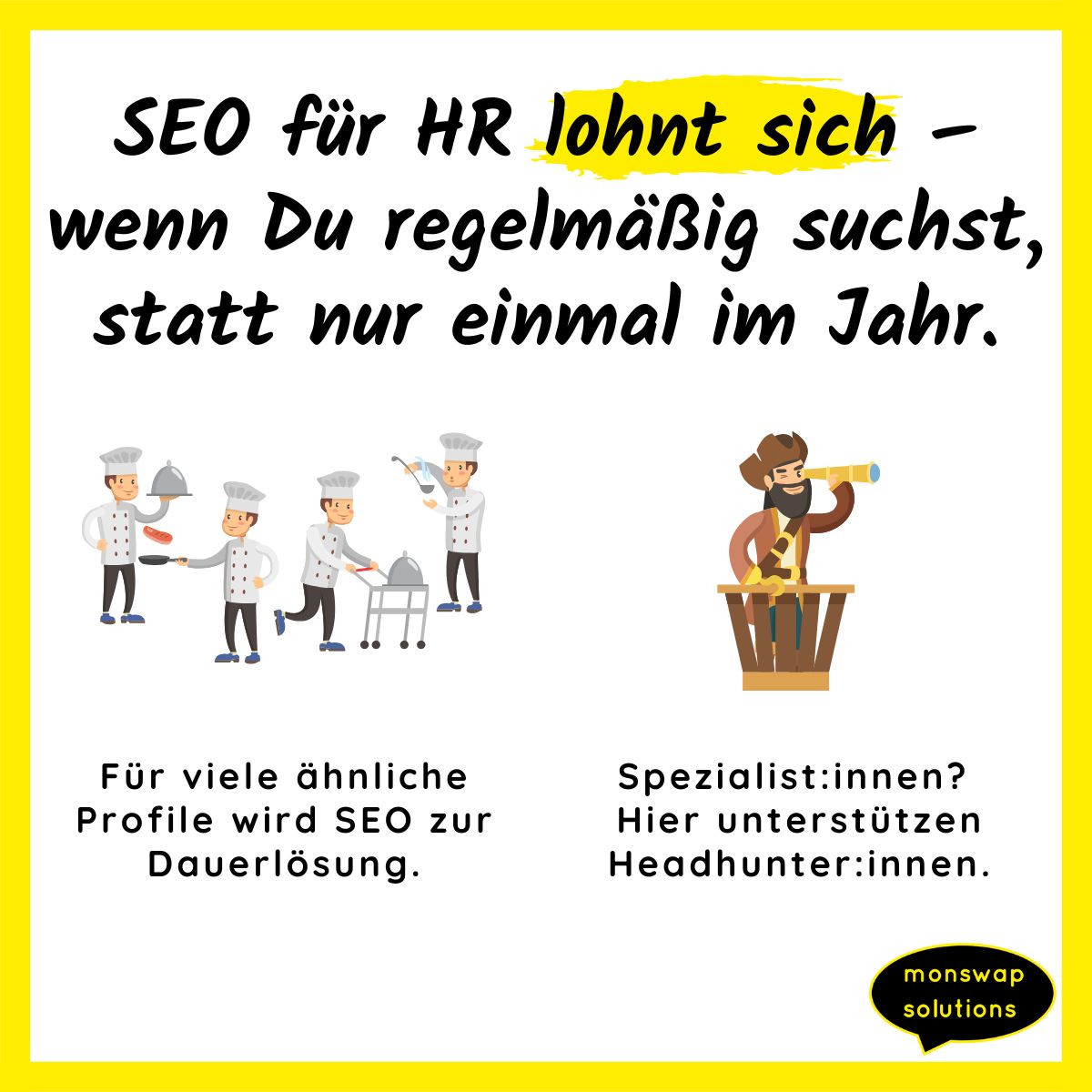
SEO is worthwhile for HR. Specifically, if you regularly need to fill similar positions , for example in manufacturing, hospitality, or healthcare. In other words, anywhere where it's not about a single, highly specialized role, but rather about finding as many employees as possible with comparable profiles.
In such cases, SEO helps you achieve lasting visibility – for applicants who are actively searching online for exactly these kinds of jobs. This eliminates the need for job portals and avoids wasted effort. Applicants can find you directly on Google or via AI search.
(However, if your recruiting is exclusively for individual and highly specialized specialists or managers, headhunters are a better fit for you than HR SEO.)
What does SEO for HR entail?
When I talk about SEO for HR , I mean two things:
- To build and optimize the careers section of your website so that it can be found on Google – by people looking for jobs in your company or industry.
- Optimize job postings for SEOso they also appear in organic search results – instead of paying for every click on expensive job portals or letting them languish in internal systems. Optimized content and job postings can also be integrated into your HR tools to further streamline the process.
Both SEO elements work together – and make your recruiting page permanently visible to applicants.
SEO for HR is not a replacement for traditional recruiting – but rather an effective complement to employer branding in digital HR marketing. Visibility doesn't happen by chance, but through targeted measures on the website in general, in the careers section, and in your job postings.
What are the advantages of SEO in the HR field?
Many recruiters are under pressure: there are too few applicants, too many open positions – and often too little budget to promote every job posting on job portals. Their own careers section? It often remains unused. Yet it could be a game-changer.
Here are four advantages of SEO in recruiting:
1. End our dependence on job portals
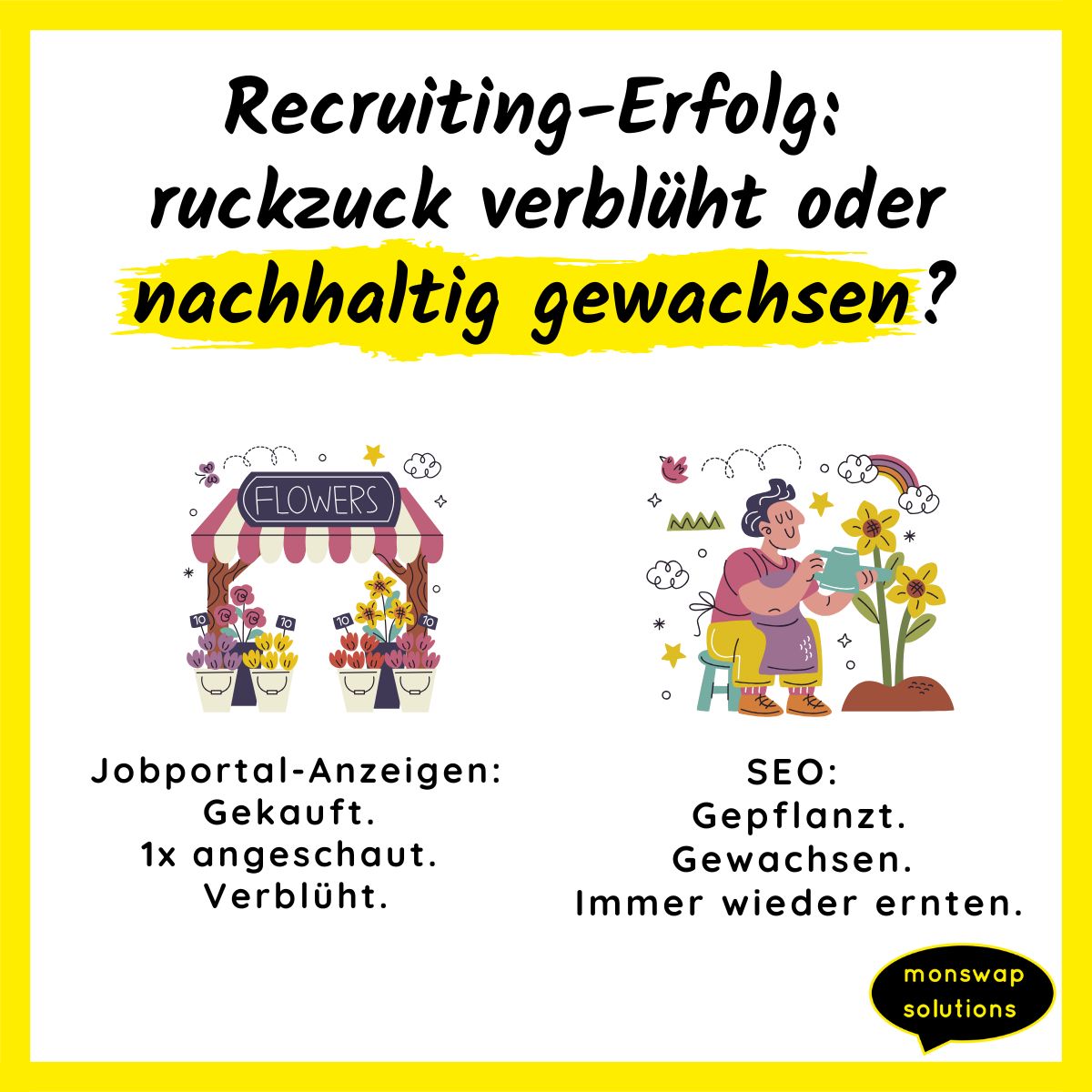
On job portals, everything is time-sensitive: You pay – you get seen. You stop paying – your ad disappears. It doesn't matter if the job posting has been revised, is still current, or has received excellent click-through rates.
SEO is different: Once your career page is properly optimized, you can remain visible permanently – without any ongoing advertising costs.
Of course, SEO isn't automatic and requires maintenance. But if the careers section is logically structured, job postings are optimized for the right keywords, and the website as a whole is solidly built, your visibility will continuously improve – sustainably and in the long term.
2. Save on HR budget thanks to organic reach
Anyone who regularly posts job ads knows the problem: Portals like StepStone, Monster, or Indeed charge fees per ad, often in the three-figure range. On StepStone, for example, individual ads cost between €400 and €1,000 – for 30 days of visibility.
And then what? The ad disappears into digital oblivion.
A calculation example:
- If you 10 ads per month , the costs can quickly add up to €4,000 to €10,000 per month,.
- With 100 ads per month – for example in larger corporate groups or with strong growth – you can quickly reach €40,000 to over €100,000 per month.
And those are just the placement costs , excluding copywriting, internal coordination, or agency services.
SEO works differently.
Here you are not investing in the short-term visibility of individual ads, but in a strategy that makes your career section and your job postings discoverable in the long term.
You can also use HR SEO and job portals in parallel – as a strategic complement. Many of my clients start by investing a portion of their advertising budget in SEO to optimize their initial job postings for Google. This allows you to specifically test which positions perform best organically. Once you see where and how your reach increases, you can gradually adjust your recruiting strategy.
Search engine optimisation (SEO) means a one-time investment in strategy followed by ongoing support: Starting at around €2,000 per month, I will support you as an SEO copywriter on a long-term basis. I will optimize your career page technically and in terms of content, develop SEO content for recurring job profiles, handle monitoring, and regularly update existing content.
This is how you can reach applicants directly via Google (and AI search) – month after month and year after year.
3. Become visible as an employer brand through SEO
Job portals have their place: they offer a wide reach – but they don't let you shine. There, you're just one company among many. Between anonymous logo tiles, pre-made layouts, and limited content fields, you can hardly show who you really are as an employer.
A dedicated career page offers completely different possibilities:
SEO ensures that your company is found – specifically when applicants are actively searching for jobs in your region, industry, or company.
And once you have applicants, you can engage them: with language, images, and information that truly reflect your employer brand. No platform requirements. No cookie-cutter approach. You show who you are – and who you're looking for.
In short: SEO for HR makes your company exactly as visible as you want to be.
4. Save time with automated SEO templates
Many companies write their job postings by hand, repeatedly. The result: a lot of work, few applications. Especially if you regularly want to fill similar positions – for example, in nursing, industry, or hospitality – it makes little sense to start from scratch every time.
With a well-thought-out HR SEO strategy, things can be different: For my clients, I develop SEO-optimized content modules and templates for recurring job postings – including keywords, meta data, URL structure and introductory content.
This not only saves time, but also ensures that your ads are found specifically via Google, e.g., for search terms like..
- "Cutting machine job"
- “Job offers as a geriatric nurse”
- “Mini Job Care Hamburg”
This way you reach exactly the people who are looking for these jobs – without having to write or post new job descriptions every month.
How Sonnenburg Hotels attract new applicants with SEO
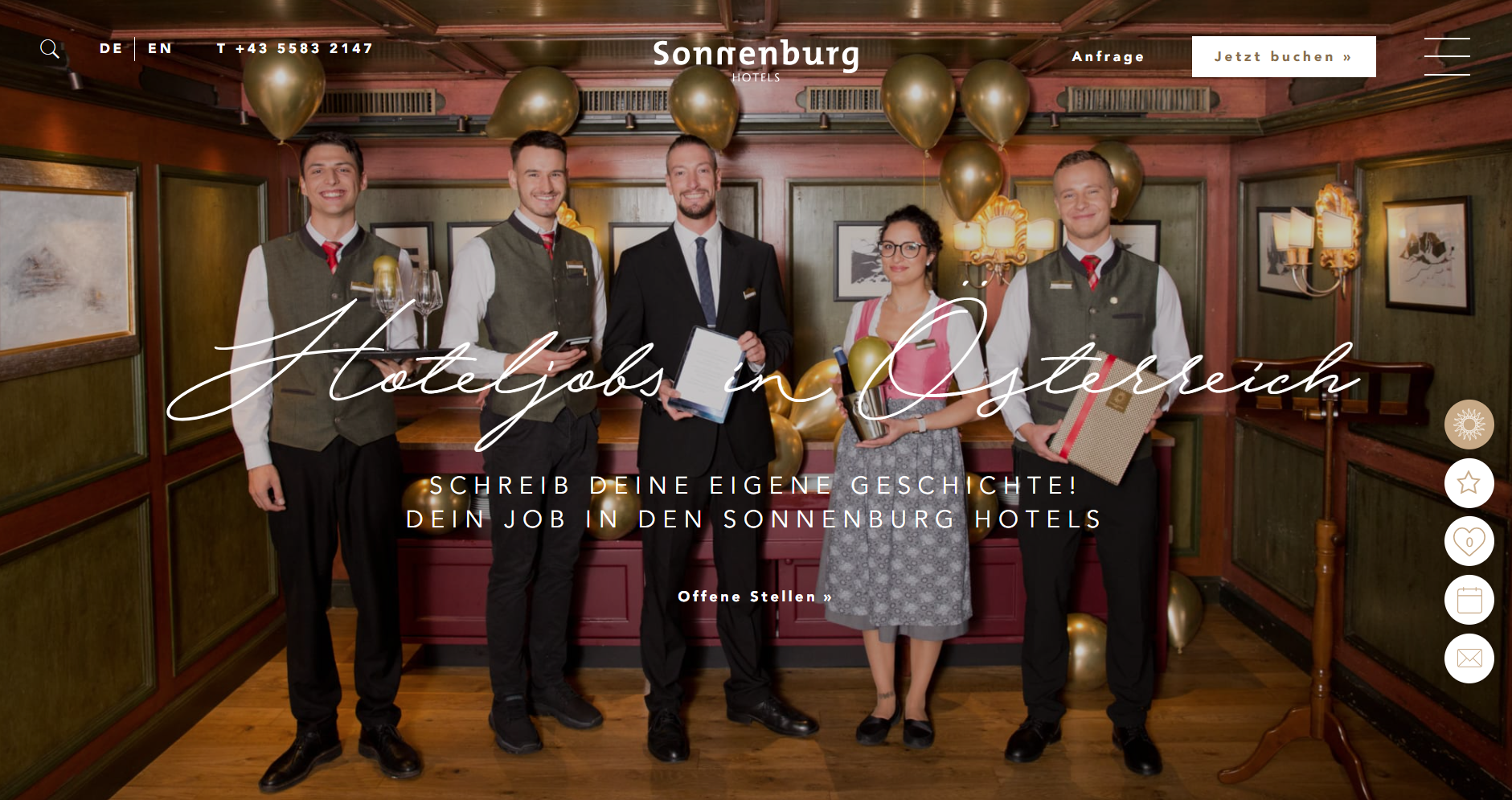
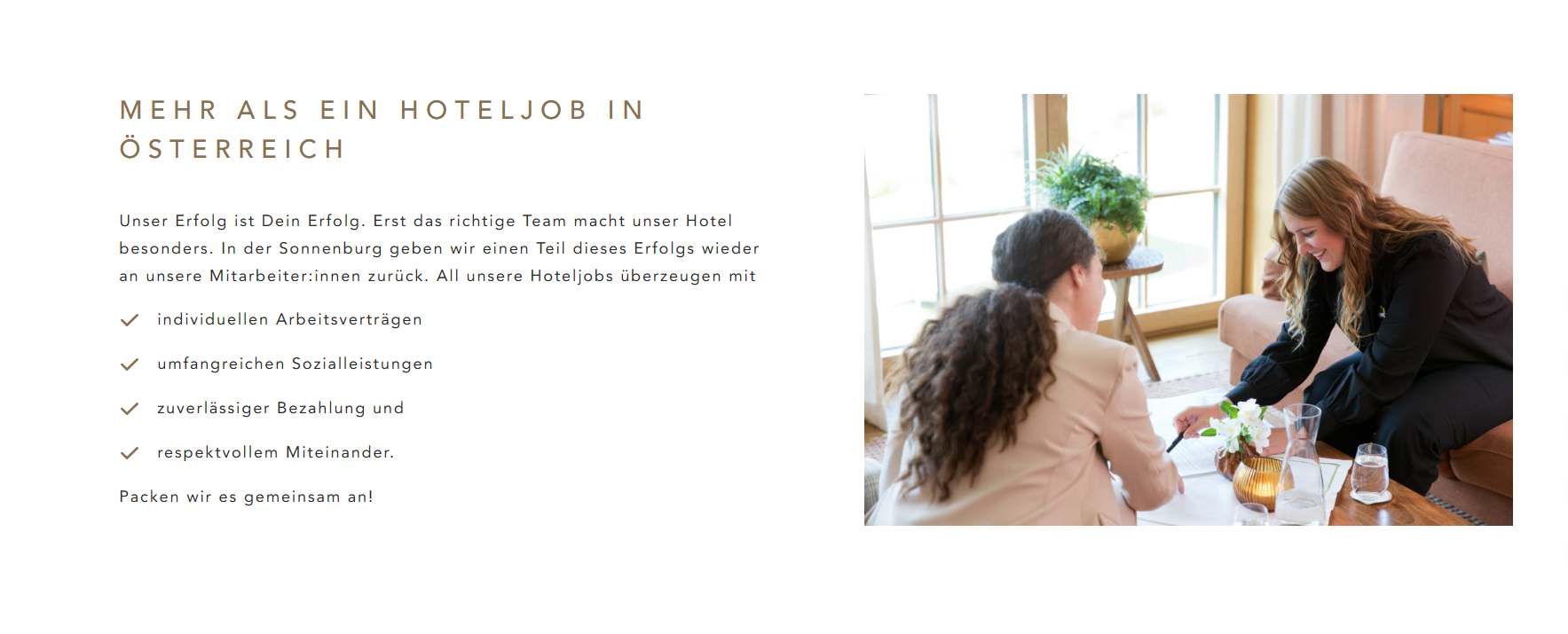
The Sonnenburg Hotels in Oberlech (Vorarlberg, Austria), with their approximately 120 employees, are an excellent example of how HR SEO works in practice. Due to the ongoing shortage of skilled workers in the tourism industry, the hotel management wanted to explore new avenues and recruit interested applicants via Google and AI search. In addition to job portals like Rolling Pin, we jointly developed their career page and strategically implement SEO for their job postings.
Initial situation
- Skilled worker shortage due to seasonal fluctuations
- Applications only came in through expensive advertisements
- There was no careers section on the website
Our SEO measures for HR
- Keyword research in German and English, e.g., "Hotel Jobs Austria", "Hoteljobs Lech", "Hotel Jobs in Austria"
- SEO strategy for the careers section: clear URL structure, well-structured content, descriptive H1 titles, appealing meta titles and descriptions
- SEO-optimized job postings: recurring positions with optimized content modules, e.g., "chef de partie hotel jobs" or "housekeeper jobs hotel Austria"
- Technical and editorial maintenance: ongoing monitoring and reporting shows current rankings and traffic, regular updates


Results after a few months
- significantly more organic traffic to the careers page
- More unsolicited applications directly via Google
- Greater visibility as an employer in the DACH region
The client is pleased: Because we strategically support their HR measures with SEO and continuously optimize site structure, content, and technology, Sonnenburg Hotels are receiving applications directly through Google for the first time. Without paying for additional ads.
Here's how you can get started with SEO for HR
My solution:
You want to use SEO for HR – but don't know where to start? No problem. The important thing is: you don't have to implement everything at once. However, you should take the first steps deliberately.
Here is a possible timetable:
- Check your careers section: Does it even exist? Is it found on Google? Can applicants easily see which jobs are currently open after just 2-3 clicks?
- Consider which positions you want to fill regularly: SEO is particularly worthwhile when there is a high demand for staff, for example for nurses, service personnel or production workers.
- Do keyword research. (Or have it done for you.)What are applicants really searching for? What do they type into Google? Tools like Sistrix, Google Autocomplete, or Ubersuggest can help you get started.
- Get support if needed: SEO is a complex, interdisciplinary topic at the intersection of HR, marketing, and technology. You don't have to handle everything alone – that's what SEO experts are for.
If you'd like, I can guide you: from keyword research and copywriting to ongoing optimisation. Together, we'll make your career page visible with SEO for HR – and your job postings successful.