
Common SEO mistakes exposed – how many of them do you make?


Common SEO mistakes exposed – how many of them do you make?
Many companies invest in website design, technology, and content – but not in visibility. And then they're surprised when no one clicks. Others believe they've already "done" SEO. Some wonder why, despite top rankings, no one buys anything. In this article, I'll show you 8 1/2 common SEO mistakes that I repeatedly encounter in website projects – and how you can avoid them on your own website. Take 5 minutes to read, find these costly errors, and gain more customers.Many companies invest in website design, technology, and content – but not in visibility. And then they're surprised when no one clicks. Others believe they've already "done" SEO. Some wonder why, despite top rankings, no one buys anything. In this article, I'll show you 8 1/2 common SEO mistakes that I repeatedly encounter in website projects – and how you can avoid them on your own website. Take 5 minutes to read, find these costly errors, and gain more customers.
What you can expect in this post
Mistake #1: "SEO? I don't need it."

Many companies overlook SEO, thinking it's "only for online shops" – and instead rely on ads, recommendations, or social media. Yet, 81% of all B2B buyers start their research on Google.
If you don't show up here, you'll lose a large portion of your customers before they even get to know you.
Before you completely dismiss SEO, invest in an SEO audit with a forecast: a look at the current state of your website and a prediction of how much new traffic or leads you can generate through SEO measures. Then you'll know whether SEO is worthwhile – or not.
This way you can avoid the first expensive SEO mistake and make an informed decision.
2. Mistake: "We already have SEO on the website, right?"
I often see websites where the SEO checkboxes in the tool are filled in. These were usually sold as "SEO" along with the website launch. And so many of my clients are confident: "We have SEO on our website.".
Nevertheless, nothing is happening in terms of rankings.
If you want to know whether Google is indexing your pages at all, the Page Indexing report in Search Console. There you can see which pages were found – and which were not.
That's because SEO is more than that: It's missing something.
- the corresponding website structure
- Landing pages and content pages with SEO content and structured data.
- Ongoing measures to promote SEO.
- the relevant technical requirements.
Most importantly, an SEO strategy. And one that is then consistently implemented.
Solution: SEO check with strategy review
Instead of relying on checkboxes in the tool, have a more in-depth SEO check done: How is your site structure organized? Which URLs are actually being indexed? What content is missing? And: Is there a clear SEO strategy – or just isolated measures?
I recommend starting with a structured SEO review that considers technology, content, and strategy together. This way, you'll know if your site is truly search engine friendly – or just looks that way.
Which brings us to the next point:
3. Mistake: "Once you've done SEO, that's enough."
A classic SEO mistake: You have your website optimized once and think it will last forever. (Or at least until the relaunch in 4 years.)
However, content and technology quickly become outdated: constant Google updates and the rapid development of AI search are just two examples. Most topics also evolve in terms of content.
And outdated pages cost visibility.
SEO is not a one-off project, but a continuous process.

Solution: Schedule regular content maintenance.
As an SEO copywriter, I recommend you: Remember to maintain your content – especially for topics that are frequently searched and constantly evolving.
Schedule maintenance firmly into your editorial calendar: Which pages are well-visited but outdated? What isn't ranking but has potential? I often work with my clients on an SEO maintenance plan: Every 3–6 months, we jointly review the most important pages, update content, add FAQs, and adjust internal links.
Here's how to fix this common SEO mistake – and not only stay visible, but become even more relevant.
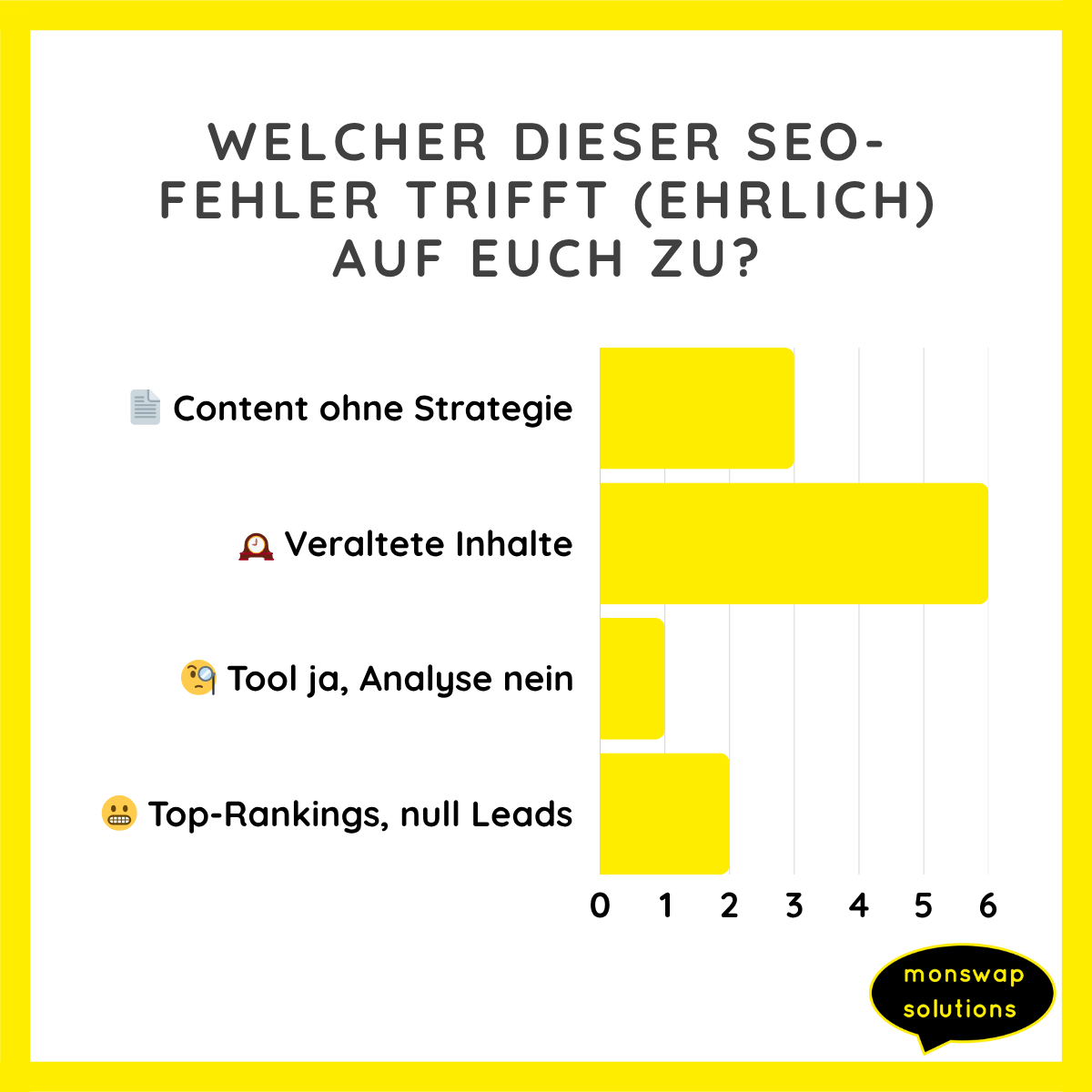
Incidentally, my LinkedIn survey shows that many make the mistake of not regularly updating their website.
4. Mistake: "Guaranteed to be in first place?"
No one can guarantee you the number one spot on Google – and anyone who does is untrustworthy. Google evaluates each search query individually. Ranking depends on many factors: technical condition, content, competition, and user signals. And: the results are constantly changing.
What really counts is not that one top rank – but continuous visibility with the right pages for the right search queries.
Solution: Define a long-term SEO strategy
I recommend you define realistic goals: Which topics do you want to cover? Which pages should be found for what purpose? And what is the underlying goal – visibility, leads, or revenue?
I usually work with my clients for years. Together we develop an SEO & content strategythat fits their website and business model: with topic clusters, good content and ongoing optimisation.
This is how you achieve stable rankings on page 1 – and build a reliable source of organic traffic.
I'll tell you more about this in my article "Getting found on Google: SEO & more".
5. Mistake: “The main thing is to include keywords, or: SEO content read badly”
Keyword stuffing was so 2010. Today, what matters is understanding search intent, building targeted content, and creating a thematic structure. Your content should be understandable, helpful, and easy to read.
Keyword stuffing was so 2010. Today, what matters is understanding search intent, building targeted content, and creating a thematic structure. Your content should be understandable, helpful, and easy to read.
This is precisely where a common SEO mistake lies: when the content has been optimized for Google – but not for humans.
Solution: Write content for both people AND search engines
Good SEO content achieve both – without sounding like “SEO content”: They engage readers and simultaneously meet the requirements of Google or AI search.
As an SEO copywriter, I always start with the question: What do users really want to know? I then build content on this foundation that are clearly structured, naturally integrate relevant keywords, and lead directly to the next step.
This transforms pure Google optimisation into real added value for your target group; and visibility into measurable success.
Mistake #6: "We have the blog for SEO."
Surprise: A blog alone is no substitute for an SEO strategy. Many companies write excellent blogs – and think that's all there is to SEO. That's a classic SEO mistake.
Don't get me wrong: A cleverly structured blog is incredibly important for any content marketing strategy. However, blogs generally cater more to informational search queries .
But you surely also want to rank for transactional, brand or product search queries – and these are best placed on landing pages, category or product pages.
Solution: Align content strategy with search intent
SEO only works if content is tailored to the correct search intent. A blog can do a lot, but not everything. I recommend you check which search intents your website currently covers and which ones are still missing.
A comprehensive SEO strategy should specify which page types play which role: FAQs or blog articles for information needs, landing pages for targeted search queries, overview pages for orientation.
This results in a clear website architecture – geared towards what your target audience is really looking for.
I created an example of such a B2B SEO strategy for my client FST Filtertechnik GmbH. Take a look.
Mistake #7: "We have an SEO tool for that."
Tools provide data. But if no one analyzes the data, even the best SEO tool with the best monitoring useless.
A common SEO mistake is relying on tools without interpreting the results:
- What do changes in the visibility index mean?
- Why did a website crash?
- What do I do with 20 "interesting" keywords?
- How can I revise pages that aren't performing well?
Solution: Actively use monitoring and reporting
For my clients, I monitor the most important key performance indicators and regularly create SEO reports, from which we derive concrete measures in the live call – understandable, prioritized and feasible.
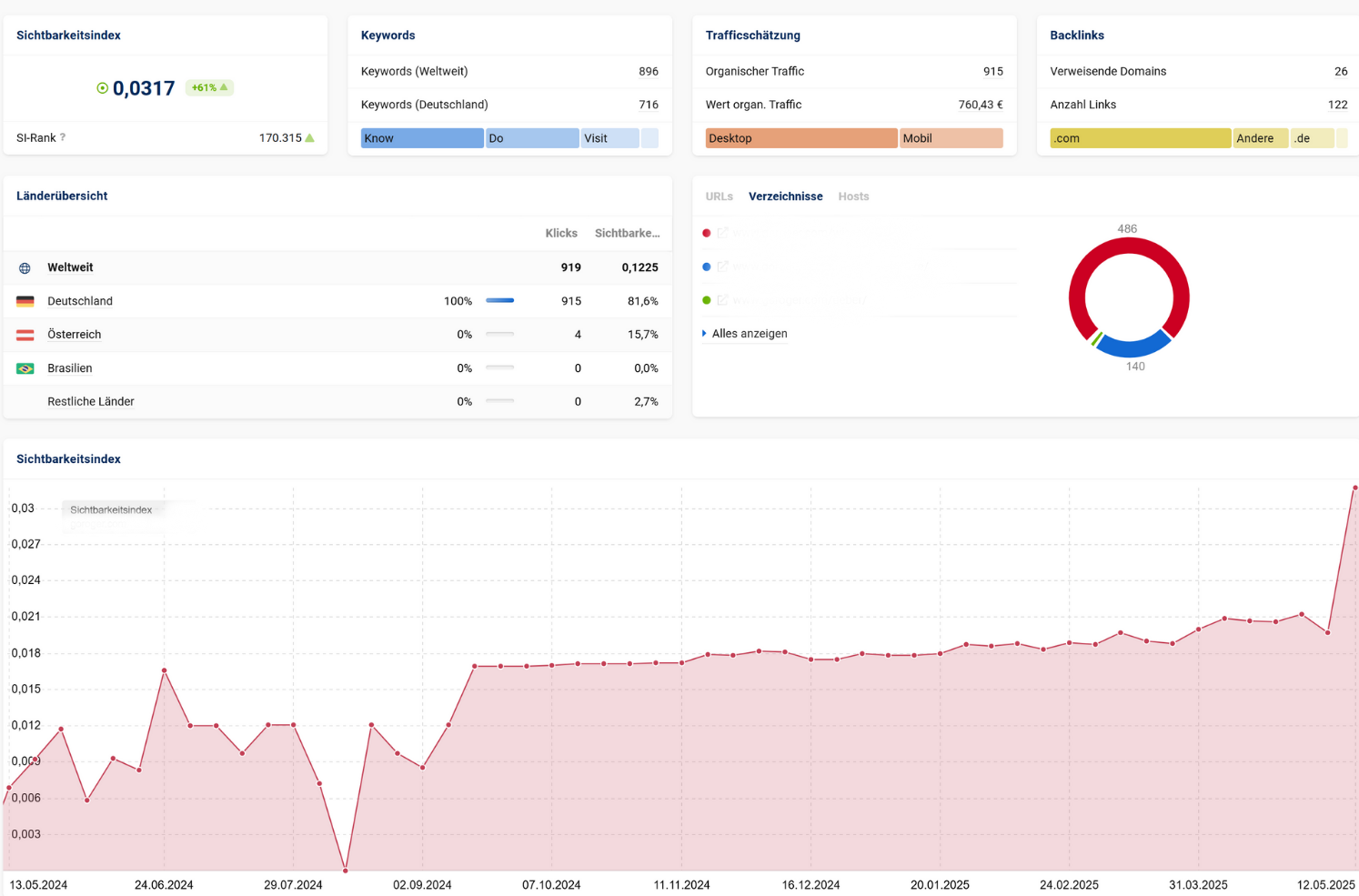
This transforms pure numbers into a real control instrument: We recognize what works, what needs improvement, and where SEO resources really make an impact.
Only then will the expenses for the SEO tool pay off.
8. Mistake: "SEO is no longer effective – now AI search is coming."
AI is changing search. But it doesn't replace SEO. Rather, good content is good content – regardless of which search engine it's found through.
What's changing: The way content is found and delivered.
But the foundation remains: You need really good content that
- Answer questions.
- are relevant.
- to really help the users.
Whether on Google, ChatGPT or SGE: If your content is compelling, you'll be found. Even in AI search.
Solution: Consider AI search as part of your SEO strategy
My recommendation is: Don't see AI search as a contradiction, but rather as an integral part of your SEO strategy. If you prepare your content in a way that AI systems can understand, you'll automatically remain visible in Google.
This includes: clearly structured content, precise answers, easily readable headings, FAQs, and logical content modules. My SEO strategies incorporate the changed search logic brought about by AI from the very beginning – for visibility today and tomorrow.
Therefore, search engine optimisation will remain a key lever in the future – perhaps even more so than ever.
8 1/2. Mistake: "We're ranking well – that's fine."
(8 ½, you ask? Yes, I want to go one step further, because this mistake is just as fatal as the other SEO mistakes.)
Good rankings initially "only" bring visibility: If you are in first place on Google, more people will click on your page – logically.
But a large part of the work begins after the click: If the content disappoints, the design is confusing, or the next step is missing, you will lose your visitors again.
That's why good SEO always needs good UX. Revenue only arises when people can easily navigate your site, develop trust, and want to do business with you.
Solution: Think about SEO and UX together
I recommend you always consider SEO in conjunction with user experience. Visibility brings people to your site – good user guidance also gets them to their goal.
This starts with readability, extends to clear CTAs, and includes the question: Can you understand at first glance what you are supposed to do on your website?
In my projects, I analyze: Which pages perform well – and where are we losing users? With small contentual adjustments (microcopy), a clear page structure, and understandable language, SEO traffic becomes real conversion.
How this can look on your website is something I write about in my blog post “UX Writer & the Magic of User-Friendly Microcopy”.
SEO is not a sprint – it's a smart marathon

As you can see, many SEO errors don't arise from malicious intent – but from a lack of knowledge, strategy, or structure. That's precisely where I come in.
If you want to build a strategic, effective, and sustainable SEO presence – with realistic goals, strong content, and smart tools – then feel free to contact me. As a content marketing and SEO consultant, I'd be happy to help you gain visibility and acquire customers.